




In the members of class Scyphozoa,
(a) Polyp stage is well developed.
(b) Polyp stage is reduced.
(c) Medusa stage is absent.
(d) Medusa stage is reduced.
Answer
 Verified
601.8k+ views
Hint: The class Scyphozoa belongs to the phylum Cnidaria. The Cnidarians exhibit two distinct morphological body plans namely polyp and medusa. At the adult stage, the polyps are sessile whereas the medusa is mobile. But in the class Scyphozoa, the sessile stage is decreased.
Complete answer:
In the members of class Scyphozoa, the polyp stage is reduced. Class Scyphozoa is one of the classes inside the phylum Cnidaria. The class Scyphozoa is alluded to as "genuine jellyfish".
The jellyfish stage is predominant, and the polyp stage might be available, contingent upon the family in the class Scyphozoa.
-The scyphozoan class can be found on the edge of Cnidaria, the edge of "stinging" animals, similar to jellyfish.
-There are around 200 species that have a place with the Scyphozoa class, and they are the most notable coagulated animals in reality. These incorporate ocean brambles, moon jellyfish, and jellyfish.
-The class Scyphozoa presents the primary attributes of cnidarians.
-The sort of evenness they show is outspread balance and they are diploblastic animals.
-The body mass of these species is composed of the external epidermis or ectoderm and inside gastrodermis or endoderm, and they are isolated by the mesoglea.
-They have a nematocyst, which is the quality of the phylum cnidaria wherein this class Scyphozoa has a place with.
So, the correct answer is the ‘Polyp stage is reduced’.
Note:
-Scyphozoa are the exclusive species that are a marine class of the phylum Cnidaria, so they are generally known as genuine jellyfish or true jellyfish.
-The name of the class Scyphozoa came from the Greek word skyphos, which implies a kind of a drinking cup and the creature regularly alludes to the cup state of the living being.
-The polyp may be solitary, as found in the sea anemone, or colonial, as found in coral, and it can be sessile or attached to a surface. In the sessile polyp, a fertilized egg develops that buds asexually and eventually buds off one or more medusae.
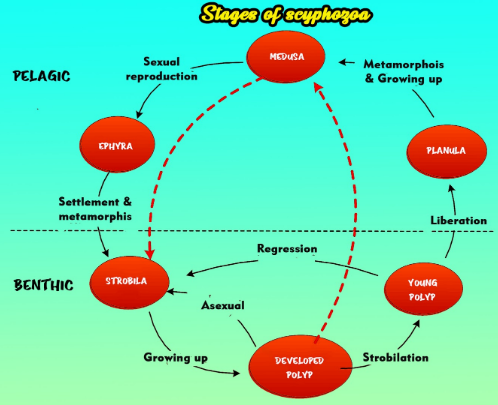
Complete answer:
In the members of class Scyphozoa, the polyp stage is reduced. Class Scyphozoa is one of the classes inside the phylum Cnidaria. The class Scyphozoa is alluded to as "genuine jellyfish".
The jellyfish stage is predominant, and the polyp stage might be available, contingent upon the family in the class Scyphozoa.
-The scyphozoan class can be found on the edge of Cnidaria, the edge of "stinging" animals, similar to jellyfish.
-There are around 200 species that have a place with the Scyphozoa class, and they are the most notable coagulated animals in reality. These incorporate ocean brambles, moon jellyfish, and jellyfish.
-The class Scyphozoa presents the primary attributes of cnidarians.
-The sort of evenness they show is outspread balance and they are diploblastic animals.
-The body mass of these species is composed of the external epidermis or ectoderm and inside gastrodermis or endoderm, and they are isolated by the mesoglea.
-They have a nematocyst, which is the quality of the phylum cnidaria wherein this class Scyphozoa has a place with.
So, the correct answer is the ‘Polyp stage is reduced’.
Note:
-Scyphozoa are the exclusive species that are a marine class of the phylum Cnidaria, so they are generally known as genuine jellyfish or true jellyfish.
-The name of the class Scyphozoa came from the Greek word skyphos, which implies a kind of a drinking cup and the creature regularly alludes to the cup state of the living being.
-The polyp may be solitary, as found in the sea anemone, or colonial, as found in coral, and it can be sessile or attached to a surface. In the sessile polyp, a fertilized egg develops that buds asexually and eventually buds off one or more medusae.
Recently Updated Pages
If x a + bt + ct2 where x is in meters and t is in class 11 physics CBSE

A car covers the first half distance between two places class 11 physics CBSE
The resultant of two vectors overrightarrow P and overrightarrow class 11 physics CBSE
Find the value of cos 135 class 11 maths CBSE
A mass M is held in place by an applied force F and class 11 physics CBSE
A solution of glucose in water is labelled as 10 dfracwv class 11 chemistry CBSE
Trending doubts
One Metric ton is equal to kg A 10000 B 1000 C 100 class 11 physics CBSE
Find the value of the expression given below sin 30circ class 11 maths CBSE
What do you mean by retardation What is its SI uni class 11 physics CBSE
Draw a diagram of nephron and explain its structur class 11 biology CBSE
10 examples of friction in our daily life
Difference between physical and chemical change class 11 chemistry CBSE