




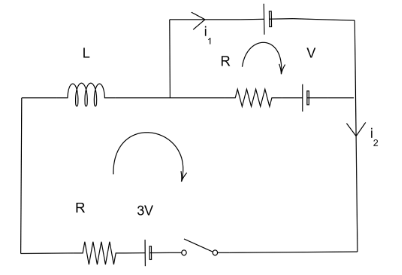
In the LR circuit shown, what is the variation of the current $ I $ as a function of time? The switch is closed at time $ t = 0s $
Answer
 Verified
489.9k+ views
Hint: We start by noting down the given data. Then we apply Kirchhoff's voltage law and find the value of current and the relationship between the current, voltage and resistance. Using the circuit as two separate loops we get a value for the value of individual currents in the loops. We find the resultant of the two to find the value of total current.
Complete Step By Step Answer:
We start by writing down the given information. We then find the relationship between the individual currents in the loops.
Let us consider $ I = {i_1} + {i_2} $
Where, $ {i_1} $ is the current travelling through the small loop
$ {i_2} $ is the current travelling through the bigger loop
Taking the Kirchhoff’s law in the first loop, $ {i_1}R + 2V - V = 0 $
Now we take the unknown value of current on one side and the known value on the other. This helps us to get the value as, $ {i_1} = \dfrac{{ - V}}{R} $
In the second or the bigger loop, we apply the Kirchhoff’s law we get $ {i_2}R + L\dfrac{{d{i_2}}}{{dt}} - {i_1}R + V - 3V = 0 $
Substitute the value of current through loop one and get, $ \left( {I + \dfrac{V}{R}} \right)R + L\dfrac{{dI}}{{dt}} + V + V - 3V = 0 $
$ L\dfrac{{dI}}{{dt}} = - IR $
We take the known values to the other side and get
$ \dfrac{{dI}}{{dt}} = \dfrac{{ - IR}}{L} $
Now we will integrate this value. Before we integrate this equation, we can see that the value of current that is unknown is on both sides, so we bring it to one side and then integrate.
$ \int {\dfrac{{dI}}{I} = \int {\dfrac{{ - R}}{2}dt} } $
Solving this, we get $ \ln \dfrac{I}{{\left( {\dfrac{{ - V}}{R}} \right)}} = \dfrac{{ - R}}{2}dt $
To remove the value of natural logarithm, we take base $ e $ on both the sides and get,
$ I = \dfrac{{ - V}}{R}{e^{\left( {\dfrac{{ - Rt}}{2}} \right)}} $
The variation of current is given by, $ I = \dfrac{{ - V}}{R}{e^{\left( {\dfrac{{ - Rt}}{2}} \right)}} $
Note:
A resistor–inductor circuit, or RL filter or RL network, is an electrical circuit that consists of resistors and inductors which are driven by a voltage or current source. A RL circuit consisting of one resistor and one inductor is called a first degree RL Circuit. The kirchhoff's loop rule helps us to form the equations for the voltage drops in the loops.
Complete Step By Step Answer:
We start by writing down the given information. We then find the relationship between the individual currents in the loops.
Let us consider $ I = {i_1} + {i_2} $
Where, $ {i_1} $ is the current travelling through the small loop
$ {i_2} $ is the current travelling through the bigger loop
Taking the Kirchhoff’s law in the first loop, $ {i_1}R + 2V - V = 0 $
Now we take the unknown value of current on one side and the known value on the other. This helps us to get the value as, $ {i_1} = \dfrac{{ - V}}{R} $
In the second or the bigger loop, we apply the Kirchhoff’s law we get $ {i_2}R + L\dfrac{{d{i_2}}}{{dt}} - {i_1}R + V - 3V = 0 $
Substitute the value of current through loop one and get, $ \left( {I + \dfrac{V}{R}} \right)R + L\dfrac{{dI}}{{dt}} + V + V - 3V = 0 $
$ L\dfrac{{dI}}{{dt}} = - IR $
We take the known values to the other side and get
$ \dfrac{{dI}}{{dt}} = \dfrac{{ - IR}}{L} $
Now we will integrate this value. Before we integrate this equation, we can see that the value of current that is unknown is on both sides, so we bring it to one side and then integrate.
$ \int {\dfrac{{dI}}{I} = \int {\dfrac{{ - R}}{2}dt} } $
Solving this, we get $ \ln \dfrac{I}{{\left( {\dfrac{{ - V}}{R}} \right)}} = \dfrac{{ - R}}{2}dt $
To remove the value of natural logarithm, we take base $ e $ on both the sides and get,
$ I = \dfrac{{ - V}}{R}{e^{\left( {\dfrac{{ - Rt}}{2}} \right)}} $
The variation of current is given by, $ I = \dfrac{{ - V}}{R}{e^{\left( {\dfrac{{ - Rt}}{2}} \right)}} $
Note:
A resistor–inductor circuit, or RL filter or RL network, is an electrical circuit that consists of resistors and inductors which are driven by a voltage or current source. A RL circuit consisting of one resistor and one inductor is called a first degree RL Circuit. The kirchhoff's loop rule helps us to form the equations for the voltage drops in the loops.
Recently Updated Pages
Master Class 12 Economics: Engaging Questions & Answers for Success

Master Class 12 Physics: Engaging Questions & Answers for Success
Master Class 12 English: Engaging Questions & Answers for Success
Master Class 12 Social Science: Engaging Questions & Answers for Success
Master Class 12 Maths: Engaging Questions & Answers for Success
Master Class 12 Business Studies: Engaging Questions & Answers for Success
Trending doubts
Which are the Top 10 Largest Countries of the World?
What are the major means of transport Explain each class 12 social science CBSE
Draw a labelled sketch of the human eye class 12 physics CBSE
Why cannot DNA pass through cell membranes class 12 biology CBSE
Differentiate between insitu conservation and exsitu class 12 biology CBSE
Draw a neat and well labeled diagram of TS of ovary class 12 biology CBSE