




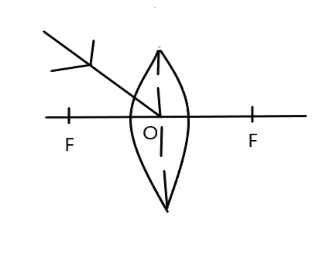
In the image given below redraw the diagram and show the direction of the light ray after refraction from the lens.
Answer
 Verified
603k+ views
Hint:
-Rarer medium has less density than denser medium.
-When light rays travel from rarer medium to the denser medium the rays of light bend toward the center of the normal ray.
-When light rays travel from denser medium to the rarer medium the rays of light bend away from the center of the normal rays.
Complete step-by-step solution:
The lens is an optical device refracting medium bounded by the two surfaces, at least one of which is a curved surface. There are two types of lenses:
-Convex or converging lens: It is the combination of two plano-convex lenses where the plane side is joined together therefore, the center is thicker than the edges. Due to the refraction phenomenon, the light parallel beams converge through it.
-Concave or diverging lens: It is the combination of two plano-concave lenses where the plane sides are joined together therefore, the center is thinner than the edges. Due to the refraction phenomenon, the light parallel beams diverge through it.
-When light rays travel through the optical center then it will go in the same direction without any deviation (path change).
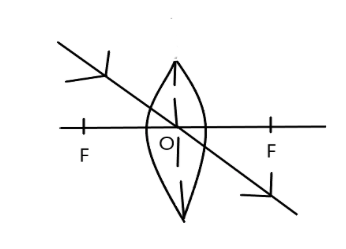
This is the required diagram.
Note:
-For a convex lens, it has a real focus.
-For a concave lens, it has a virtual focus.
-When light travels from rarer to the denser medium, the image formed is real.
-When light travels from denser to the rarer medium, the image formed is virtual.
-The direction of light in which it travels is always taken as positive and the opposite direction of light is taken as a negative value.
-Rarer medium has less density than denser medium.
-When light rays travel from rarer medium to the denser medium the rays of light bend toward the center of the normal ray.
-When light rays travel from denser medium to the rarer medium the rays of light bend away from the center of the normal rays.
Complete step-by-step solution:
The lens is an optical device refracting medium bounded by the two surfaces, at least one of which is a curved surface. There are two types of lenses:
-Convex or converging lens: It is the combination of two plano-convex lenses where the plane side is joined together therefore, the center is thicker than the edges. Due to the refraction phenomenon, the light parallel beams converge through it.
-Concave or diverging lens: It is the combination of two plano-concave lenses where the plane sides are joined together therefore, the center is thinner than the edges. Due to the refraction phenomenon, the light parallel beams diverge through it.
-When light rays travel through the optical center then it will go in the same direction without any deviation (path change).
This is the required diagram.
Note:
-For a convex lens, it has a real focus.
-For a concave lens, it has a virtual focus.
-When light travels from rarer to the denser medium, the image formed is real.
-When light travels from denser to the rarer medium, the image formed is virtual.
-The direction of light in which it travels is always taken as positive and the opposite direction of light is taken as a negative value.
Recently Updated Pages
Three beakers labelled as A B and C each containing 25 mL of water were taken A small amount of NaOH anhydrous CuSO4 and NaCl were added to the beakers A B and C respectively It was observed that there was an increase in the temperature of the solutions contained in beakers A and B whereas in case of beaker C the temperature of the solution falls Which one of the following statements isarecorrect i In beakers A and B exothermic process has occurred ii In beakers A and B endothermic process has occurred iii In beaker C exothermic process has occurred iv In beaker C endothermic process has occurred

Master Class 12 Social Science: Engaging Questions & Answers for Success
Master Class 12 Physics: Engaging Questions & Answers for Success
Master Class 12 Maths: Engaging Questions & Answers for Success
Master Class 12 Economics: Engaging Questions & Answers for Success
Master Class 12 Chemistry: Engaging Questions & Answers for Success
Three beakers labelled as A B and C each containing 25 mL of water were taken A small amount of NaOH anhydrous CuSO4 and NaCl were added to the beakers A B and C respectively It was observed that there was an increase in the temperature of the solutions contained in beakers A and B whereas in case of beaker C the temperature of the solution falls Which one of the following statements isarecorrect i In beakers A and B exothermic process has occurred ii In beakers A and B endothermic process has occurred iii In beaker C exothermic process has occurred iv In beaker C endothermic process has occurred
Master Class 12 Social Science: Engaging Questions & Answers for Success
Master Class 12 Physics: Engaging Questions & Answers for Success
Trending doubts
Which are the Top 10 Largest Countries of the World?
Draw a labelled sketch of the human eye class 12 physics CBSE
Differentiate between homogeneous and heterogeneous class 12 chemistry CBSE
What are the major means of transport Explain each class 12 social science CBSE
Sulphuric acid is known as the king of acids State class 12 chemistry CBSE
Why should a magnesium ribbon be cleaned before burning class 12 chemistry CBSE