




In the Hell Volhard Zelinsky reaction, the carboxylic acids are halogenated at _____ position by using _______ and _________.
A. $\alpha $ , NaOH, iodine
B. $\alpha $, phosphorus, halogen
C.$\beta $, phosphorus, ${{\rm{H}}_{\rm{2}}}{\rm{O}}$
D. $\beta $, ${\rm{PC}}{{\rm{l}}_{\rm{5}}}$, NaOH
Answer
 Verified
662.4k+ views
Hint: We know that addition of halogen to a compound is termed as halogenation. Hell Volhard Zelinsky reaction is a reaction in which a carboxylic acid is halogenated.
Complete step by step answer:
We know that alpha carbon is the carbon which is bonded to the carbonyl group. Hell Volhard Zelinsky reaction is the reaction in which alpha carbon of the carboxylic acid is halogenated. In this reaction, carboxylic acid possessing alpha hydrogen is halogenated at the alpha position on reacting with bromine or chlorine in the presence of fewer quantities of red phosphorus to result in $\alpha $-halo carboxylic acid. The HVZ reaction can be represented as follows:
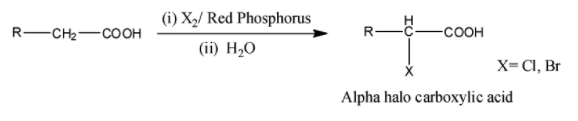
From the above reaction, it is concluded that in Hell Volhard Zelinsky reaction, an carboxylic acid having alpha carbon is when halogenated in presence of phosphorus, gives an alpha halo carboxylic acid.
So, the correct option is B, that is, lactic acid.
Additional Information: Reactions of carboxylic acid:
1)Carboxylic acid can be reduced to primary alcohol by lithium aluminium hydride or by diborane. The reduction of functional groups such as ester, nitro, halo etc. is not easy by diborane.
2) Carboxylic acid loses carbon dioxide to form hydrocarbons when their sodium salt is heated with soda lime (The ratio of ${\rm{NaOH}}$ and ${\rm{CaO}}$ in the ratio of 1:3).
Note: The Hell Volhard reaction is only used for halogenations of carboxylic acid containing alpha hydrogen atoms. If no alpha hydrogen atoms are present, the HVZ reaction is not used to produce alpha halo carboxylic acid.
Complete step by step answer:
We know that alpha carbon is the carbon which is bonded to the carbonyl group. Hell Volhard Zelinsky reaction is the reaction in which alpha carbon of the carboxylic acid is halogenated. In this reaction, carboxylic acid possessing alpha hydrogen is halogenated at the alpha position on reacting with bromine or chlorine in the presence of fewer quantities of red phosphorus to result in $\alpha $-halo carboxylic acid. The HVZ reaction can be represented as follows:
From the above reaction, it is concluded that in Hell Volhard Zelinsky reaction, an carboxylic acid having alpha carbon is when halogenated in presence of phosphorus, gives an alpha halo carboxylic acid.
So, the correct option is B, that is, lactic acid.
Additional Information: Reactions of carboxylic acid:
1)Carboxylic acid can be reduced to primary alcohol by lithium aluminium hydride or by diborane. The reduction of functional groups such as ester, nitro, halo etc. is not easy by diborane.
2) Carboxylic acid loses carbon dioxide to form hydrocarbons when their sodium salt is heated with soda lime (The ratio of ${\rm{NaOH}}$ and ${\rm{CaO}}$ in the ratio of 1:3).
Note: The Hell Volhard reaction is only used for halogenations of carboxylic acid containing alpha hydrogen atoms. If no alpha hydrogen atoms are present, the HVZ reaction is not used to produce alpha halo carboxylic acid.
Recently Updated Pages
Which of the following graphs shows the variation of class 12 physics CBSE

Draw a labelled diagram of the human male reproductive class 12 biology CBSE
Describe the experiment to compare the emf of two cells class 12 physics CBSE
What is standard hydrogen electrode
What is conventional current and electric current class 12 physics CBSE
2Bromopentane is treated with an alcoholic KOH solution class 12 chemistry CBSE
Trending doubts
Draw a labelled sketch of the human eye class 12 physics CBSE
Which are the Top 10 Largest Countries of the World?
Differentiate between homogeneous and heterogeneous class 12 chemistry CBSE
Draw ray diagrams each showing i myopic eye and ii class 12 physics CBSE
Which is the correct genotypic ratio of mendel dihybrid class 12 biology CBSE
What is the Full Form of PVC, PET, HDPE, LDPE, PP and PS ?