




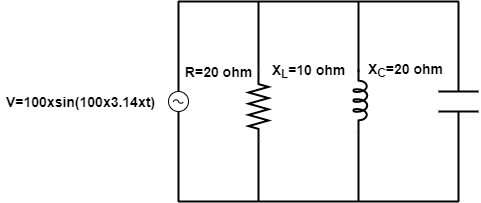
In the given, the current drawn from the source is
A.$20A$
B.$10A$
C.$5A$
D.$5\sqrt{2}A$
Answer
 Verified
543.3k+ views
Hint: In this question, we find out the total current drawn from the source. We divide this circuit into three parts and find the current in the resistor first then find the current in the inductor and then the current in the capacitor. After that, we find the total current in the circuit.
According to the equation $v={{v}_{0}}\sin (\omega t)$we get, the value of the ${{V}_{0}}$ and $\omega $ by comparing the given equation.
So, \[{{V}_{0}}=100\,V\]
\[\omega =100\,\pi \]
We are going to use a basic formula for an electrical circuit.
Complete answer:
All the three are connected in parallel so the voltage is the same across them
Given that
${{X}_{L}}=10\,\Omega $
${{X}_{C}}=20\,\Omega $
$R=20\,\Omega $
${{V}_{\circ }}=100\,V$
Current in resistor \[{{i}_{R}}=\dfrac{{{V}_{0}}}{R}\]
Current in the inductor \[{{i}_{L}}=\dfrac{{{V}_{0}}}{{{X}_{L}}}\]
Current in capacitor \[{{i}_{C}}=\dfrac{{{V}_{0}}}{{{X}_{C}}}\]
${{i}_{R}}=\dfrac{{{V}_{0}}}{R}$
Now we substitute the given values in the equation
$\Rightarrow \dfrac{100}{20}=5\,amp.$
Now calculate current in the inductor
${{i}_{L}}=\dfrac{{{V}_{0}}}{{{X}_{L}}}$
Now we substitute the given values in the equation
$\Rightarrow \dfrac{100}{10}=10\,amp.$
Now the current in the capacitor is
${{i}_{C}}=\dfrac{{{V}_{0}}}{{{X}_{C}}}$
After substituting the given values we get,
$\Rightarrow \dfrac{100}{20}=5\,amp.$
So, the total current $I=({{i}_{R}})+({{i}_{L}}+{{i}_{L}})j$
Therefore magnitude of the current $i$
Current, $i=\sqrt{i_{R}^{2}+{{({{i}_{C}}-{{i}_{L}})}^{2}}}$
$=\sqrt{{{5}^{2}}+{{5}^{2}}}=5\sqrt{2}\,amp$.
So the total current is drawn from the source is $5\sqrt{2}\,amp.$
Note:
To solve this type of question we know the basics of electrical circuits. And their formulas to solve the circuits. We can use the different methods to solve the circuits like the nodal method and Thevenin's theorem and the other methods. To know about these methods we have to learn about circuit analysis. After studying these methods, you can easily solve these types of questions.
According to the equation $v={{v}_{0}}\sin (\omega t)$we get, the value of the ${{V}_{0}}$ and $\omega $ by comparing the given equation.
So, \[{{V}_{0}}=100\,V\]
\[\omega =100\,\pi \]
We are going to use a basic formula for an electrical circuit.
Complete answer:
All the three are connected in parallel so the voltage is the same across them
Given that
${{X}_{L}}=10\,\Omega $
${{X}_{C}}=20\,\Omega $
$R=20\,\Omega $
${{V}_{\circ }}=100\,V$
Current in resistor \[{{i}_{R}}=\dfrac{{{V}_{0}}}{R}\]
Current in the inductor \[{{i}_{L}}=\dfrac{{{V}_{0}}}{{{X}_{L}}}\]
Current in capacitor \[{{i}_{C}}=\dfrac{{{V}_{0}}}{{{X}_{C}}}\]
${{i}_{R}}=\dfrac{{{V}_{0}}}{R}$
Now we substitute the given values in the equation
$\Rightarrow \dfrac{100}{20}=5\,amp.$
Now calculate current in the inductor
${{i}_{L}}=\dfrac{{{V}_{0}}}{{{X}_{L}}}$
Now we substitute the given values in the equation
$\Rightarrow \dfrac{100}{10}=10\,amp.$
Now the current in the capacitor is
${{i}_{C}}=\dfrac{{{V}_{0}}}{{{X}_{C}}}$
After substituting the given values we get,
$\Rightarrow \dfrac{100}{20}=5\,amp.$
So, the total current $I=({{i}_{R}})+({{i}_{L}}+{{i}_{L}})j$
Therefore magnitude of the current $i$
Current, $i=\sqrt{i_{R}^{2}+{{({{i}_{C}}-{{i}_{L}})}^{2}}}$
$=\sqrt{{{5}^{2}}+{{5}^{2}}}=5\sqrt{2}\,amp$.
So the total current is drawn from the source is $5\sqrt{2}\,amp.$
Note:
To solve this type of question we know the basics of electrical circuits. And their formulas to solve the circuits. We can use the different methods to solve the circuits like the nodal method and Thevenin's theorem and the other methods. To know about these methods we have to learn about circuit analysis. After studying these methods, you can easily solve these types of questions.
Recently Updated Pages
Master Class 12 Economics: Engaging Questions & Answers for Success

Master Class 12 Physics: Engaging Questions & Answers for Success
Master Class 12 English: Engaging Questions & Answers for Success
Master Class 12 Social Science: Engaging Questions & Answers for Success
Master Class 12 Maths: Engaging Questions & Answers for Success
Master Class 12 Business Studies: Engaging Questions & Answers for Success
Trending doubts
Which are the Top 10 Largest Countries of the World?
What are the major means of transport Explain each class 12 social science CBSE
Draw a labelled sketch of the human eye class 12 physics CBSE
Why cannot DNA pass through cell membranes class 12 biology CBSE
Differentiate between insitu conservation and exsitu class 12 biology CBSE
Draw a neat and well labeled diagram of TS of ovary class 12 biology CBSE