




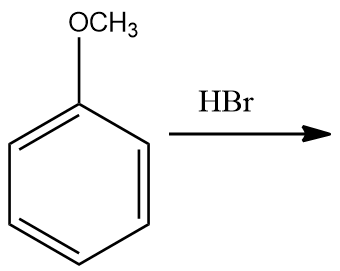
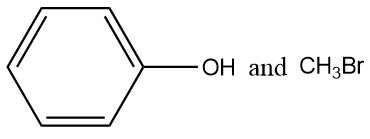
In the given reaction, products are:
(A)
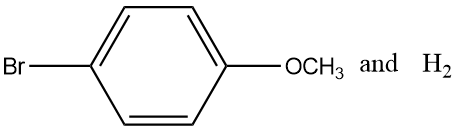
(B)
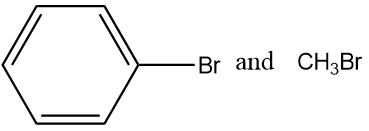
(C)
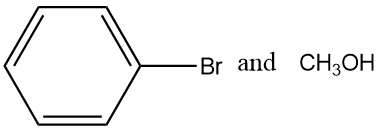
(D)
Answer
 Verified
599.4k+ views
Hint: Ethers are very less reactive for substitution because alkoxide ions are a very poor leaving group. Under very strong conditions, they undergo protonation and become a leaving group and undergo substitution.
Complete step by step answer:
On reaction of Anisole and HBr, substitution reaction takes place. The products of the reaction are Phenol and methyl bromide.
$S{{N}_{1}}$ reaction occurs when stable carbocation intermediate is formed.
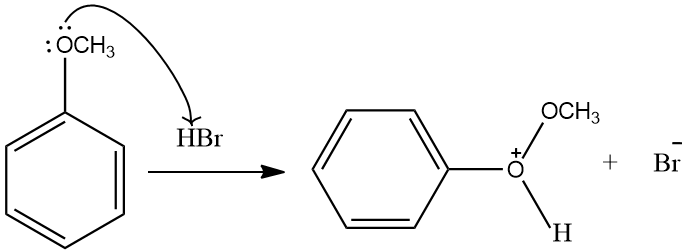
In the following reaction, lone pairs on oxygen , attacks on the proton of the HBr. The Methoxy group on the anisole gets protonated. After protonation it forms methyl phenyl oxonium ion. Then the methoxy group leaves the compound thereby giving the group. The methoxy group now reacts with the Bromide ion, to give methyl bromide.
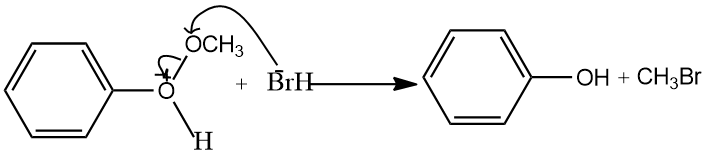
Cleavage of methoxy group from the oxonium ion takes place, because oxygen atom attached to the benzene ring have a partial double bond character due to the resonance, therefore, oxygen benzene bond was stronger than oxygen methoxy bond, therefore, cleavage of methoxy group from the oxonium ion takes place.
So, the correct answer is “Option D”.
Note: The $S{{N}_{1}}$ reaction is a substitution nucleophilic unimolecular reaction. It is a two-step reaction. In the first step, The carbon-halogen bond breaks heterolytically with the halogen retaining the previously shared pair of electrons. In the second step, the nucleophile reacts rapidly with the carbocation that was formed in the first step.This reaction is carried out in polar protic solvents such as water, alcohol, acetic acid etc
Complete step by step answer:
On reaction of Anisole and HBr, substitution reaction takes place. The products of the reaction are Phenol and methyl bromide.
$S{{N}_{1}}$ reaction occurs when stable carbocation intermediate is formed.
In the following reaction, lone pairs on oxygen , attacks on the proton of the HBr. The Methoxy group on the anisole gets protonated. After protonation it forms methyl phenyl oxonium ion. Then the methoxy group leaves the compound thereby giving the group. The methoxy group now reacts with the Bromide ion, to give methyl bromide.
Cleavage of methoxy group from the oxonium ion takes place, because oxygen atom attached to the benzene ring have a partial double bond character due to the resonance, therefore, oxygen benzene bond was stronger than oxygen methoxy bond, therefore, cleavage of methoxy group from the oxonium ion takes place.
So, the correct answer is “Option D”.
Note: The $S{{N}_{1}}$ reaction is a substitution nucleophilic unimolecular reaction. It is a two-step reaction. In the first step, The carbon-halogen bond breaks heterolytically with the halogen retaining the previously shared pair of electrons. In the second step, the nucleophile reacts rapidly with the carbocation that was formed in the first step.This reaction is carried out in polar protic solvents such as water, alcohol, acetic acid etc
Recently Updated Pages
Three beakers labelled as A B and C each containing 25 mL of water were taken A small amount of NaOH anhydrous CuSO4 and NaCl were added to the beakers A B and C respectively It was observed that there was an increase in the temperature of the solutions contained in beakers A and B whereas in case of beaker C the temperature of the solution falls Which one of the following statements isarecorrect i In beakers A and B exothermic process has occurred ii In beakers A and B endothermic process has occurred iii In beaker C exothermic process has occurred iv In beaker C endothermic process has occurred

Master Class 12 Social Science: Engaging Questions & Answers for Success
Master Class 12 Physics: Engaging Questions & Answers for Success
Master Class 12 Maths: Engaging Questions & Answers for Success
Master Class 12 Economics: Engaging Questions & Answers for Success
Master Class 12 Chemistry: Engaging Questions & Answers for Success
Three beakers labelled as A B and C each containing 25 mL of water were taken A small amount of NaOH anhydrous CuSO4 and NaCl were added to the beakers A B and C respectively It was observed that there was an increase in the temperature of the solutions contained in beakers A and B whereas in case of beaker C the temperature of the solution falls Which one of the following statements isarecorrect i In beakers A and B exothermic process has occurred ii In beakers A and B endothermic process has occurred iii In beaker C exothermic process has occurred iv In beaker C endothermic process has occurred
Master Class 12 Social Science: Engaging Questions & Answers for Success
Master Class 12 Physics: Engaging Questions & Answers for Success
Trending doubts
Which are the Top 10 Largest Countries of the World?
Draw a labelled sketch of the human eye class 12 physics CBSE
Differentiate between homogeneous and heterogeneous class 12 chemistry CBSE
What are the major means of transport Explain each class 12 social science CBSE
Sulphuric acid is known as the king of acids State class 12 chemistry CBSE
Why should a magnesium ribbon be cleaned before burning class 12 chemistry CBSE