




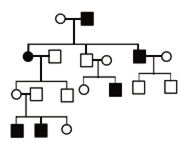
In the given human pedigree, the filled symbols represent an affected individual
A. X linked dominant
B. Autosomal dominant
C. X linked recessive
D. Autosomal recessive
Answer
 Verified
591k+ views
Hint: X linked recessive and dominant are genes present on X chromosomes and autosomal dominant and autosomal recessive genes are present on autosomes.
Complete answer: A Pedigree chart depicts how the gene or the phenotype is inherited from one generation to the other. There are five types of traits namely:
a) Autosomal dominant: A gene for this trait is present on autosomes. Both males and females are equally affected.
b) Autosomal recessive: This trait is inherited equally in male and female siblings whose parents are carriers. This gene requires mutant alleles in the homozygous form to express itself.
c) X linked dominant: Genes for this trait is located on the X chromosome. if a female parent is affected in the heterozygous form, then half of the sons are affected, and if the male parent is affected, all the daughters are affected.
d) X linked recessive: If the female is homozygous, 100% of the sons are affected and if they are the carrier, then half the sons are affected. Only homozygous females are affected but both homo and hemizygous males are affected.
e) Y linked: Y-chromosome has a gene for this trait. As only males have Y chromosomes, this trait is only expressed in males. All affected males produce affected sons but no affected daughters. The given pedigree is not of the dominant disorder as III-6 and III-7 are not affected by the disorder. The given pedigree is of X-linked recessive disorder.
Hence, the correct answer is option C.
Note: In the above pedigree chart both males and females are not equally affected which shows that it is not a dominant disorder. In parents, the female is a carrier of the disease and male is affected by the disease. In the second generation, the female has the homozygous condition as she got diseased alleles from both mother and father. When this affected female marries a normal male, no offspring is affected but the female is a carrier as both male offspring are affected.
Complete answer: A Pedigree chart depicts how the gene or the phenotype is inherited from one generation to the other. There are five types of traits namely:
a) Autosomal dominant: A gene for this trait is present on autosomes. Both males and females are equally affected.
b) Autosomal recessive: This trait is inherited equally in male and female siblings whose parents are carriers. This gene requires mutant alleles in the homozygous form to express itself.
c) X linked dominant: Genes for this trait is located on the X chromosome. if a female parent is affected in the heterozygous form, then half of the sons are affected, and if the male parent is affected, all the daughters are affected.
d) X linked recessive: If the female is homozygous, 100% of the sons are affected and if they are the carrier, then half the sons are affected. Only homozygous females are affected but both homo and hemizygous males are affected.
e) Y linked: Y-chromosome has a gene for this trait. As only males have Y chromosomes, this trait is only expressed in males. All affected males produce affected sons but no affected daughters. The given pedigree is not of the dominant disorder as III-6 and III-7 are not affected by the disorder. The given pedigree is of X-linked recessive disorder.
Hence, the correct answer is option C.
Note: In the above pedigree chart both males and females are not equally affected which shows that it is not a dominant disorder. In parents, the female is a carrier of the disease and male is affected by the disease. In the second generation, the female has the homozygous condition as she got diseased alleles from both mother and father. When this affected female marries a normal male, no offspring is affected but the female is a carrier as both male offspring are affected.
Recently Updated Pages
Master Class 12 Economics: Engaging Questions & Answers for Success

Master Class 12 English: Engaging Questions & Answers for Success
Master Class 12 Social Science: Engaging Questions & Answers for Success
Master Class 12 Maths: Engaging Questions & Answers for Success
Master Class 12 Physics: Engaging Questions & Answers for Success
Master Class 12 Business Studies: Engaging Questions & Answers for Success
Trending doubts
Which are the Top 10 Largest Countries of the World?
Draw a labelled sketch of the human eye class 12 physics CBSE
Differentiate between homogeneous and heterogeneous class 12 chemistry CBSE
Sulphuric acid is known as the king of acids State class 12 chemistry CBSE
Why is the cell called the structural and functional class 12 biology CBSE
Draw ray diagrams each showing i myopic eye and ii class 12 physics CBSE