




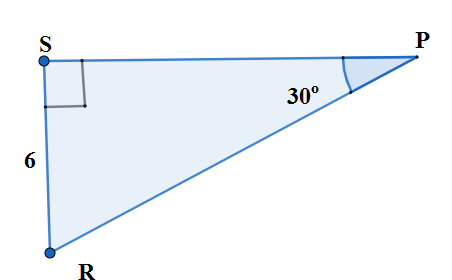
In the given figure. Find RP and PS using the information given in $\Delta PSR$.
Answer
 Verified
584.7k+ views
Hint: We recall the definitions of sine, cosine and tangent trigonometric ratios. We take sine of given angle $\angle SPR={{30}^{\circ }}$ to get the length SP and we take tangent of the given angle $\angle SPR={{30}^{\circ }}$ to get the length PS.
Complete answer:
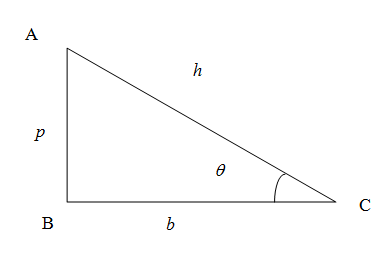
We know from the trigonometric ratios in a right angled triangle the sine of any angle is given by the ratio of length of side opposite to the angle to the length of hypotenuse. In the figure the sine of the angle $\theta $ is given by
\[\sin \theta =\dfrac{p}{h}\]
Similarly the cosine of an angle is the ratio of length of side adjacent to the angle (excluding hypotenuse) to the length of hypotenuse. So we have cosine of angle $\theta $
\[\cos \theta =\dfrac{b}{h}\]
The tangent of the angle is the ratio of length of opposite side to the length of adjacent side (excluding hypotenuse) . So we have tangent of the angle of angle $\theta $
\[\tan \theta =\dfrac{p}{b}\]
Let us observe the given figure
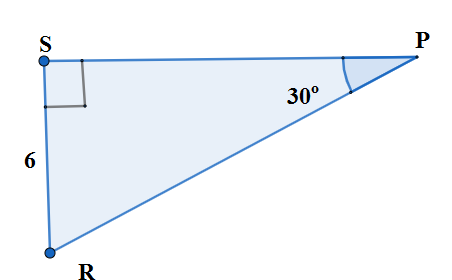
We see that we are given the right angled triangle PRS where $\angle PSR={{90}^{\circ }}$ and whose opposite side is the hypotenuse PS. We are also given a measure of the angle $\angle SPR={{30}^{\circ }}$ whose opposite side is SR and its length is given as 6 units. The adjacent side to the angle $\angle SPR={{30}^{\circ }}$ is PS excluding hypotenuse.
Let us take the sine of the angle $\angle SPR={{30}^{\circ }}$. We have;
\[\begin{align}
& \sin \left( \angle SPR \right)=\dfrac{SR}{RP} \\
& \Rightarrow \sin {{30}^{\circ }}=\dfrac{6}{RP} \\
& \Rightarrow \dfrac{1}{2}=\dfrac{6}{RP} \\
& \Rightarrow RP=12 \\
\end{align}\]
Let us take the tangent of the angle $\angle SPR={{30}^{\circ }}$. We have;
\[\begin{align}
& \tan \left( \angle SPR \right)=\dfrac{SR}{PS} \\
& \Rightarrow \tan {{30}^{\circ }}=\dfrac{6}{SP} \\
& \Rightarrow \dfrac{1}{\sqrt{3}}=\dfrac{6}{SP} \\
& \Rightarrow SP=6\sqrt{3} \\
\end{align}\]
So the required lengths are $RP=12$ units and $PS=6\sqrt{3}$ units.
Note:
We can alternatively find PS by taking cosine of the angle $\angle SPR={{30}^{\circ }}$ after we obtained length of hypotenuse $RP=12$ units where we can use $\cos {{30}^{\circ }}=\dfrac{\sqrt{3}}{2}$.We should properly remember basic trigonometric values from the table for ${{30}^{\circ }},{{45}^{\circ }},{{60}^{\circ }}$ and must not confuse among them. The given triangle is a ${{30}^{\circ }}-{{60}^{\circ }}-{{90}^{\circ }}$ triangle whose sides are always at a ratio $1:\sqrt{3}:2$.
Complete answer:
We know from the trigonometric ratios in a right angled triangle the sine of any angle is given by the ratio of length of side opposite to the angle to the length of hypotenuse. In the figure the sine of the angle $\theta $ is given by
\[\sin \theta =\dfrac{p}{h}\]
Similarly the cosine of an angle is the ratio of length of side adjacent to the angle (excluding hypotenuse) to the length of hypotenuse. So we have cosine of angle $\theta $
\[\cos \theta =\dfrac{b}{h}\]
The tangent of the angle is the ratio of length of opposite side to the length of adjacent side (excluding hypotenuse) . So we have tangent of the angle of angle $\theta $
\[\tan \theta =\dfrac{p}{b}\]
Let us observe the given figure
We see that we are given the right angled triangle PRS where $\angle PSR={{90}^{\circ }}$ and whose opposite side is the hypotenuse PS. We are also given a measure of the angle $\angle SPR={{30}^{\circ }}$ whose opposite side is SR and its length is given as 6 units. The adjacent side to the angle $\angle SPR={{30}^{\circ }}$ is PS excluding hypotenuse.
Let us take the sine of the angle $\angle SPR={{30}^{\circ }}$. We have;
\[\begin{align}
& \sin \left( \angle SPR \right)=\dfrac{SR}{RP} \\
& \Rightarrow \sin {{30}^{\circ }}=\dfrac{6}{RP} \\
& \Rightarrow \dfrac{1}{2}=\dfrac{6}{RP} \\
& \Rightarrow RP=12 \\
\end{align}\]
Let us take the tangent of the angle $\angle SPR={{30}^{\circ }}$. We have;
\[\begin{align}
& \tan \left( \angle SPR \right)=\dfrac{SR}{PS} \\
& \Rightarrow \tan {{30}^{\circ }}=\dfrac{6}{SP} \\
& \Rightarrow \dfrac{1}{\sqrt{3}}=\dfrac{6}{SP} \\
& \Rightarrow SP=6\sqrt{3} \\
\end{align}\]
So the required lengths are $RP=12$ units and $PS=6\sqrt{3}$ units.
Note:
We can alternatively find PS by taking cosine of the angle $\angle SPR={{30}^{\circ }}$ after we obtained length of hypotenuse $RP=12$ units where we can use $\cos {{30}^{\circ }}=\dfrac{\sqrt{3}}{2}$.We should properly remember basic trigonometric values from the table for ${{30}^{\circ }},{{45}^{\circ }},{{60}^{\circ }}$ and must not confuse among them. The given triangle is a ${{30}^{\circ }}-{{60}^{\circ }}-{{90}^{\circ }}$ triangle whose sides are always at a ratio $1:\sqrt{3}:2$.
Recently Updated Pages
Master Class 12 Social Science: Engaging Questions & Answers for Success

Master Class 12 Physics: Engaging Questions & Answers for Success
Master Class 12 Maths: Engaging Questions & Answers for Success
Master Class 12 Economics: Engaging Questions & Answers for Success
Master Class 12 Chemistry: Engaging Questions & Answers for Success
Master Class 12 Business Studies: Engaging Questions & Answers for Success
Trending doubts
Which are the Top 10 Largest Countries of the World?
Draw a labelled sketch of the human eye class 12 physics CBSE
Explain the structure of megasporangium class 12 biology CBSE
What are the major means of transport Explain each class 12 social science CBSE
How many chromosomes are found in human ovum a 46 b class 12 biology CBSE
The diagram of the section of a maize grain is given class 12 biology CBSE