




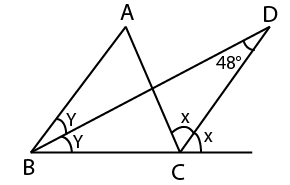
In the given figure, \[ABC\] is a triangle. The bisector of internal $\angle B$ and external $\angle C$ interest at $D$. If $\angle BDC = 48^\circ $, then what is the value (in degree) of $\angle A$?
Answer
 Verified
589.5k+ views
Hint: This problem is based on the exterior angle theorem which states that in a triangle, the exterior angle is equal to the sum of two internal opposite angles. We will use the concept of exterior angle theorem and solve this problem.
Complete step-by-step answer:
Given a triangle \[ABC\] in which the bisector of internal $\angle B$ and external $\angle C$ interest at $D$.
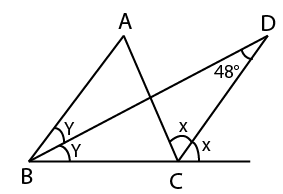
As we know that exterior angle is equal to the sum of two internal opposite angles.
Apply exterior angle property in $\Delta BCD$,
$\therefore \angle DCE = \angle DBC + \angle BDC$
$ \Rightarrow x = y + 48^\circ $
\[ \Rightarrow x - y = 48^\circ \]…..…….……(1)
Similarly, apply exterior angle property in$\Delta ABC$,
$\therefore \angle ACE = \angle BAC + \angle ABC$
$ \Rightarrow 2x = \angle A + 2y$
$ \Rightarrow 2x - 2y = \angle A$
$ \Rightarrow \angle A = 2\left( {x - y} \right)$
$ \Rightarrow \angle A = 2 \times 48^\circ $ [From (1)]
$ \Rightarrow \angle A = 96^\circ $
Therefore the value of $ \angle A$ is $96^\circ $
Note: This problem can also be solved as follows:
As we know that exterior angle is equal to the sum of two internal opposite angles.
Apply exterior angle property in $\Delta BCD$,
$\therefore \angle DCE = \angle DBC + \angle BDC$
$ \Rightarrow x = y + 48^\circ $
\[ \Rightarrow x - y = 48^\circ \]...........……(1)
As we know, the sum of interior angles of a triangle is $180^\circ $.
Apply angle sum property in $\Delta ABC$,
$\therefore \angle BAC + \angle ABC + \angle ACB = 180^\circ $
$ \Rightarrow \angle A + 2x + \left( {180 - 2y} \right) = 180^\circ $ $\left[ {\because \angle ACB = 180 - 2y} \right]$
$ \Rightarrow \angle A + 2x + 180 - 2y = 180^\circ $
$ \Rightarrow \angle A = 2x - 2y$
$ \Rightarrow \angle A = 2\left( {x - y} \right)$
$ \Rightarrow \angle A = 2 \times 48^\circ $ [From (1)]
$ \Rightarrow \angle A = 96^\circ $
Complete step-by-step answer:
Given a triangle \[ABC\] in which the bisector of internal $\angle B$ and external $\angle C$ interest at $D$.
As we know that exterior angle is equal to the sum of two internal opposite angles.
Apply exterior angle property in $\Delta BCD$,
$\therefore \angle DCE = \angle DBC + \angle BDC$
$ \Rightarrow x = y + 48^\circ $
\[ \Rightarrow x - y = 48^\circ \]…..…….……(1)
Similarly, apply exterior angle property in$\Delta ABC$,
$\therefore \angle ACE = \angle BAC + \angle ABC$
$ \Rightarrow 2x = \angle A + 2y$
$ \Rightarrow 2x - 2y = \angle A$
$ \Rightarrow \angle A = 2\left( {x - y} \right)$
$ \Rightarrow \angle A = 2 \times 48^\circ $ [From (1)]
$ \Rightarrow \angle A = 96^\circ $
Therefore the value of $ \angle A$ is $96^\circ $
Note: This problem can also be solved as follows:
As we know that exterior angle is equal to the sum of two internal opposite angles.
Apply exterior angle property in $\Delta BCD$,
$\therefore \angle DCE = \angle DBC + \angle BDC$
$ \Rightarrow x = y + 48^\circ $
\[ \Rightarrow x - y = 48^\circ \]...........……(1)
As we know, the sum of interior angles of a triangle is $180^\circ $.
Apply angle sum property in $\Delta ABC$,
$\therefore \angle BAC + \angle ABC + \angle ACB = 180^\circ $
$ \Rightarrow \angle A + 2x + \left( {180 - 2y} \right) = 180^\circ $ $\left[ {\because \angle ACB = 180 - 2y} \right]$
$ \Rightarrow \angle A + 2x + 180 - 2y = 180^\circ $
$ \Rightarrow \angle A = 2x - 2y$
$ \Rightarrow \angle A = 2\left( {x - y} \right)$
$ \Rightarrow \angle A = 2 \times 48^\circ $ [From (1)]
$ \Rightarrow \angle A = 96^\circ $
Recently Updated Pages
Basicity of sulphurous acid and sulphuric acid are

Master Class 11 Business Studies: Engaging Questions & Answers for Success
Master Class 11 Computer Science: Engaging Questions & Answers for Success
Master Class 11 Economics: Engaging Questions & Answers for Success
Master Class 12 English: Engaging Questions & Answers for Success
Master Class 12 Social Science: Engaging Questions & Answers for Success
Trending doubts
Fill the blanks with the suitable prepositions 1 The class 9 english CBSE
Difference Between Plant Cell and Animal Cell
What is the color of ferrous sulphate crystals? How does this color change after heating? Name the products formed on strongly heating ferrous sulphate crystals. What type of chemical reaction occurs in this type of change.
What is the Full Form of ICSE / ISC ?
Find the mode and median of the data 13 16 12 14 1-class-9-maths-CBSE
What is pollution? How many types of pollution? Define it
Fill the blanks with the suitable prepositions 1 The class 9 english CBSE
Difference Between Plant Cell and Animal Cell
What is the color of ferrous sulphate crystals? How does this color change after heating? Name the products formed on strongly heating ferrous sulphate crystals. What type of chemical reaction occurs in this type of change.