




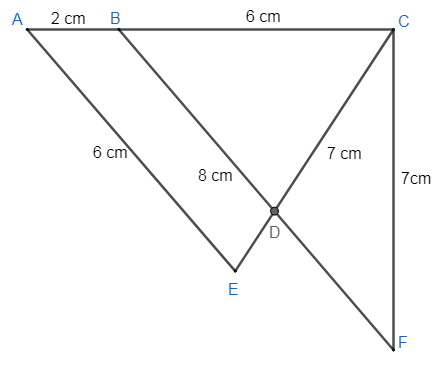
In the given figure, $AB=2,BC=6,AE=6,BF=8,CE=7\text{ and }CF=7.$ The ratio of ar ABDE to the $ar\Delta CDF$ is:
A. 1:1
B. 2:1
C. 1:2
D. None
Answer
 Verified
648k+ views
Hint: To find the ratio of ar ABDE: ar $\Delta CDF$ we need to find the area of a quadrilateral ABDE & area of $\Delta CDF$. For that first we will observe the given figure, by this we will find that $\Delta ACE\And \Delta BCF$ is congruent. Then by taking Area of Quadrilateral $\text{ABDE = Area of }\Delta ACE\text{ }-\text{ Area of }\Delta BCD$ and $\text{Area of }\Delta CDF=\text{Area of }\Delta BCF-\text{ Area of }\Delta BCD$ . Then we can find the ratio by substituting the values.
Complete step-by-step answer:
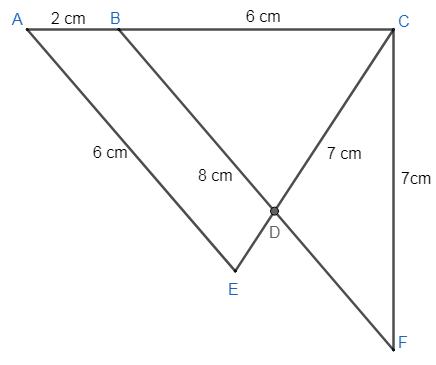
By observing the figure, we get to know that $AB=2,BC=6,AE=6,BF=8,CE=7,CF=7\text{ and }AC=AB+BC$.
By substituting the values of AB and BC, we get –
∃ΑΧ=2+6=8∃
We can also observe from the $\Delta ACE\And \Delta BCF$that –
$\begin{align}
& AC=BF=8cm \\
& AE=BC=6cm \\
& CE=CF=7cm \\
\end{align}$
As the sides of both the triangles are same, we can say that $\Delta ACE\And \Delta BCF$ are congruent.
Therefore, $\text{Area of }\Delta ACE=\text{ Area of }\Delta BCF$.
Let us consider ‘x’ as the $\text{Area of }\Delta ACE=\text{Area of }\Delta BCF=x$ ……………………………… (1)
Now, we need to find the ratio of the area of quadrilateral ABDE to the area of $\Delta CDF$.
To find this let us draw the figure and shade the area which we need to find.
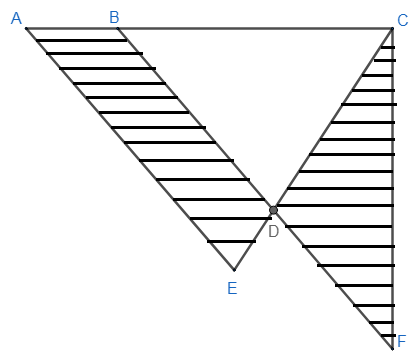
Here, the shaded regions are quadrilateral ABDE and $\Delta CDF$.
From the figure we get that –
Area of Quadrilateral $\text{ABDE = Area of }\Delta ACE\text{ }-\text{ Area of }\Delta BCD$
By substituting the value of $\Delta ACE$ from equation (1) we get –
Area of ABDE $=x-\Delta BCD$ …………………….. (2)
We can also observe that –
$\text{Area of }\Delta CDF=\text{Area of }\Delta BCF-\text{ Area of }\Delta BCD$.
By substituting the value of $\Delta ACE$ from equation (1) we get –
$\text{Area of }\Delta CDF=x-\Delta BCD$ ……………………….. (3)
Now, we will find the ration of ar ABDE: ar $\Delta CDF$
Therefore,
$\dfrac{\text{Area of Quadrilateral ABDE}}{\text{Area if }\Delta \text{CDF}}$
By substituting the values from equation (1) and (2) , we get that –
$\Rightarrow \dfrac{x-\Delta BCD}{x-\Delta BCD}$
By cancelling the common factors from numerator and denominator, we get –
$\Rightarrow \dfrac{1}{1}$
Therefore, the ration of ar ABDE: ar $\Delta CDF$ is 1:1
Hence, option A. is the correct answer.
Note: Students should know that, if all the sides of two triangles are proportional, then this is called SSS similarity and the two triangles called congruent or similar triangles.
For example: In our question –
For $\Delta ACE\And \Delta BCF$
$\dfrac{AE}{BC}=\dfrac{CE}{CF}=\dfrac{AC}{BF}$
By substituting their values, we get –
$\dfrac{6}{6}=\dfrac{7}{7}=\dfrac{8}{8}$
By cancelling the common factors from numerator and denominator, we get –
$1=1=1$
Therefore, it proves that $\Delta ACE\cong \Delta BCF$ which is congruent.
Complete step-by-step answer:
By observing the figure, we get to know that $AB=2,BC=6,AE=6,BF=8,CE=7,CF=7\text{ and }AC=AB+BC$.
By substituting the values of AB and BC, we get –
∃ΑΧ=2+6=8∃
We can also observe from the $\Delta ACE\And \Delta BCF$that –
$\begin{align}
& AC=BF=8cm \\
& AE=BC=6cm \\
& CE=CF=7cm \\
\end{align}$
As the sides of both the triangles are same, we can say that $\Delta ACE\And \Delta BCF$ are congruent.
Therefore, $\text{Area of }\Delta ACE=\text{ Area of }\Delta BCF$.
Let us consider ‘x’ as the $\text{Area of }\Delta ACE=\text{Area of }\Delta BCF=x$ ……………………………… (1)
Now, we need to find the ratio of the area of quadrilateral ABDE to the area of $\Delta CDF$.
To find this let us draw the figure and shade the area which we need to find.
Here, the shaded regions are quadrilateral ABDE and $\Delta CDF$.
From the figure we get that –
Area of Quadrilateral $\text{ABDE = Area of }\Delta ACE\text{ }-\text{ Area of }\Delta BCD$
By substituting the value of $\Delta ACE$ from equation (1) we get –
Area of ABDE $=x-\Delta BCD$ …………………….. (2)
We can also observe that –
$\text{Area of }\Delta CDF=\text{Area of }\Delta BCF-\text{ Area of }\Delta BCD$.
By substituting the value of $\Delta ACE$ from equation (1) we get –
$\text{Area of }\Delta CDF=x-\Delta BCD$ ……………………….. (3)
Now, we will find the ration of ar ABDE: ar $\Delta CDF$
Therefore,
$\dfrac{\text{Area of Quadrilateral ABDE}}{\text{Area if }\Delta \text{CDF}}$
By substituting the values from equation (1) and (2) , we get that –
$\Rightarrow \dfrac{x-\Delta BCD}{x-\Delta BCD}$
By cancelling the common factors from numerator and denominator, we get –
$\Rightarrow \dfrac{1}{1}$
Therefore, the ration of ar ABDE: ar $\Delta CDF$ is 1:1
Hence, option A. is the correct answer.
Note: Students should know that, if all the sides of two triangles are proportional, then this is called SSS similarity and the two triangles called congruent or similar triangles.
For example: In our question –
For $\Delta ACE\And \Delta BCF$
$\dfrac{AE}{BC}=\dfrac{CE}{CF}=\dfrac{AC}{BF}$
By substituting their values, we get –
$\dfrac{6}{6}=\dfrac{7}{7}=\dfrac{8}{8}$
By cancelling the common factors from numerator and denominator, we get –
$1=1=1$
Therefore, it proves that $\Delta ACE\cong \Delta BCF$ which is congruent.
Recently Updated Pages
Basicity of sulphurous acid and sulphuric acid are

Master Class 12 Economics: Engaging Questions & Answers for Success
Master Class 12 Biology: Engaging Questions & Answers for Success
Master Class 11 English: Engaging Questions & Answers for Success
Master Class 11 Physics: Engaging Questions & Answers for Success
Master Class 11 Computer Science: Engaging Questions & Answers for Success
Trending doubts
Draw a labelled sketch of the human eye class 12 physics CBSE
The chemical formula of tear gas is A CO Cl 2 B C 10 class 12 chemistry CBSE
Draw ray diagrams each showing i myopic eye and ii class 12 physics CBSE
Which are the Top 10 Largest Countries of the World?
Differentiate between homogeneous and heterogeneous class 12 chemistry CBSE
Which is the correct genotypic ratio of mendel dihybrid class 12 biology CBSE