




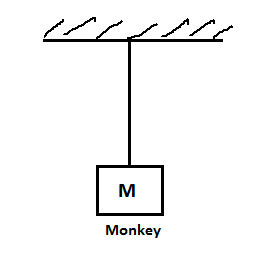
In the given figure a monkey of mass m is climbing a rope hanging from the roof with acceleration a. The coefficient of static friction between the body of the monkey and the rope is $\mu $. Find the direction and value of friction on the monkey.
Answer
 Verified
620.7k+ views
Hint: When two bodies are kept in contact, electromagnetic force act between charged particles at the surface of the bodies. As a result, each body exerts a force on the other body.
Complete step by step answer:
Given, a monkey of mass $m$ is climbing a rope hanging from the roof with acceleration $a$, the coefficient of static friction between the body of the monkey and the rope is $\mu $.
The coefficient of static friction depends on the nature of the surface it is in contact with.
If there is no friction between the monkey and the rope then the monkey would fall down. Therefore, the frictional force helps the monkey to climb. Hence, friction is in an upward direction.
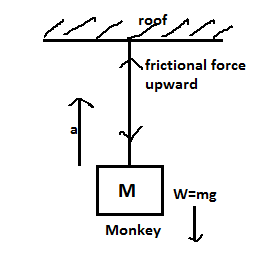
Force acting in a downward direction is weight and upward direction is friction.
Since the net force is in an upward direction.
Therefore, $ma = F - mg$
$ \Rightarrow F = ma + mg$
$\therefore F = m(a + g)$
The value of friction on the monkey is $F = m(a + g)$ in upward direction.
Note:
Friction is defined as the opposing force which comes into play tangentially between two surfaces so as to destroy the relative motion between them. A surface appears smooth by seeing in the naked eye, but when we see microscopically, we can find many numbers of irregularities. When two bodies are placed one above the other, these surface irregularities interlock together and oppose any changes of relative motion between the bodies.
Safe walking on the floor nails and screws are held in the walls, helps the fingers to hold drinking water, vehicles move on the roads without slipping all these are advantages of friction.
The wear and tear of the machinery parts, heating of the machinery parts, large amount of power loss in the engine all these are disadvantages of friction.
Complete step by step answer:
Given, a monkey of mass $m$ is climbing a rope hanging from the roof with acceleration $a$, the coefficient of static friction between the body of the monkey and the rope is $\mu $.
The coefficient of static friction depends on the nature of the surface it is in contact with.
If there is no friction between the monkey and the rope then the monkey would fall down. Therefore, the frictional force helps the monkey to climb. Hence, friction is in an upward direction.
Force acting in a downward direction is weight and upward direction is friction.
Since the net force is in an upward direction.
Therefore, $ma = F - mg$
$ \Rightarrow F = ma + mg$
$\therefore F = m(a + g)$
The value of friction on the monkey is $F = m(a + g)$ in upward direction.
Note:
Friction is defined as the opposing force which comes into play tangentially between two surfaces so as to destroy the relative motion between them. A surface appears smooth by seeing in the naked eye, but when we see microscopically, we can find many numbers of irregularities. When two bodies are placed one above the other, these surface irregularities interlock together and oppose any changes of relative motion between the bodies.
Safe walking on the floor nails and screws are held in the walls, helps the fingers to hold drinking water, vehicles move on the roads without slipping all these are advantages of friction.
The wear and tear of the machinery parts, heating of the machinery parts, large amount of power loss in the engine all these are disadvantages of friction.
Recently Updated Pages
Master Class 12 Economics: Engaging Questions & Answers for Success

Master Class 12 English: Engaging Questions & Answers for Success
Master Class 12 Social Science: Engaging Questions & Answers for Success
Master Class 12 Maths: Engaging Questions & Answers for Success
Master Class 12 Physics: Engaging Questions & Answers for Success
Master Class 12 Business Studies: Engaging Questions & Answers for Success
Trending doubts
Which are the Top 10 Largest Countries of the World?
Draw a labelled sketch of the human eye class 12 physics CBSE
Differentiate between homogeneous and heterogeneous class 12 chemistry CBSE
Why is the cell called the structural and functional class 12 biology CBSE
Draw ray diagrams each showing i myopic eye and ii class 12 physics CBSE
Which is the correct genotypic ratio of mendel dihybrid class 12 biology CBSE