




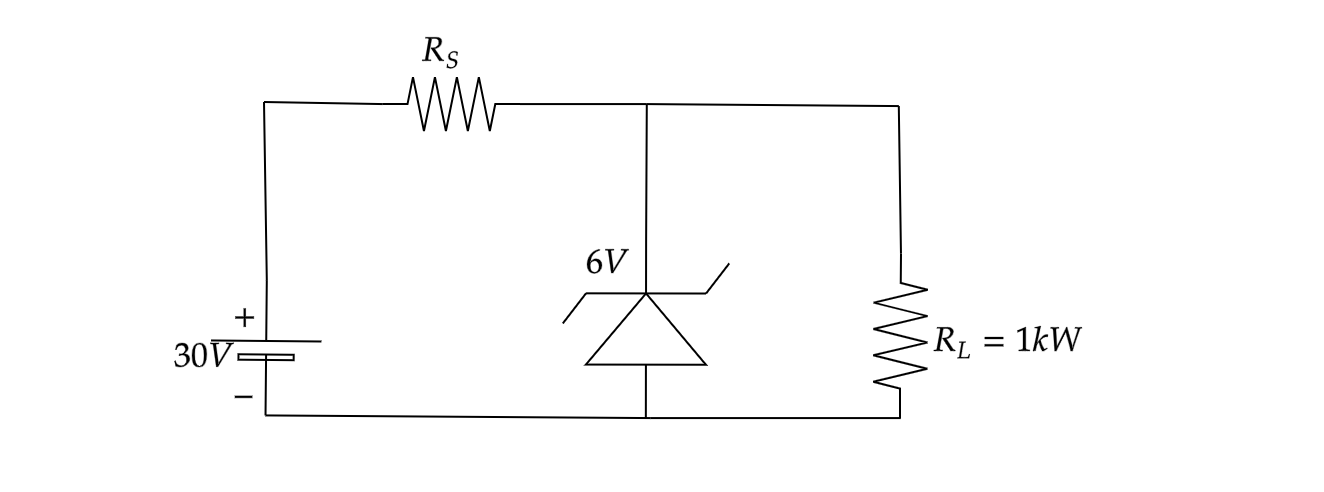
In the given circuit what is the maximum value of $ R_S $ for a zener diode to regulate voltage on load resistance?
$ \left( A \right)2k\Omega $
$ \left( B \right)5k\Omega $
$ \left( C \right)6k\Omega $
$ \left( D \right)4k\Omega $
Answer
 Verified
523.5k+ views
Hint: There is a mistake in the question that the value of load resistance is given in matt it should be in ohm. If calculated by taking its power then the solution will not match with the optio. Hence we will solve by taking load resistance on kiloohm. To satisfy the given condition the voltage across the load must be equal to the enor voltage. Then using ohm’s law in the further step we can calculate the value of $ R_S $ .
Complete answer:
As per the problem we need to calculate the maximum value of $ R_S $ for a zener diode to regulate voltage on load resistance.
Now the zener diode to regulate voltage on load resistance we can write it as,
$ V_{R_L} = V_Z \ldots \ldots \left( 1 \right) $
Where,
The voltage across the load resistance is represent as $ V_{R_L} $
And the voltage across zener diode is represented as $ VZ $
Now in place of $ V_{R_L} $ we can write,
$ V_{R_L} = I_{R_L} \ldots \ldots \left( 2 \right) $
Now using ohm's law on current value we will get,
$ I = \dfrac{V}{{\operatorname{R} {\text{eq}}}} $
Here the load resistance and $ R_S $ are connected in series,
Hence the equivalent resistance be,
$ \operatorname{R} {\text{eq}} = R_S + R_L $
Now putting the value in the above current equation we will get,
$ I = \dfrac{V}{{R_S + R_L}} $
Putting this value in the above equation $ \left( 2 \right) $ we will get,
$ V_{R_L} = \dfrac{V}{{R_S + R_L}}R_L \ldots \ldots \left( 3 \right) $
Putting equation $ \left( 3 \right) $ in place of equation $ \left( 1 \right) $ we will get,
$ \dfrac{V}{{R_S + R_L}}R_L = V_Z $
From the figure we know,
$ V = 30V $
$ RL = 1k\Omega $
$ V_Z = 6V $
Now putting these values we will get,
$ \dfrac{{30V}}{{R_S + 1k\Omega }} \times 1k\Omega = 6V $
Cancelling the terms we will get,
$ \dfrac{{5k\Omega }}{{R_S + 1k\Omega }} = 1 $
Rearranging the above equation we will egt,
$ 5k\Omega = R_S + 1k\Omega $
Hence the value of $ R_S = 4k\Omega $ .
Therefore the correct option is $ \left( D \right) $ .
Note:
Here the zener diode is also called voltage regulator only reverse biased because it is specially made to have a reverse voltage breakdown at a specific voltage. Note that if the zener diode is biased in the forward direction it behaves like a normal signal passing the current increasing linearly with voltage, now in this case it will not act as a voltage regulator.
Complete answer:
As per the problem we need to calculate the maximum value of $ R_S $ for a zener diode to regulate voltage on load resistance.
Now the zener diode to regulate voltage on load resistance we can write it as,
$ V_{R_L} = V_Z \ldots \ldots \left( 1 \right) $
Where,
The voltage across the load resistance is represent as $ V_{R_L} $
And the voltage across zener diode is represented as $ VZ $
Now in place of $ V_{R_L} $ we can write,
$ V_{R_L} = I_{R_L} \ldots \ldots \left( 2 \right) $
Now using ohm's law on current value we will get,
$ I = \dfrac{V}{{\operatorname{R} {\text{eq}}}} $
Here the load resistance and $ R_S $ are connected in series,
Hence the equivalent resistance be,
$ \operatorname{R} {\text{eq}} = R_S + R_L $
Now putting the value in the above current equation we will get,
$ I = \dfrac{V}{{R_S + R_L}} $
Putting this value in the above equation $ \left( 2 \right) $ we will get,
$ V_{R_L} = \dfrac{V}{{R_S + R_L}}R_L \ldots \ldots \left( 3 \right) $
Putting equation $ \left( 3 \right) $ in place of equation $ \left( 1 \right) $ we will get,
$ \dfrac{V}{{R_S + R_L}}R_L = V_Z $
From the figure we know,
$ V = 30V $
$ RL = 1k\Omega $
$ V_Z = 6V $
Now putting these values we will get,
$ \dfrac{{30V}}{{R_S + 1k\Omega }} \times 1k\Omega = 6V $
Cancelling the terms we will get,
$ \dfrac{{5k\Omega }}{{R_S + 1k\Omega }} = 1 $
Rearranging the above equation we will egt,
$ 5k\Omega = R_S + 1k\Omega $
Hence the value of $ R_S = 4k\Omega $ .
Therefore the correct option is $ \left( D \right) $ .
Note:
Here the zener diode is also called voltage regulator only reverse biased because it is specially made to have a reverse voltage breakdown at a specific voltage. Note that if the zener diode is biased in the forward direction it behaves like a normal signal passing the current increasing linearly with voltage, now in this case it will not act as a voltage regulator.
Recently Updated Pages
Master Class 12 Economics: Engaging Questions & Answers for Success

Master Class 12 English: Engaging Questions & Answers for Success
Master Class 12 Social Science: Engaging Questions & Answers for Success
Master Class 12 Maths: Engaging Questions & Answers for Success
Master Class 12 Physics: Engaging Questions & Answers for Success
Master Class 9 General Knowledge: Engaging Questions & Answers for Success
Trending doubts
Which are the Top 10 Largest Countries of the World?
Draw a labelled sketch of the human eye class 12 physics CBSE
Differentiate between homogeneous and heterogeneous class 12 chemistry CBSE
Sulphuric acid is known as the king of acids State class 12 chemistry CBSE
Why is the cell called the structural and functional class 12 biology CBSE
A dentist uses a small mirror that gives a magnification class 12 physics CBSE