




In the given circuit the current ${I_1}$ (magnitude only) is:

A. $0.4\,A$
B. $0.7\,A$
C. $0.8\,A$
D. None of these
Answer
 Verified
525.3k+ views
Hint:Use the Kirchhoff’s laws to solve the circuit problem. Kirchhoff’s current law states that the algebraic sum of the currents meeting at a junction in an electrical circuit is zero.
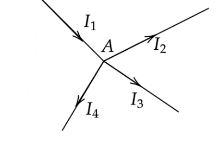
According to Kirchhoff’s Current law at the junction A in the above diagram,
$ - {I_1} + {I_2} + {I_3} + {I_4} = 0$
$\Rightarrow {I_1} = {I_2} + {I_3} + {I_4}$
The algebraic sum of incoming currents is equal to algebraic the sum of outgoing currents. Kirchhoff’s voltage law states that in any electrical circuit loop, the algebraic sum of all the electromotive forces and the voltage drops in resistors is equal to zero
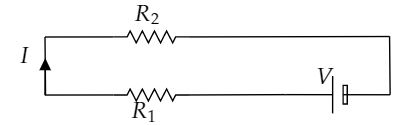
Apply Kirchhoff's voltage law in the above loop.
$ - I{R_1} - I{R_2} + V = 0$
$ \Rightarrow V = I{R_1} + I{R_2}$
The algebraic sum of all electromotive forces is equal to the algebraic sum of voltage drops across the resistors.
Complete step by step answer:
Let’s redraw the given diagram
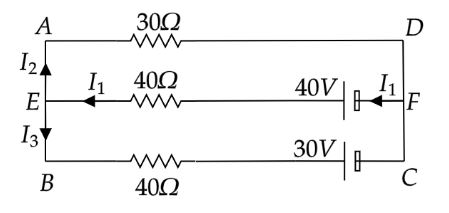
Apply Kirchhoff's Current law at the junction $E$ in the above circuit diagram.
${I_1} = {I_2} + {I_3}$
Now apply Kirchhoff’s voltage law in the loop $AEFD$.
$40{I_1} + 30{I_2} = 40$
$4{I_1} + 3{I_2} = 4$ …… (1)
Apply Kirchhoff’s voltage law in the loop $EBCF$.
$40{I_1} + 40{I_3} = 40 - 30$
Now substitute ${I_3} = {I_1} - {I_2}$ in the above equation.
$4{I_1} + 4\left( {{I_1} - {I_2}} \right) = 1$
$ \Rightarrow 8{I_1} - 4{I_2} = 1$
Further simplifying in terms of ${I_1}$
$ \Rightarrow {I_2} = 2{I_1}$
Substitute the value of ${I_2}$ in the above equation (1).
$4{I_1} + 3\left( {2{I_1}} \right) = 4$
Further calculating
$10{I_1} = 4$
$ \therefore {I_1} = 0.4\,A$
Hence, the correct option is $\left( A \right)$.
Note:While applying the Kirchhoff’s voltage law to a closed, algebraic sums are considered. Therefore, it is very important to assign proper signs to electromotive forces (e.m.f.) and voltage drops in the loop. A rise in potential should be considered positive and fall in potential should be considered as negative.
According to Kirchhoff’s Current law at the junction A in the above diagram,
$ - {I_1} + {I_2} + {I_3} + {I_4} = 0$
$\Rightarrow {I_1} = {I_2} + {I_3} + {I_4}$
The algebraic sum of incoming currents is equal to algebraic the sum of outgoing currents. Kirchhoff’s voltage law states that in any electrical circuit loop, the algebraic sum of all the electromotive forces and the voltage drops in resistors is equal to zero
Apply Kirchhoff's voltage law in the above loop.
$ - I{R_1} - I{R_2} + V = 0$
$ \Rightarrow V = I{R_1} + I{R_2}$
The algebraic sum of all electromotive forces is equal to the algebraic sum of voltage drops across the resistors.
Complete step by step answer:
Let’s redraw the given diagram
Apply Kirchhoff's Current law at the junction $E$ in the above circuit diagram.
${I_1} = {I_2} + {I_3}$
Now apply Kirchhoff’s voltage law in the loop $AEFD$.
$40{I_1} + 30{I_2} = 40$
$4{I_1} + 3{I_2} = 4$ …… (1)
Apply Kirchhoff’s voltage law in the loop $EBCF$.
$40{I_1} + 40{I_3} = 40 - 30$
Now substitute ${I_3} = {I_1} - {I_2}$ in the above equation.
$4{I_1} + 4\left( {{I_1} - {I_2}} \right) = 1$
$ \Rightarrow 8{I_1} - 4{I_2} = 1$
Further simplifying in terms of ${I_1}$
$ \Rightarrow {I_2} = 2{I_1}$
Substitute the value of ${I_2}$ in the above equation (1).
$4{I_1} + 3\left( {2{I_1}} \right) = 4$
Further calculating
$10{I_1} = 4$
$ \therefore {I_1} = 0.4\,A$
Hence, the correct option is $\left( A \right)$.
Note:While applying the Kirchhoff’s voltage law to a closed, algebraic sums are considered. Therefore, it is very important to assign proper signs to electromotive forces (e.m.f.) and voltage drops in the loop. A rise in potential should be considered positive and fall in potential should be considered as negative.
Recently Updated Pages
Master Class 12 Business Studies: Engaging Questions & Answers for Success

Master Class 12 Biology: Engaging Questions & Answers for Success
Master Class 12 Chemistry: Engaging Questions & Answers for Success
Class 12 Question and Answer - Your Ultimate Solutions Guide
Master Class 11 English: Engaging Questions & Answers for Success
Master Class 11 Social Science: Engaging Questions & Answers for Success
Trending doubts
Which are the Top 10 Largest Countries of the World?
Draw a labelled sketch of the human eye class 12 physics CBSE
Differentiate between homogeneous and heterogeneous class 12 chemistry CBSE
Why is the cell called the structural and functional class 12 biology CBSE
Draw ray diagrams each showing i myopic eye and ii class 12 physics CBSE
Which is the correct genotypic ratio of mendel dihybrid class 12 biology CBSE