




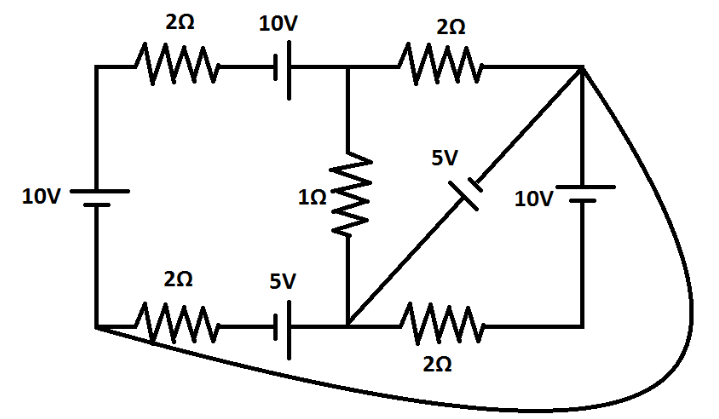
In the given circuit diagram, the current through the $1\Omega $ resistor is given by $Iamp$. Fill $2I$ in OMR sheet.
Answer
 Verified
606.9k+ views
Hint:In this question, we need to find the current passing through the resistor of $1\Omega $. For this, first we need to know the potential difference for this resistor. Then, we will apply ohm’s law to find the required answer.
Complete step by step answer:
First, we will find the potential difference across the resistor of $1\Omega $. For this, we will consider the diagram as shown in the figure.
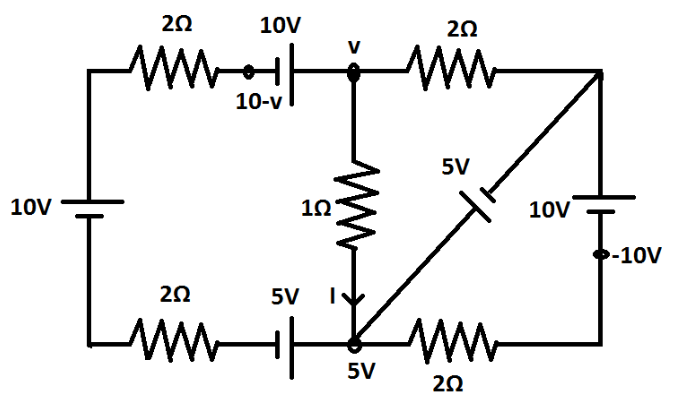
We will take the voltage of the upper-middle point to be $v$.
Now, we will consider the voltage drop which is given by:
\[
\dfrac{{(v - 10) - 10}}{2} + \dfrac{{v - 0}}{2} + \dfrac{{v - 5}}{1} = 0\; \\
\Rightarrow v = \dfrac{{30}}{4} = \dfrac{{15}}{2}V \\ \]
We will now apply the ohm’s law to find the required current.
$I = \dfrac{{v - 5}}{R} = \dfrac{{\dfrac{{15}}{2} - 5}}{1} = \dfrac{{15 - 10}}{2} = \dfrac{5}{2}A$
Thus, the current flowing through the resistor of $1\Omega $ is $\dfrac{5}{2}A$.
But, here, we are asked to find the value of $2I$.
$ \therefore 2I = 2 \times \dfrac{5}{2} = 5A$
Hence, our final answer is $5A$.
Note:Here, we have used the application of Ohm’s law to determine our final answer. Ohm’s law states that the voltage across a conductor is directly proportional to the current flowing through it, provided all physical conditions and temperature remain constant. We can write it mathematically as:
$
V \propto I \\
\Rightarrow V = IR \\ $
Where, $V$is the potential difference, $I$ is the current and $R$ is the resistance.Ohm’s law is used to validate the static values of circuit components such as current levels, voltage supplies, and voltage drops. It is also important to know that Ohm’s law is not a universal law. This is because ohm’s law is only applicable to ohmic conductors such as iron and copper but is not applicable to non-ohmic conductors such as semiconductors.
Complete step by step answer:
First, we will find the potential difference across the resistor of $1\Omega $. For this, we will consider the diagram as shown in the figure.
We will take the voltage of the upper-middle point to be $v$.
Now, we will consider the voltage drop which is given by:
\[
\dfrac{{(v - 10) - 10}}{2} + \dfrac{{v - 0}}{2} + \dfrac{{v - 5}}{1} = 0\; \\
\Rightarrow v = \dfrac{{30}}{4} = \dfrac{{15}}{2}V \\ \]
We will now apply the ohm’s law to find the required current.
$I = \dfrac{{v - 5}}{R} = \dfrac{{\dfrac{{15}}{2} - 5}}{1} = \dfrac{{15 - 10}}{2} = \dfrac{5}{2}A$
Thus, the current flowing through the resistor of $1\Omega $ is $\dfrac{5}{2}A$.
But, here, we are asked to find the value of $2I$.
$ \therefore 2I = 2 \times \dfrac{5}{2} = 5A$
Hence, our final answer is $5A$.
Note:Here, we have used the application of Ohm’s law to determine our final answer. Ohm’s law states that the voltage across a conductor is directly proportional to the current flowing through it, provided all physical conditions and temperature remain constant. We can write it mathematically as:
$
V \propto I \\
\Rightarrow V = IR \\ $
Where, $V$is the potential difference, $I$ is the current and $R$ is the resistance.Ohm’s law is used to validate the static values of circuit components such as current levels, voltage supplies, and voltage drops. It is also important to know that Ohm’s law is not a universal law. This is because ohm’s law is only applicable to ohmic conductors such as iron and copper but is not applicable to non-ohmic conductors such as semiconductors.
Recently Updated Pages
Basicity of sulphurous acid and sulphuric acid are

Master Class 12 Economics: Engaging Questions & Answers for Success
Master Class 12 Biology: Engaging Questions & Answers for Success
Master Class 11 English: Engaging Questions & Answers for Success
Master Class 11 Physics: Engaging Questions & Answers for Success
Master Class 11 Computer Science: Engaging Questions & Answers for Success
Trending doubts
Draw a labelled sketch of the human eye class 12 physics CBSE
The chemical formula of tear gas is A CO Cl 2 B C 10 class 12 chemistry CBSE
Draw ray diagrams each showing i myopic eye and ii class 12 physics CBSE
Which are the Top 10 Largest Countries of the World?
Differentiate between homogeneous and heterogeneous class 12 chemistry CBSE
Which is the correct genotypic ratio of mendel dihybrid class 12 biology CBSE