




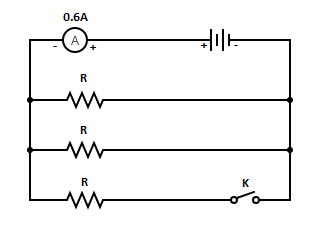
In the given circuit diagram, the cell and the ammeter have negligible resistances. The resistances are identical. With the switch K open the ammeter reads 0.6 A. What will be the ammeter reading when the switch is closed?
Answer
 Verified
571.2k+ views
Hint: When the resistances are connected in parallel the total equivalent resistance is calculated by taking the reciprocal of each. Ohm's law gives the relation between the voltage, current and resistance. In an electric circuit the start of the point from where the electrons start flowing is called the source whereas the point where electrons leave the electrical circuit is called the return.
Complete step by step answer:
Let us consider the case when the switch K is open. Then, only two resistances are in circuit. These two resistances are in parallel connection. So the equivalent resistance in this case where the switch K is open can be calculated as,
$
\dfrac{1}{{{R_1}}} = \dfrac{1}{R} + \dfrac{1}{R}\\
\Rightarrow\dfrac{1}{{{R_1}}} = \dfrac{2}{R}\\
\Rightarrow{R_1} = \dfrac{R}{2}
$
Now we can consider the potential difference of the cell. Let v volt be the potential difference. The current through the circuit is given as 0.6 A. We have the Ohm’s law that states voltage as the product of current passing through the circuit and the resistance offered by it. So, we have in this case, the voltage as,
$V = I{R_1}$
Substituting the value of current and resistance in the above equation, we have,
$
V = 0.6 \times \dfrac{R}{2}\\
\Rightarrow V = 0.3R
$
Now let us consider the case when the key is closed. When the switch K is closed all the three resistances are in parallel. So the equivalent resistance in this case where the switch K is closed can be calculated as,
$
\dfrac{1}{{{R_2}}} = \dfrac{1}{R} + \dfrac{1}{R} + \dfrac{1}{R}\\
\Rightarrow\dfrac{1}{{{R_2}}} = \dfrac{3}{R}\\
\Rightarrow{R_2} = \dfrac{R}{3}
$
Thus, again using the Ohm’s law, we can calculate the voltage as,
$V = I{R_2}$
But we know that the value of V is 0.3 R and the resistance R2 as R/3. Therefore substituting these values in the above equation, we have,
$
0.3R = I\left( {\dfrac{R}{3}} \right)\\
\Rightarrow I = \dfrac{{0.3R \times 3}}{R}\\
\therefore I = 0.9\;{\rm{A}}
$
Therefore the ammeter reads 0.9 A when the switch is closed.
Note: When the switch is open, there is no current that flows through the last section as it remains disconnected. Hence the last resistance was neglected for calculating the equivalent resistance.The electric circuits are closed-loop or path which forms a network of electrical components, where electrons are able to flow. This path is made using electrical wires and is powered by a source, like a battery.
Complete step by step answer:
Let us consider the case when the switch K is open. Then, only two resistances are in circuit. These two resistances are in parallel connection. So the equivalent resistance in this case where the switch K is open can be calculated as,
$
\dfrac{1}{{{R_1}}} = \dfrac{1}{R} + \dfrac{1}{R}\\
\Rightarrow\dfrac{1}{{{R_1}}} = \dfrac{2}{R}\\
\Rightarrow{R_1} = \dfrac{R}{2}
$
Now we can consider the potential difference of the cell. Let v volt be the potential difference. The current through the circuit is given as 0.6 A. We have the Ohm’s law that states voltage as the product of current passing through the circuit and the resistance offered by it. So, we have in this case, the voltage as,
$V = I{R_1}$
Substituting the value of current and resistance in the above equation, we have,
$
V = 0.6 \times \dfrac{R}{2}\\
\Rightarrow V = 0.3R
$
Now let us consider the case when the key is closed. When the switch K is closed all the three resistances are in parallel. So the equivalent resistance in this case where the switch K is closed can be calculated as,
$
\dfrac{1}{{{R_2}}} = \dfrac{1}{R} + \dfrac{1}{R} + \dfrac{1}{R}\\
\Rightarrow\dfrac{1}{{{R_2}}} = \dfrac{3}{R}\\
\Rightarrow{R_2} = \dfrac{R}{3}
$
Thus, again using the Ohm’s law, we can calculate the voltage as,
$V = I{R_2}$
But we know that the value of V is 0.3 R and the resistance R2 as R/3. Therefore substituting these values in the above equation, we have,
$
0.3R = I\left( {\dfrac{R}{3}} \right)\\
\Rightarrow I = \dfrac{{0.3R \times 3}}{R}\\
\therefore I = 0.9\;{\rm{A}}
$
Therefore the ammeter reads 0.9 A when the switch is closed.
Note: When the switch is open, there is no current that flows through the last section as it remains disconnected. Hence the last resistance was neglected for calculating the equivalent resistance.The electric circuits are closed-loop or path which forms a network of electrical components, where electrons are able to flow. This path is made using electrical wires and is powered by a source, like a battery.
Recently Updated Pages
Master Class 12 Economics: Engaging Questions & Answers for Success

Master Class 12 English: Engaging Questions & Answers for Success
Master Class 12 Social Science: Engaging Questions & Answers for Success
Master Class 12 Maths: Engaging Questions & Answers for Success
Master Class 12 Physics: Engaging Questions & Answers for Success
Master Class 12 Business Studies: Engaging Questions & Answers for Success
Trending doubts
Which are the Top 10 Largest Countries of the World?
Draw a labelled sketch of the human eye class 12 physics CBSE
Differentiate between homogeneous and heterogeneous class 12 chemistry CBSE
Why is the cell called the structural and functional class 12 biology CBSE
Draw ray diagrams each showing i myopic eye and ii class 12 physics CBSE
Which is the correct genotypic ratio of mendel dihybrid class 12 biology CBSE