




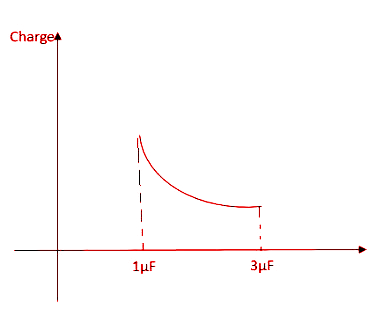
In the given circuit, charge ${Q_2}$ on the 2μF capacitor changes as $C$ is varied from 1μF to 3μF. ${Q_2}$ as a function of ‘$C$’ is given properly by:
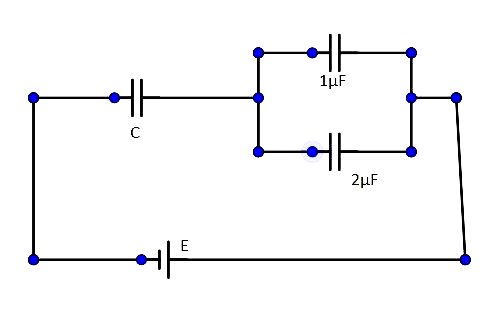
(Figures are drawn schematically and are not to scale).
A.
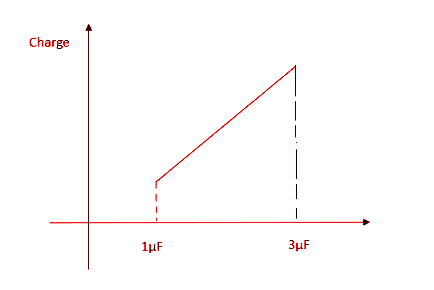
B.
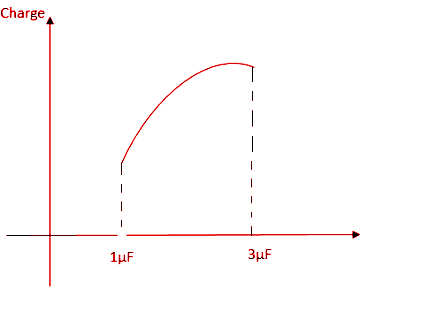
C.
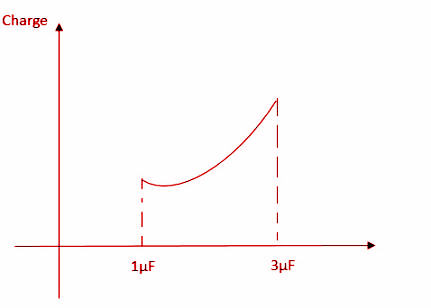
D.
Answer
 Verified
587.7k+ views
Hint: The capacitors 1μF and 2μF are arranged in parallel and this system is arranged with the capacitor 3μF in series. The charge will increase until the capacitance is equal to 3.
Complete step-by-step answer: It is given that the capacitors 1μF and 2μF are arranged in parallel and this system is arranged with the capacitor 3μF in series.
Let the charge on the capacitor $C$ be $Q$.
Charge on the combination of 1μF and 2μF is also $Q$. This is because they are connected in series.
From the law of arrangement of capacitors, ${Q_2} = \dfrac{2}{{1 + 2}}Q = \dfrac{2}{3}Q$.
But, it is known to us that, $Q = E\left( {\dfrac{{3C}}{{3 + C}}} \right)$, from the law of arrangement of capacitors.
$\therefore {Q_2} = \dfrac{2}{3}E\left( {\dfrac{{3C}}{{3 + C}}} \right) = \dfrac{{2EC}}{{3 + C}}$
As we can see, since the value of $C$ is between 1µF and 3µF, ${Q_2}$ will increase until $C = 3$.
Options A and D are thus eliminated.
The slope of the curve is given by the formula, $\dfrac{y}{x}$.
Thus, the slope in this case is given by,
$\dfrac{{{\text{d}}\left( {{\text{Charge}}} \right)}}{{{\text{dC}}}} = \dfrac{{\left( {3 + C} \right)2E - 2EC}}{{{{\left( {3 + C} \right)}^2}}} = \dfrac{{6E}}{{{{\left( {3 + C} \right)}^2}}}$.
Thus, slope decreases as $C$ increases.
Hence, the correct answer is Option B.
Note: A capacitor is a device for storing separated charge. No single electronic component plays a more important role today than the capacitor. This device is used to store information in computer memories, to regulate voltages in power supplies, to establish electrical fields, to store electrical energy, to detect and produce electromagnetic waves, and to measure time. Any two conductors separated by an insulating medium form a capacitor.
Complete step-by-step answer: It is given that the capacitors 1μF and 2μF are arranged in parallel and this system is arranged with the capacitor 3μF in series.
Let the charge on the capacitor $C$ be $Q$.
Charge on the combination of 1μF and 2μF is also $Q$. This is because they are connected in series.
From the law of arrangement of capacitors, ${Q_2} = \dfrac{2}{{1 + 2}}Q = \dfrac{2}{3}Q$.
But, it is known to us that, $Q = E\left( {\dfrac{{3C}}{{3 + C}}} \right)$, from the law of arrangement of capacitors.
$\therefore {Q_2} = \dfrac{2}{3}E\left( {\dfrac{{3C}}{{3 + C}}} \right) = \dfrac{{2EC}}{{3 + C}}$
As we can see, since the value of $C$ is between 1µF and 3µF, ${Q_2}$ will increase until $C = 3$.
Options A and D are thus eliminated.
The slope of the curve is given by the formula, $\dfrac{y}{x}$.
Thus, the slope in this case is given by,
$\dfrac{{{\text{d}}\left( {{\text{Charge}}} \right)}}{{{\text{dC}}}} = \dfrac{{\left( {3 + C} \right)2E - 2EC}}{{{{\left( {3 + C} \right)}^2}}} = \dfrac{{6E}}{{{{\left( {3 + C} \right)}^2}}}$.
Thus, slope decreases as $C$ increases.
Hence, the correct answer is Option B.
Note: A capacitor is a device for storing separated charge. No single electronic component plays a more important role today than the capacitor. This device is used to store information in computer memories, to regulate voltages in power supplies, to establish electrical fields, to store electrical energy, to detect and produce electromagnetic waves, and to measure time. Any two conductors separated by an insulating medium form a capacitor.
Recently Updated Pages
Master Class 12 Business Studies: Engaging Questions & Answers for Success

Master Class 12 Chemistry: Engaging Questions & Answers for Success
Master Class 12 Biology: Engaging Questions & Answers for Success
Class 12 Question and Answer - Your Ultimate Solutions Guide
Master Class 11 English: Engaging Questions & Answers for Success
Master Class 11 Maths: Engaging Questions & Answers for Success
Trending doubts
Which is more stable and why class 12 chemistry CBSE
Which are the Top 10 Largest Countries of the World?
Draw a labelled sketch of the human eye class 12 physics CBSE
Differentiate between homogeneous and heterogeneous class 12 chemistry CBSE
What are the major means of transport Explain each class 12 social science CBSE
Sulphuric acid is known as the king of acids State class 12 chemistry CBSE