




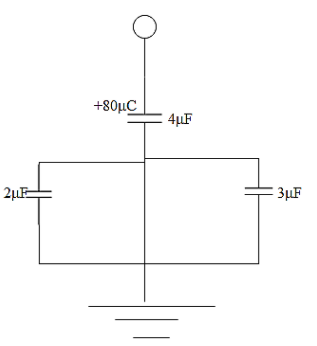
In the given circuit, a charge of $+80\mu C$ is given to the upper plate of the $4\mu F$ capacitor. Then at the steady state, the charge on the upper plate of the $3\mu F$ capacitor will be given as,
$\begin{align}
& A.+32\mu C \\
& B.+40\mu C \\
& C.+48\mu C \\
& D.+80\mu C \\
\end{align}$
Answer
 Verified
660.9k+ views
Hint: The capacitors, B and C are parallel, therefore the potential across both the capacitors will be equal. This relation is to be used in the equation of total charge. Rearranging this equation will give the answer. As the lower plate of C is connected to ground so the upper plate of C will be positive. These all may help you in solving the question.
Complete answer:
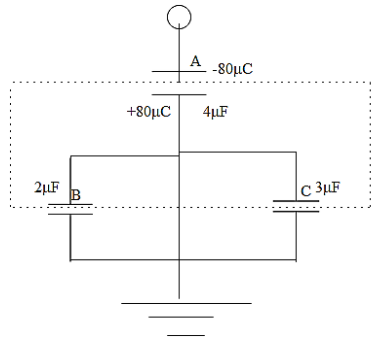
As per the question, we know that the total charge on the plate will be given as $80\mu C$. Let us assume that the charge on the plate B be ${{q}_{B}}$ and charge on the plate C be ${{q}_{C}}$. Therefore we can write that,
${{q}_{C}}+{{q}_{B}}=80\mu C$
As we can see in the circuit that the capacitors B and C are parallel. Therefore the potential across both these capacitors will be identical. That is we can write that,
$\dfrac{{{q}_{B}}}{{{C}_{B}}}=\dfrac{{{q}_{C}}}{{{C}_{C}}}$
This on the basis of the equation of potential given as,
$V=\dfrac{q}{C}$
Substitute the value of capacitance in the equation,
$\begin{align}
& \dfrac{{{q}_{B}}}{2}=\dfrac{{{q}_{C}}}{3} \\
& \Rightarrow {{q}_{B}}=\dfrac{2}{3}{{q}_{C}} \\
\end{align}$
We can substitute this in the equation of total charge. That is,
$\begin{align}
& {{q}_{C}}+{{q}_{B}}=80\mu C \\
& {{q}_{C}}+\dfrac{2}{3}{{q}_{C}}=80\mu C \\
\end{align}$
Rearranging the equation will give,
$\dfrac{80-{{q}_{C}}}{2}=\dfrac{{{q}_{C}}}{3}$
Simplifying this equation will give,
$240-3{{q}_{C}}=2{{q}_{C}}$
That is,
${{q}_{C}}=48\mu C$
In the case of the sign of charge, as it is shown that the lower plate of C is connected to ground therefore the upper plate of C should be positive.
Hence the charge on the upper plate of $3\mu F$ is $+48\mu C$. Hence the answer for the question has been calculated.
The answer is option C.
Note:
The capacitor is a device used to store the electrical energy in general. The efficiency of the capacitor in performing its function is mentioned using the quantity called capacitance. The charge has been stored using two metal plates separated by a small distance.
Complete answer:
As per the question, we know that the total charge on the plate will be given as $80\mu C$. Let us assume that the charge on the plate B be ${{q}_{B}}$ and charge on the plate C be ${{q}_{C}}$. Therefore we can write that,
${{q}_{C}}+{{q}_{B}}=80\mu C$
As we can see in the circuit that the capacitors B and C are parallel. Therefore the potential across both these capacitors will be identical. That is we can write that,
$\dfrac{{{q}_{B}}}{{{C}_{B}}}=\dfrac{{{q}_{C}}}{{{C}_{C}}}$
This on the basis of the equation of potential given as,
$V=\dfrac{q}{C}$
Substitute the value of capacitance in the equation,
$\begin{align}
& \dfrac{{{q}_{B}}}{2}=\dfrac{{{q}_{C}}}{3} \\
& \Rightarrow {{q}_{B}}=\dfrac{2}{3}{{q}_{C}} \\
\end{align}$
We can substitute this in the equation of total charge. That is,
$\begin{align}
& {{q}_{C}}+{{q}_{B}}=80\mu C \\
& {{q}_{C}}+\dfrac{2}{3}{{q}_{C}}=80\mu C \\
\end{align}$
Rearranging the equation will give,
$\dfrac{80-{{q}_{C}}}{2}=\dfrac{{{q}_{C}}}{3}$
Simplifying this equation will give,
$240-3{{q}_{C}}=2{{q}_{C}}$
That is,
${{q}_{C}}=48\mu C$
In the case of the sign of charge, as it is shown that the lower plate of C is connected to ground therefore the upper plate of C should be positive.
Hence the charge on the upper plate of $3\mu F$ is $+48\mu C$. Hence the answer for the question has been calculated.
The answer is option C.
Note:
The capacitor is a device used to store the electrical energy in general. The efficiency of the capacitor in performing its function is mentioned using the quantity called capacitance. The charge has been stored using two metal plates separated by a small distance.
Recently Updated Pages
Explain the structure of megasporangium class 12 biology CBSE

Why is chloroform kept in dark coloured bottles class 12 chemistry CBSE
Derive the balancing condition of a Wheatstone bri class 12 physics CBSE
Draw VI characteristics of a pn junction diode Explain class 12 physics CBSE
Is it possible to carry pride in ones language too class 12 english CBSE
In a population at Hardy Weinberg equilibrium the allele class 12 biology CBSE
Trending doubts
Draw a labelled sketch of the human eye class 12 physics CBSE
Which are the Top 10 Largest Countries of the World?
Draw ray diagrams each showing i myopic eye and ii class 12 physics CBSE
One megawatt is equal to how many units of electri class 12 physics CBSE
Which is the correct genotypic ratio of mendel dihybrid class 12 biology CBSE
Give 10 examples of unisexual and bisexual flowers