




In the following reaction
$C{{H}_{3}}CHO+N{{H}_{2}}.N{{H}_{2}}\to A\xrightarrow{B}C{{H}_{3}}C{{H}_{3}}+{{N}_{2}}$
Identify A and B
(A) $C{{H}_{3}}CH=NN{{H}_{2}},{{C}_{2}}{{H}_{5}}ONa$
(B) $C{{H}_{3}}C{{H}_{2}}-N{{H}_{2}},{{C}_{2}}{{H}_{5}}ONa$
(C) $C{{H}_{3}}-NH-NH-C{{H}_{3}},{{C}_{2}}{{H}_{5}}OH$
(D) $C{{H}_{3}}C{{H}_{2}}N{{H}_{2}},{{C}_{2}}{{H}_{5}}OH$
Answer
 Verified
601.8k+ views
Hint: When aldehydes react with hydrazine, it forms hydrazone. This reacts with base then and hence, ethane is formed.
Complete step by step solution:
The above stated reaction is none other than Wolff-Kishner reduction reaction.
Let us see about Wolff-Kishner reduction at first,
Wolff-Kishner reduction reaction-
This is also known as the nucleophilic addition of hydrazine. It is an organic redox reaction.
Aldehydes or ketones are converted to hydrazine derivatives when reacted with hydrazine. This then reacts with a strong base and heat is provided to form alkane as a product.
In short aldehydes or ketones are converted to corresponding alkanes by this reduction reaction. Mostly, the base used here will be strong so that it would make reduction easy.
Mechanism-
1. Condensation of hydrazine with aldehyde or ketone
2. Formation of hydrazone
3. Deprotonation of hydrazone by strong base
4. Formation of alkyl diimide as an intermediate
5. Formation of alkyl anion by the loss of ${{N}_{2}}$ from alkyl diimide
6. Protonation of alkyl anion by solvent to give alkane.
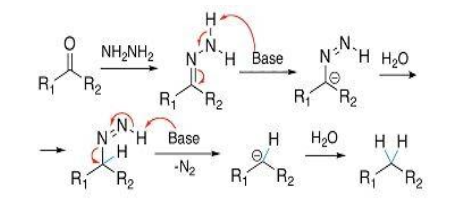
Illustration-
Given reaction is,
$C{{H}_{3}}CHO+N{{H}_{2}}.N{{H}_{2}}\to A\xrightarrow{B}C{{H}_{3}}C{{H}_{3}}+{{N}_{2}}$
Solving this by the mechanism of Wolff-Kishner reaction we get,
1. When acetaldehyde group reacts with hydrazine, hydrazone is formed i.e. $C{{H}_{3}}CH=NN{{H}_{2}}$
2. $C{{H}_{3}}CH=NN{{H}_{2}}$ reacts with strong base (here, sodium ethoxide) to give corresponding ethane.
Thus, A and B in the given reaction is $C{{H}_{3}}CH=NN{{H}_{2}},{{C}_{2}}{{H}_{5}}ONa$ respectively.
Therefore option (A) is correct.
Note: This reaction requires highly basic conditions. Thus, it is impossible for the base sensitive substrates. Also, in some cases due to steric hindrance in the carbonyl group, formation of hydrazone will not occur.
Option (C) and (D) would never be the answer as we require a strong base for the reaction and these options have ethanol which is unpreferable.
Complete step by step solution:
The above stated reaction is none other than Wolff-Kishner reduction reaction.
Let us see about Wolff-Kishner reduction at first,
Wolff-Kishner reduction reaction-
This is also known as the nucleophilic addition of hydrazine. It is an organic redox reaction.
Aldehydes or ketones are converted to hydrazine derivatives when reacted with hydrazine. This then reacts with a strong base and heat is provided to form alkane as a product.
In short aldehydes or ketones are converted to corresponding alkanes by this reduction reaction. Mostly, the base used here will be strong so that it would make reduction easy.
Mechanism-
1. Condensation of hydrazine with aldehyde or ketone
2. Formation of hydrazone
3. Deprotonation of hydrazone by strong base
4. Formation of alkyl diimide as an intermediate
5. Formation of alkyl anion by the loss of ${{N}_{2}}$ from alkyl diimide
6. Protonation of alkyl anion by solvent to give alkane.
Illustration-
Given reaction is,
$C{{H}_{3}}CHO+N{{H}_{2}}.N{{H}_{2}}\to A\xrightarrow{B}C{{H}_{3}}C{{H}_{3}}+{{N}_{2}}$
Solving this by the mechanism of Wolff-Kishner reaction we get,
1. When acetaldehyde group reacts with hydrazine, hydrazone is formed i.e. $C{{H}_{3}}CH=NN{{H}_{2}}$
2. $C{{H}_{3}}CH=NN{{H}_{2}}$ reacts with strong base (here, sodium ethoxide) to give corresponding ethane.
Thus, A and B in the given reaction is $C{{H}_{3}}CH=NN{{H}_{2}},{{C}_{2}}{{H}_{5}}ONa$ respectively.
Therefore option (A) is correct.
Note: This reaction requires highly basic conditions. Thus, it is impossible for the base sensitive substrates. Also, in some cases due to steric hindrance in the carbonyl group, formation of hydrazone will not occur.
Option (C) and (D) would never be the answer as we require a strong base for the reaction and these options have ethanol which is unpreferable.
Recently Updated Pages
Master Class 12 Business Studies: Engaging Questions & Answers for Success

Master Class 12 Chemistry: Engaging Questions & Answers for Success
Master Class 12 Biology: Engaging Questions & Answers for Success
Class 12 Question and Answer - Your Ultimate Solutions Guide
Master Class 11 English: Engaging Questions & Answers for Success
Master Class 11 Maths: Engaging Questions & Answers for Success
Trending doubts
Which is more stable and why class 12 chemistry CBSE
Which are the Top 10 Largest Countries of the World?
Draw a labelled sketch of the human eye class 12 physics CBSE
Differentiate between homogeneous and heterogeneous class 12 chemistry CBSE
What are the major means of transport Explain each class 12 social science CBSE
Sulphuric acid is known as the king of acids State class 12 chemistry CBSE