




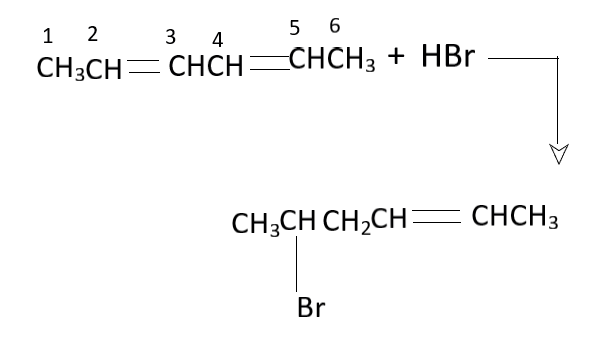
In the following reaction, addition is called
A. $2,3$ addition
B. $1,2$ addition
C. $1,4$ addition-addition
D. $4,5$ addition
Answer
 Verified
576.6k+ views
Hint:As the bonds in alkene residue breaks there is the formation of a partial positive charge $\partial \left( + \right)$ and the partial negative charge $\partial \left( - \right)$. The electrophilic or nucleophilic attack of the reacting elements with the organic molecule takes place based on this charge.
Complete step by step answer:
Due to the action of the \[HBr\] on the residue with the double bonded structure, the $\pi $ bond breaks and there is the formation of a partial positive charge on one of the carbon, while there is the formation of a partial negative charge on the other carbon. The electrophile is attracted to the partial negative charge while the nucleophile is attracted to the partial positive charge. The \[HBr\] is the reactant which is converted to ${H^ + }$ and $B{r^ - }$ ions. The ${2^o}$ carbocation is the one which has stability while the terminal carbanion has is the structure. This is why the partial positive charge is formed in the carbon number $2$ while the partial negative charge is formed on the carbon number $1$ of the given molecule. The nucleophile $B{r^ - }$ is associated with the partial positive charge, which is why the linkage of bromide occurs at the carbon number $2$. The hydrogen ${H^{{ + ^{}}}}$ is the electrophile which bonds at the carbon with the partially negative charge. Therefore, a simple addition of the components of \[HBr\] takes place and this is known as $1,2$ addition. This is because the addition of the ions takes place in the carbon numbers $1$ and $2$ of the organic molecule.
So the correct answer for the given question is option B.
Note:
The addition reaction is the process in which one of the reactant components is added to the other molecule. The addition of specific components of this reactant is possible for the formation of a new molecule as the product with this association.
Complete step by step answer:
Due to the action of the \[HBr\] on the residue with the double bonded structure, the $\pi $ bond breaks and there is the formation of a partial positive charge on one of the carbon, while there is the formation of a partial negative charge on the other carbon. The electrophile is attracted to the partial negative charge while the nucleophile is attracted to the partial positive charge. The \[HBr\] is the reactant which is converted to ${H^ + }$ and $B{r^ - }$ ions. The ${2^o}$ carbocation is the one which has stability while the terminal carbanion has is the structure. This is why the partial positive charge is formed in the carbon number $2$ while the partial negative charge is formed on the carbon number $1$ of the given molecule. The nucleophile $B{r^ - }$ is associated with the partial positive charge, which is why the linkage of bromide occurs at the carbon number $2$. The hydrogen ${H^{{ + ^{}}}}$ is the electrophile which bonds at the carbon with the partially negative charge. Therefore, a simple addition of the components of \[HBr\] takes place and this is known as $1,2$ addition. This is because the addition of the ions takes place in the carbon numbers $1$ and $2$ of the organic molecule.
So the correct answer for the given question is option B.
Note:
The addition reaction is the process in which one of the reactant components is added to the other molecule. The addition of specific components of this reactant is possible for the formation of a new molecule as the product with this association.
Recently Updated Pages
In a plane electromagnetic wave the electric field class 12 physics CBSE

A plane electromagnetic wave travels in vacuum along class 12 physics CBSE
Basicity of sulphurous acid and sulphuric acid are
The magnetic field in a plane electromagnetic wave class 11 physics CBSE
Master Class 12 English: Engaging Questions & Answers for Success
Master Class 12 Social Science: Engaging Questions & Answers for Success
Trending doubts
Which are the Top 10 Largest Countries of the World?
Draw a labelled sketch of the human eye class 12 physics CBSE
Which state in the country is at the forefront in controlling class 12 social science CBSE
Mention the role of cyanobacteria as a biofertiliz class 12 biology ICSE
Where is the largest hydroelectric power station located class 12 biology CBSE
Which country did Danny Casey play for class 12 english CBSE