




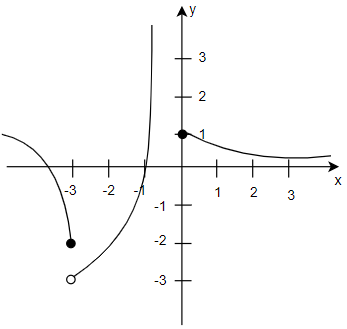
In the following graph how do you determine the value of c such that \[\displaystyle \lim_{x \to c}f\left( x \right)\] exists?
Answer
 Verified
595.2k+ views
Hint: Here we have to determine the value of c such that \[\displaystyle \lim_{x \to c}f\left( x \right)\] exists. We can see that in the graph the function \[f\left( x \right)\] is defined when x = -2 but the value which \[f\left( x \right)\] will approach as x gets closer to -3 from the left is different from the value as it approaches from the right. We can apply the limits by looking at the graph and find the c values.
Complete step by step solution:
Here we have to determine the value of c such that \[\displaystyle \lim_{x \to c}f\left( x \right)\] exists.
We can see that in the graph the function \[f\left( x \right)\] is defined when x = -2 but the value which \[f\left( x \right)\] will approach as x gets closer to -3 from the left is different from the value as it approaches from the right.
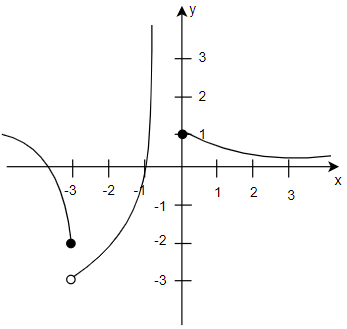
We can now analyse the graph, as x approaches -3 from left \[f\left( x \right)\] approaches (negative 2) however as x approaches -3 from the right \[f\left( x \right)\] approaches (negative 3)
We can now apply the limits, we get
\[\begin{align}
& \Rightarrow \displaystyle \lim_{x \to -{{3}^{+}}}=-3 \\
& \Rightarrow \displaystyle \lim_{x \to -{{3}^{-}}}=-2 \\
\end{align}\]
Where the limit does not exist at x = -3.
We can now see that, in the same way when x tends to 0, we get
\[\begin{align}
& \Rightarrow \displaystyle \lim_{x \to {{0}^{+}}}=1 \\
& \Rightarrow \displaystyle \lim_{x \to {{0}^{-}}}=+\infty \\
\end{align}\]
So, clearly we can assume that c = -3 or c = 0, but the limit does not exist.
Note: here we have already given a graph, from which we can analyse the numbers to be found and we can assume the limit values to find the value for what we have been asked for. We should also know how to apply the limit concept to solve these types.
Complete step by step solution:
Here we have to determine the value of c such that \[\displaystyle \lim_{x \to c}f\left( x \right)\] exists.
We can see that in the graph the function \[f\left( x \right)\] is defined when x = -2 but the value which \[f\left( x \right)\] will approach as x gets closer to -3 from the left is different from the value as it approaches from the right.
We can now analyse the graph, as x approaches -3 from left \[f\left( x \right)\] approaches (negative 2) however as x approaches -3 from the right \[f\left( x \right)\] approaches (negative 3)
We can now apply the limits, we get
\[\begin{align}
& \Rightarrow \displaystyle \lim_{x \to -{{3}^{+}}}=-3 \\
& \Rightarrow \displaystyle \lim_{x \to -{{3}^{-}}}=-2 \\
\end{align}\]
Where the limit does not exist at x = -3.
We can now see that, in the same way when x tends to 0, we get
\[\begin{align}
& \Rightarrow \displaystyle \lim_{x \to {{0}^{+}}}=1 \\
& \Rightarrow \displaystyle \lim_{x \to {{0}^{-}}}=+\infty \\
\end{align}\]
So, clearly we can assume that c = -3 or c = 0, but the limit does not exist.
Note: here we have already given a graph, from which we can analyse the numbers to be found and we can assume the limit values to find the value for what we have been asked for. We should also know how to apply the limit concept to solve these types.
Recently Updated Pages
Master Class 11 Social Science: Engaging Questions & Answers for Success

Master Class 11 English: Engaging Questions & Answers for Success
Master Class 11 Accountancy: Engaging Questions & Answers for Success
Master Class 11 Physics: Engaging Questions & Answers for Success
Master Class 11 Computer Science: Engaging Questions & Answers for Success
Master Class 11 Business Studies: Engaging Questions & Answers for Success
Trending doubts
One Metric ton is equal to kg A 10000 B 1000 C 100 class 11 physics CBSE
Find the value of the expression given below sin 30circ class 11 maths CBSE
Draw a diagram of nephron and explain its structur class 11 biology CBSE
10 examples of friction in our daily life
Proton was discovered by A Thomson B Rutherford C Chadwick class 11 chemistry CBSE
The teeth used for biting and cutting food are called class 11 biology CBSE