




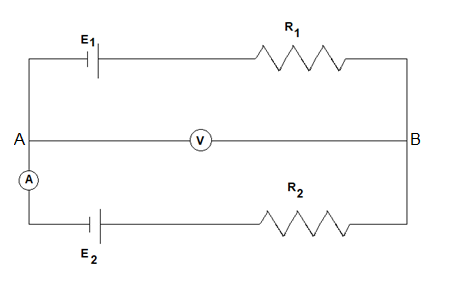
In the following diagram (fig) if the ammeter reading is zero, then the voltmeter reading will be
(This question has multiple correct options)
A. Zero
B. ${{E}_{1}}+{{E}_{2}}$
C. ${{E}_{1}}$
D. ${{E}_{2}}$
Answer
 Verified
627.9k+ views
Hint: Assume that the voltmeter and the ammeter are ideal. Hence, they will not be involved in the circuit. The voltmeter will measure the potential difference across the points A and B. Make use of Ohm’s law and Kirchhoff’s voltage law
Formula used:
V=iR
Complete step by step answer:
The given circuit contains two batteries or e.m.f (electro-motive-force) sources. That is ${{E}_{1}}$ and ${{E}_{2}}$. Let us assume that the ammeter and voltmeter that are connected in the circuit are ideal.
The voltmeter will measure the voltage or potential difference across the points A and B. remember that a voltmeter is always connected in parallel.
The ammeter will measure the value of current that is following in the section (wire) where it is connected. An ammeter is always connected in series connection.
Now, it is given that the ammeter reads current of 0A. This means that there is no current flowing through the ammeter.
Since, the main circuit contains only one loop, zero current in ammeter means no current is passing in the entire loop. Therefore, current in the circuit is zero.
By Ohm’s law we know that V=iR, where V is the potential difference across the resistor, i is the current flowing through the resistor and R is the resistance of the resistor.
Now, apply Kirchhoff’s voltage law for the loop from point A in clockwise direction.
(According to Kirchhoff’s voltage law the net potential difference in a loop is zero. This means that if we go round the loop from a point, calculating the total potential difference in the circuit and come back at the same point, the net potential difference will be zero.)
Therefore, we get
${{E}_{1}}-i{{R}_{1}}-i{{R}_{2}}-{{E}_{2}}=0$.
Here, i=0.
$\Rightarrow {{E}_{1}}-0.{{R}_{1}}-0.{{R}_{2}}-{{E}_{2}}=0\Rightarrow {{E}_{1}}-{{E}_{2}}=0$.
Therefore, ${{E}_{1}}={{E}_{2}}$.
That means the potential difference across points A and B is equal to ${{E}_{1}}={{E}_{2}}$.
Therefore, the voltmeter will read a number, which is equal to ${{E}_{1}}$and ${{E}_{2}}$.
Hence, the correct options are C and D.
Note: Points to remember:
(i) When we go from the negative terminal to a positive terminal of a battery, the potential increases. And if we go from positive to negative terminal, the potential decreases.
(i) There is always a potential drop across a resistor, if we go in the direction of the current. That means the potential decreases across the resistor.
Also not that we have assumed that the voltmeter and ammeter used are ideal. The meaning of this is that they will not be involved in the main circuit. Meaning, the voltmeter will draw any current not it and the ammeter will not create any potential difference across it. However, this does not happen in real scenarios.
Formula used:
V=iR
Complete step by step answer:
The given circuit contains two batteries or e.m.f (electro-motive-force) sources. That is ${{E}_{1}}$ and ${{E}_{2}}$. Let us assume that the ammeter and voltmeter that are connected in the circuit are ideal.
The voltmeter will measure the voltage or potential difference across the points A and B. remember that a voltmeter is always connected in parallel.
The ammeter will measure the value of current that is following in the section (wire) where it is connected. An ammeter is always connected in series connection.
Now, it is given that the ammeter reads current of 0A. This means that there is no current flowing through the ammeter.
Since, the main circuit contains only one loop, zero current in ammeter means no current is passing in the entire loop. Therefore, current in the circuit is zero.
By Ohm’s law we know that V=iR, where V is the potential difference across the resistor, i is the current flowing through the resistor and R is the resistance of the resistor.
Now, apply Kirchhoff’s voltage law for the loop from point A in clockwise direction.
(According to Kirchhoff’s voltage law the net potential difference in a loop is zero. This means that if we go round the loop from a point, calculating the total potential difference in the circuit and come back at the same point, the net potential difference will be zero.)
Therefore, we get
${{E}_{1}}-i{{R}_{1}}-i{{R}_{2}}-{{E}_{2}}=0$.
Here, i=0.
$\Rightarrow {{E}_{1}}-0.{{R}_{1}}-0.{{R}_{2}}-{{E}_{2}}=0\Rightarrow {{E}_{1}}-{{E}_{2}}=0$.
Therefore, ${{E}_{1}}={{E}_{2}}$.
That means the potential difference across points A and B is equal to ${{E}_{1}}={{E}_{2}}$.
Therefore, the voltmeter will read a number, which is equal to ${{E}_{1}}$and ${{E}_{2}}$.
Hence, the correct options are C and D.
Note: Points to remember:
(i) When we go from the negative terminal to a positive terminal of a battery, the potential increases. And if we go from positive to negative terminal, the potential decreases.
(i) There is always a potential drop across a resistor, if we go in the direction of the current. That means the potential decreases across the resistor.
Also not that we have assumed that the voltmeter and ammeter used are ideal. The meaning of this is that they will not be involved in the main circuit. Meaning, the voltmeter will draw any current not it and the ammeter will not create any potential difference across it. However, this does not happen in real scenarios.
Recently Updated Pages
Master Class 12 Business Studies: Engaging Questions & Answers for Success

Master Class 12 Biology: Engaging Questions & Answers for Success
Master Class 12 Chemistry: Engaging Questions & Answers for Success
Class 12 Question and Answer - Your Ultimate Solutions Guide
Master Class 11 Social Science: Engaging Questions & Answers for Success
Master Class 11 English: Engaging Questions & Answers for Success
Trending doubts
Which is more stable and why class 12 chemistry CBSE
Which are the Top 10 Largest Countries of the World?
Draw a labelled sketch of the human eye class 12 physics CBSE
Differentiate between homogeneous and heterogeneous class 12 chemistry CBSE
What are the major means of transport Explain each class 12 social science CBSE
Sulphuric acid is known as the king of acids State class 12 chemistry CBSE