




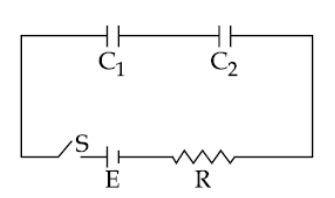
In the following circuit, the switch S is closed at t = 0. The charge on the capacitor
C1 as a function of time will be given by $\left( {{C_{eq}} = \dfrac{{{C_1}{C_2}}}{{{C_1} + {C_2}}}} \right)$.
A $C_{eq}E[1-exp(-t/RC_{eq})]$
B $C_1E[1-exp(-t/RC_1)]$
C $C_2E[1-exp(-t/RC_2)]$
D $C_{eq}A exp(-t/RC_{eq})$
Answer
 Verified
569.1k+ views
Hint: Capacitance is the ratio of the change in electric charge of a system to the corresponding change in its electric potential,$C = \dfrac{Q}{\varepsilon }$. Here charge Q changes with time and for an RC circuit can be written as Q(t)\[ = {Q_0}(1 - {e^{ - \dfrac{t}{\tau }}})\].
Complete step by step answer:
The figure shows a series RC circuit with a battery, resistor, and capacitors in series. The capacitor is initially uncharged, but starts to charge when the switch is closed. Initially the potential difference across the resistor is the battery emf, but that steadily drops (as does the current) as the potential difference across the capacitor increases.
Applying Kirchoff's loop rule:
$\varepsilon - IR - \dfrac{Q}{{{C_{eq}}}} = 0$
As Q increases I decreases, but Q changes because there is a current I. As the current decreases Q changes more slowly.
$I = \dfrac{{dQ}}{{dt}}$, so the equation can be written:
$\varepsilon - \dfrac{{dQ}}{{dt}}R - \dfrac{Q}{{{C_{eq}}}} = 0$
This is a differential equation that can be solved for Q as a function of time. The solution is
Q(t)\[ = {Q_0}(1 - {e^{ - \dfrac{t}{\tau }}})\]
where ${Q_0} = {C_{eq}}\varepsilon $ and the time constant $\tau = R{C_{eq}}$.
Therefore, $Q(t) = \varepsilon {C_{eq}}(1 - {e^{ - \dfrac{t}{{R{C_{eq}}}}}})$
Therefore, option A is the correct answer.
Note:
Students should know to write the time varying equation of charge for a series RC circuit. The differential equation should be solved carefully without any mathematical mistake to avoid error in answer.Here $\tau $is the time constant of the RC circuit and is defined as the time required to charge the capacitor, through the resistance, by 63.2 percent of the difference between the initial value and final value or discharge the capacitor to 36.8 percent.
Complete step by step answer:
The figure shows a series RC circuit with a battery, resistor, and capacitors in series. The capacitor is initially uncharged, but starts to charge when the switch is closed. Initially the potential difference across the resistor is the battery emf, but that steadily drops (as does the current) as the potential difference across the capacitor increases.
Applying Kirchoff's loop rule:
$\varepsilon - IR - \dfrac{Q}{{{C_{eq}}}} = 0$
As Q increases I decreases, but Q changes because there is a current I. As the current decreases Q changes more slowly.
$I = \dfrac{{dQ}}{{dt}}$, so the equation can be written:
$\varepsilon - \dfrac{{dQ}}{{dt}}R - \dfrac{Q}{{{C_{eq}}}} = 0$
This is a differential equation that can be solved for Q as a function of time. The solution is
Q(t)\[ = {Q_0}(1 - {e^{ - \dfrac{t}{\tau }}})\]
where ${Q_0} = {C_{eq}}\varepsilon $ and the time constant $\tau = R{C_{eq}}$.
Therefore, $Q(t) = \varepsilon {C_{eq}}(1 - {e^{ - \dfrac{t}{{R{C_{eq}}}}}})$
Therefore, option A is the correct answer.
Note:
Students should know to write the time varying equation of charge for a series RC circuit. The differential equation should be solved carefully without any mathematical mistake to avoid error in answer.Here $\tau $is the time constant of the RC circuit and is defined as the time required to charge the capacitor, through the resistance, by 63.2 percent of the difference between the initial value and final value or discharge the capacitor to 36.8 percent.
Recently Updated Pages
Master Class 12 Economics: Engaging Questions & Answers for Success

Master Class 12 Physics: Engaging Questions & Answers for Success
Master Class 12 English: Engaging Questions & Answers for Success
Master Class 12 Social Science: Engaging Questions & Answers for Success
Master Class 12 Maths: Engaging Questions & Answers for Success
Master Class 12 Business Studies: Engaging Questions & Answers for Success
Trending doubts
Which are the Top 10 Largest Countries of the World?
What are the major means of transport Explain each class 12 social science CBSE
Draw a labelled sketch of the human eye class 12 physics CBSE
Why cannot DNA pass through cell membranes class 12 biology CBSE
Differentiate between insitu conservation and exsitu class 12 biology CBSE
Draw a neat and well labeled diagram of TS of ovary class 12 biology CBSE