




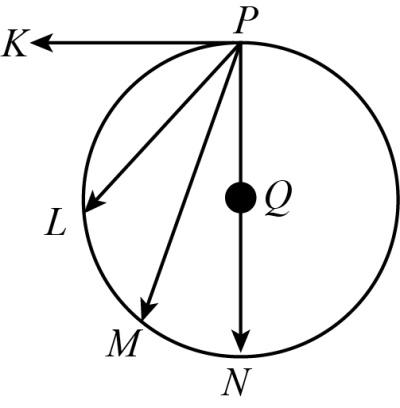
In the figure the charge Q is at the center of the circle. Work done is maximum when another charge is taken from point P to
A P
B K
C M
D N
Answer
 Verified
578.1k+ views
Hint: This question is based on the equipotential surface. The equipotential surface is the locus of points in which all the potential remains the same. So, we can find the maximum work where the point is outside the equipotential surface.
Complete step by step answer:
It is given in the question that the charge Q is placed at the center of the circle. So, the charge forms an equipotential surface around it. On the equipotential surface, there are three points L, M, N lying on the electric field. We have to find the maximum work done when the charge is taking from the point P.
Now, the expression of the equipotential surface is given as,
$v = \dfrac{{kQ}}{r}$
Here, $V$ is the electric potential, $Q$ is the charge of magnitude and $r$ is the point distance away from the point charge.
On an equipotential surface, the potential remains the same. If we move from point P to point L the potential remains the same, similarly for point M and N the potential remains the same because the points lie on the equipotential surface.
So, the work done becomes zero when we move from P to points L, M and N.
Now, if we move from point P to point K, then the work done becomes positive. The potential at point K is less than the potential at point P. So, the work done has become positive.
Thus, the correct option is (B).
Note:
These types of questions can be answered with basic understanding of the situation. Since any gravity is not present in outer space the surface tension will be an unbalanced force. Students should be able to make this kind of assertion and then the question can be easily solved by them.
Complete step by step answer:
It is given in the question that the charge Q is placed at the center of the circle. So, the charge forms an equipotential surface around it. On the equipotential surface, there are three points L, M, N lying on the electric field. We have to find the maximum work done when the charge is taking from the point P.
Now, the expression of the equipotential surface is given as,
$v = \dfrac{{kQ}}{r}$
Here, $V$ is the electric potential, $Q$ is the charge of magnitude and $r$ is the point distance away from the point charge.
On an equipotential surface, the potential remains the same. If we move from point P to point L the potential remains the same, similarly for point M and N the potential remains the same because the points lie on the equipotential surface.
So, the work done becomes zero when we move from P to points L, M and N.
Now, if we move from point P to point K, then the work done becomes positive. The potential at point K is less than the potential at point P. So, the work done has become positive.
Thus, the correct option is (B).
Note:
These types of questions can be answered with basic understanding of the situation. Since any gravity is not present in outer space the surface tension will be an unbalanced force. Students should be able to make this kind of assertion and then the question can be easily solved by them.
Recently Updated Pages
Master Class 12 Economics: Engaging Questions & Answers for Success

Master Class 12 Physics: Engaging Questions & Answers for Success
Master Class 12 English: Engaging Questions & Answers for Success
Master Class 12 Social Science: Engaging Questions & Answers for Success
Master Class 12 Maths: Engaging Questions & Answers for Success
Master Class 12 Business Studies: Engaging Questions & Answers for Success
Trending doubts
Which are the Top 10 Largest Countries of the World?
What are the major means of transport Explain each class 12 social science CBSE
Draw a labelled sketch of the human eye class 12 physics CBSE
Why cannot DNA pass through cell membranes class 12 biology CBSE
Differentiate between insitu conservation and exsitu class 12 biology CBSE
Draw a neat and well labeled diagram of TS of ovary class 12 biology CBSE