




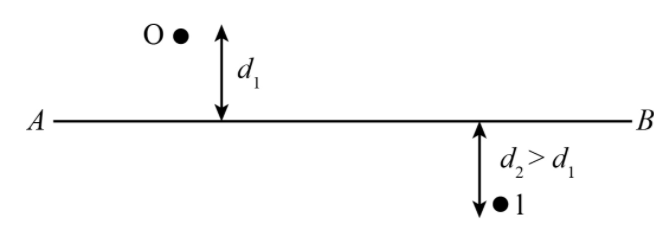
In the figure shown, the image of a real object is formed at point I.AB is the principal axis of the mirror. The mirror must be
A. Concave and placed towards right I
B. Concave and placed towards left I
C. Convex and placed towards right of I
D. Convex and placed towards left of I
Answer
 Verified
608.4k+ views
Hint: This question is based on the imaging from any of the mirrors. You need to figure out the answer by analyzing the image formed.The image formed doesn't depend on the object's position.
Complete step by step answer:
In this question, the image is forming below the line, so it is inverted, and the length from the midline is also less than the object distance from the midline; then, by using the concave mirror analysis, this question can be solved further.
There are two types of mirror exist, i.e., concave mirror and convex mirror. The image formed by the convex mirror is virtual and always smaller than the object's size, and the image formed doesn't depend on the object's position. While the concave mirror has different properties than the convex mirror, the image can be real or virtual, depending upon the object position.
In the given question, we can clearly see that the image formed is inverted, and it is magnified as well, so the mirror must be concave because the convex mirror doesn't form the real image. If we place the mirror left to the I, then the magnification is less than one; it means that the mirror cant is placed on the left of the I.So, it is a place between the O and I.
Convex and concave mirrors differ by the reflecting surfaces, and when the reflecting surface is out part of the curve type, it is called convex, and when the reflecting surface is inside the curved part, it is called a concave mirror. The mirrors work on laws of reflection. The law of reflection says that when a ray of falls on the mirror reflects back, the incident and reflected angle will be equal
Note:
In this question, we determined the mirror's place where it is situated to get the image as in the problem. You may go wrong here in analysing the image property.
The concave mirror has different properties than the convex mirror, the image can be real or virtual, depending upon the object position.
Complete step by step answer:
In this question, the image is forming below the line, so it is inverted, and the length from the midline is also less than the object distance from the midline; then, by using the concave mirror analysis, this question can be solved further.
There are two types of mirror exist, i.e., concave mirror and convex mirror. The image formed by the convex mirror is virtual and always smaller than the object's size, and the image formed doesn't depend on the object's position. While the concave mirror has different properties than the convex mirror, the image can be real or virtual, depending upon the object position.
In the given question, we can clearly see that the image formed is inverted, and it is magnified as well, so the mirror must be concave because the convex mirror doesn't form the real image. If we place the mirror left to the I, then the magnification is less than one; it means that the mirror cant is placed on the left of the I.So, it is a place between the O and I.
Convex and concave mirrors differ by the reflecting surfaces, and when the reflecting surface is out part of the curve type, it is called convex, and when the reflecting surface is inside the curved part, it is called a concave mirror. The mirrors work on laws of reflection. The law of reflection says that when a ray of falls on the mirror reflects back, the incident and reflected angle will be equal
Note:
In this question, we determined the mirror's place where it is situated to get the image as in the problem. You may go wrong here in analysing the image property.
The concave mirror has different properties than the convex mirror, the image can be real or virtual, depending upon the object position.
Recently Updated Pages
Master Class 12 Economics: Engaging Questions & Answers for Success

Master Class 12 English: Engaging Questions & Answers for Success
Master Class 12 Social Science: Engaging Questions & Answers for Success
Master Class 12 Maths: Engaging Questions & Answers for Success
Master Class 12 Physics: Engaging Questions & Answers for Success
Master Class 12 Business Studies: Engaging Questions & Answers for Success
Trending doubts
Which are the Top 10 Largest Countries of the World?
Draw a labelled sketch of the human eye class 12 physics CBSE
Differentiate between homogeneous and heterogeneous class 12 chemistry CBSE
Why is the cell called the structural and functional class 12 biology CBSE
Draw ray diagrams each showing i myopic eye and ii class 12 physics CBSE
Which is the correct genotypic ratio of mendel dihybrid class 12 biology CBSE