




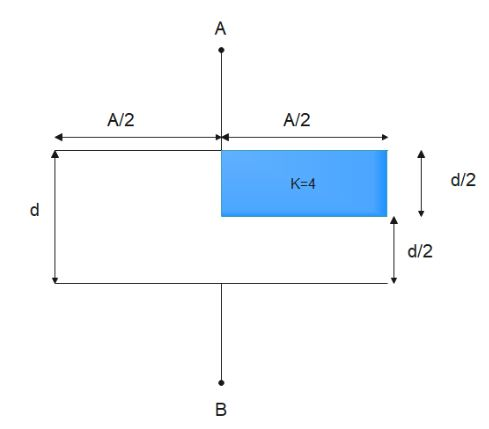
In the figure shown find the equivalent capacitance between terminals $A$ and $B$ . The letters have their usual meaning. Capacitance is $\dfrac{{x{\varepsilon _o}A}}{{10d}}$. Then $x$ is ?
Answer
 Verified
551.4k+ views
Hint: This question utilizes the concept of capacitance and electric circuits. We can easily find the total capacitance by first separating the two capacitors and then using the capacitor formula to find the total capacitance
Formulae used:
$C = \dfrac{{{\varepsilon _o}A}}{d}$
where $C$ is the capacitance of the parallel plate capacitor, ${\varepsilon _o}$ is the absolute permittivity of the dielectric material being used, $A$ is the area of the plate of the capacitor and $d$ is the distance between the two plates.
When a dielectric with dielectric constant $\kappa $ is introduced in a system, the capacitance changes to $C = \dfrac{{\kappa {\varepsilon _o}A}}{d}$.
Complete step by step answer:
We can bifurcate the complex capacitor into two parts like in the given figure.
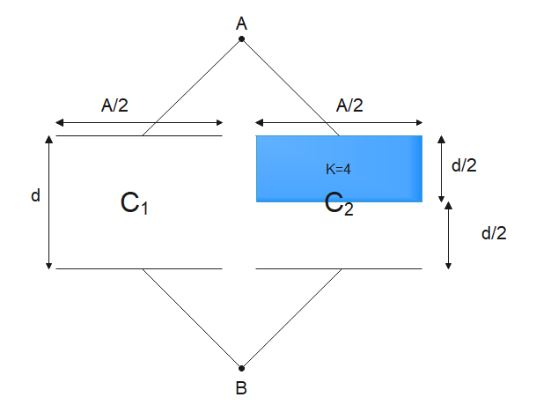
We can see that the two capacitors are in parallel configuration to each other.Now, we find the capacitance of each capacitor individually. For \[{C_1}\] , we have
\[\Rightarrow {C_1} = \dfrac{{{\varepsilon _o}\dfrac{A}{2}}}{d} \\
\Rightarrow {C_1} = \dfrac{{{\varepsilon _o}A}}{{2d}} \\ \]
For ${C_2}$ , we divide the capacitor into two individual capacitors connected in series and label them as ${C_3}$ and ${C_4}$.
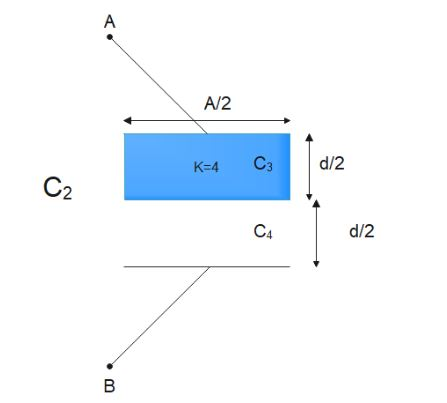
Now, for ${C_3}$
$\Rightarrow {C_3} = \dfrac{{\kappa {\varepsilon _o}\dfrac{A}{2}}}{{\dfrac{d}{2}}} \\
\Rightarrow {C_3} = \dfrac{{\kappa {\varepsilon _o}A}}{d} \\ $
And for ${C_4}$
$\Rightarrow {C_4} = \dfrac{{{\varepsilon _o}\dfrac{A}{2}}}{{\dfrac{d}{2}}} \\
\Rightarrow {C_4} = \dfrac{{{\varepsilon _o}A}}{d} \\ $
Now, since they are in series, we have
$ \Rightarrow \dfrac{1}{{{C_2}}} = \dfrac{1}{{{C_3}}} + \dfrac{1}{{{C_4}}} \\
\Rightarrow \dfrac{1}{{{C_2}}} = \dfrac{d}{{\kappa {\varepsilon _o}A}} + \dfrac{d}{{{\varepsilon _o}A}} \\
\Rightarrow \dfrac{1}{{{C_2}}} = \dfrac{{d + \kappa d}}{{\kappa {\varepsilon _o}A}} \\
\Rightarrow {C_2} = \dfrac{{k{\varepsilon _o}A}}{{d + \kappa d}} \\ $
We know from the question that $\kappa = 4$. Thus,
$ \Rightarrow {C_2} = \dfrac{{4{\varepsilon _o}A}}{{5d}}$
Now, since ${C_1}$ and ${C_2}$ are in parallel, we get
$\Rightarrow C = {C_1} + {C_2} \\
\Rightarrow C = \dfrac{{{\varepsilon _o}A}}{{2d}} + \dfrac{{4{\varepsilon _o}A}}{{5d}} \\
\Rightarrow C = \dfrac{{5{\varepsilon _o}A + 8{\varepsilon _o}A}}{{10d}} \\
\therefore C = \dfrac{{13{\varepsilon _o}A}}{{10d}} $
Therefore, the value of $x$ is $13$.
Note: Many students might commit the mistake of solving the whole capacitor as a single entity. This would result in silly mistakes and might even fetch you the wrong answer.Hence, whenever you get a complex question, first break it down into smaller pieces and then solve it.
Formulae used:
$C = \dfrac{{{\varepsilon _o}A}}{d}$
where $C$ is the capacitance of the parallel plate capacitor, ${\varepsilon _o}$ is the absolute permittivity of the dielectric material being used, $A$ is the area of the plate of the capacitor and $d$ is the distance between the two plates.
When a dielectric with dielectric constant $\kappa $ is introduced in a system, the capacitance changes to $C = \dfrac{{\kappa {\varepsilon _o}A}}{d}$.
Complete step by step answer:
We can bifurcate the complex capacitor into two parts like in the given figure.
We can see that the two capacitors are in parallel configuration to each other.Now, we find the capacitance of each capacitor individually. For \[{C_1}\] , we have
\[\Rightarrow {C_1} = \dfrac{{{\varepsilon _o}\dfrac{A}{2}}}{d} \\
\Rightarrow {C_1} = \dfrac{{{\varepsilon _o}A}}{{2d}} \\ \]
For ${C_2}$ , we divide the capacitor into two individual capacitors connected in series and label them as ${C_3}$ and ${C_4}$.
Now, for ${C_3}$
$\Rightarrow {C_3} = \dfrac{{\kappa {\varepsilon _o}\dfrac{A}{2}}}{{\dfrac{d}{2}}} \\
\Rightarrow {C_3} = \dfrac{{\kappa {\varepsilon _o}A}}{d} \\ $
And for ${C_4}$
$\Rightarrow {C_4} = \dfrac{{{\varepsilon _o}\dfrac{A}{2}}}{{\dfrac{d}{2}}} \\
\Rightarrow {C_4} = \dfrac{{{\varepsilon _o}A}}{d} \\ $
Now, since they are in series, we have
$ \Rightarrow \dfrac{1}{{{C_2}}} = \dfrac{1}{{{C_3}}} + \dfrac{1}{{{C_4}}} \\
\Rightarrow \dfrac{1}{{{C_2}}} = \dfrac{d}{{\kappa {\varepsilon _o}A}} + \dfrac{d}{{{\varepsilon _o}A}} \\
\Rightarrow \dfrac{1}{{{C_2}}} = \dfrac{{d + \kappa d}}{{\kappa {\varepsilon _o}A}} \\
\Rightarrow {C_2} = \dfrac{{k{\varepsilon _o}A}}{{d + \kappa d}} \\ $
We know from the question that $\kappa = 4$. Thus,
$ \Rightarrow {C_2} = \dfrac{{4{\varepsilon _o}A}}{{5d}}$
Now, since ${C_1}$ and ${C_2}$ are in parallel, we get
$\Rightarrow C = {C_1} + {C_2} \\
\Rightarrow C = \dfrac{{{\varepsilon _o}A}}{{2d}} + \dfrac{{4{\varepsilon _o}A}}{{5d}} \\
\Rightarrow C = \dfrac{{5{\varepsilon _o}A + 8{\varepsilon _o}A}}{{10d}} \\
\therefore C = \dfrac{{13{\varepsilon _o}A}}{{10d}} $
Therefore, the value of $x$ is $13$.
Note: Many students might commit the mistake of solving the whole capacitor as a single entity. This would result in silly mistakes and might even fetch you the wrong answer.Hence, whenever you get a complex question, first break it down into smaller pieces and then solve it.
Recently Updated Pages
Which of the following graphs shows the variation of class 12 physics CBSE

Draw a labelled diagram of the human male reproductive class 12 biology CBSE
Describe the experiment to compare the emf of two cells class 12 physics CBSE
What is standard hydrogen electrode
What is conventional current and electric current class 12 physics CBSE
2Bromopentane is treated with an alcoholic KOH solution class 12 chemistry CBSE
Trending doubts
Draw a labelled sketch of the human eye class 12 physics CBSE
Which are the Top 10 Largest Countries of the World?
Differentiate between homogeneous and heterogeneous class 12 chemistry CBSE
Draw ray diagrams each showing i myopic eye and ii class 12 physics CBSE
Which is the correct genotypic ratio of mendel dihybrid class 12 biology CBSE
What is the Full Form of PVC, PET, HDPE, LDPE, PP and PS ?