




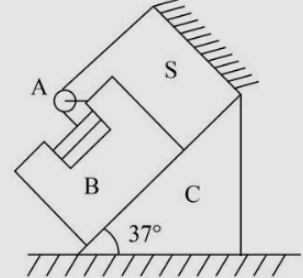
In the figure shown C is a fixed wedge. A block B is kept on the inclined surface of the wedge C. Another block A is inserted in a slot in the block B as shown in figure. A light inextensible string passes over a light pulley which is fixed to the block B through a light rod. One end of the string is fixed and the other end of the string is fixed to A.S is a fixed support on the wedge. All the surfaces are smooth. Masses of A and B are the same. Then the magnitude of acceleration of A is \[\dfrac{{\sqrt x }}{3}\;{\rm{m/}}{{\rm{s}}^{\rm{2}}}\]. Then x is \[\left( {\sin 37^\circ = 3/5} \right)\].
Answer
 Verified
590.4k+ views
Hint:The above problem can be resolved by applying the equilibrium condition for the forces acting on the block A and block B. The block A and block B are attached with a string, on which the tension force can be applied as the reaction force. Moreover, the equations for the forces at A and B compared to calculate the value of net acceleration at A
Complete step by step answer:
Apply the string constraint relation to relation between the acceleration of the block A and block B as,
\[{a_A} + {a_B} = 0\]
Here, \[{a_A}\] and \[{a_B}\] are the acceleration of block A and B. As, the magnitude of acceleration for the block A and B are same then, \[{a_A} = {a_B} = a\].
Now, balance the forces for block B as,
\[2mg\sin \theta - T = 2ma.............................\left( 1 \right)\]
Here, m is the mass of block B and its value is given equal to mass of block A, g is the gravitational acceleration and \[\theta \] is the wedge angle.
Now, write the equations of forces for the block A as,
\[T - mg\cos \theta = ma.....................................\left( 2 \right)\]
Substitute the value of equation 2 in 1 as,
\[
2mg\sin \theta - T = 2ma\\
\Rightarrow 2mg\sin \theta - T = 2\left( {T - mg\cos \theta } \right)\\
\Rightarrow \sin \theta - T = 2T - 2mg\cos \theta \\
\Rightarrow 3T = 2mg\sin 37^\circ + 2mg\cos 37^\circ
\]
Further solving the above equation as,
\[
3T = 2mg\sin 37^\circ + 2mg\cos 37^\circ \\
\Rightarrow 3T = 2mg \times \left( {\dfrac{3}{5}} \right) + 2mg \times \left( {\dfrac{4}{5}} \right)\\
\Rightarrow T = \dfrac{{14mg}}{5}
\]
The acceleration of the block A is,
\[
T - mg\cos \theta = ma\\
\Rightarrow \left( {\dfrac{{14mg}}{{15}}} \right) - mg\left( {\dfrac{4}{5}} \right) = ma\\
\Rightarrow a = \dfrac{4}{3}\;{\rm{m/}}{{\rm{s}}^{\rm{2}}}\]
As, the magnitude of acceleration for the block A and B are the same. Therefore, the net acceleration is,
\[
{a_{net}} = \sqrt {a_A^2 + a_B^2} \\
\Rightarrow{a_{net}} = \sqrt {{a^2} + {a^2}} \\
\Rightarrow{a_{net}} = \sqrt {{{\left( {\dfrac{4}{3}} \right)}^2} + {{\left( {\dfrac{4}{3}} \right)}^2}} \\
\therefore{a_{net}} = \dfrac{{\sqrt {32} }}{3}\;{\rm{m/}}{{\rm{s}}^{\rm{2}}}
\]
Compare the above value of acceleration with the given value of acceleration. The value of x obtained is 32.
Therefore, the value of x is 32.
Note:Try to analyze the conditions for the equilibrium of forces, acting between the blocks A and B. Then identify appropriate relationships within the forces by taking the direction of the motion of blocks.Moreover,tension can be defined as an action-reaction pair of forces acting at each end of the said elements. While considering a rope, the tension force is felt by every section of the rope in both the directions, apart from the endpoints. The endpoints experience tension on one side and the force from the weight attached
Throughout the string, the tension varies in some circumstances.
Complete step by step answer:
Apply the string constraint relation to relation between the acceleration of the block A and block B as,
\[{a_A} + {a_B} = 0\]
Here, \[{a_A}\] and \[{a_B}\] are the acceleration of block A and B. As, the magnitude of acceleration for the block A and B are same then, \[{a_A} = {a_B} = a\].
Now, balance the forces for block B as,
\[2mg\sin \theta - T = 2ma.............................\left( 1 \right)\]
Here, m is the mass of block B and its value is given equal to mass of block A, g is the gravitational acceleration and \[\theta \] is the wedge angle.
Now, write the equations of forces for the block A as,
\[T - mg\cos \theta = ma.....................................\left( 2 \right)\]
Substitute the value of equation 2 in 1 as,
\[
2mg\sin \theta - T = 2ma\\
\Rightarrow 2mg\sin \theta - T = 2\left( {T - mg\cos \theta } \right)\\
\Rightarrow \sin \theta - T = 2T - 2mg\cos \theta \\
\Rightarrow 3T = 2mg\sin 37^\circ + 2mg\cos 37^\circ
\]
Further solving the above equation as,
\[
3T = 2mg\sin 37^\circ + 2mg\cos 37^\circ \\
\Rightarrow 3T = 2mg \times \left( {\dfrac{3}{5}} \right) + 2mg \times \left( {\dfrac{4}{5}} \right)\\
\Rightarrow T = \dfrac{{14mg}}{5}
\]
The acceleration of the block A is,
\[
T - mg\cos \theta = ma\\
\Rightarrow \left( {\dfrac{{14mg}}{{15}}} \right) - mg\left( {\dfrac{4}{5}} \right) = ma\\
\Rightarrow a = \dfrac{4}{3}\;{\rm{m/}}{{\rm{s}}^{\rm{2}}}\]
As, the magnitude of acceleration for the block A and B are the same. Therefore, the net acceleration is,
\[
{a_{net}} = \sqrt {a_A^2 + a_B^2} \\
\Rightarrow{a_{net}} = \sqrt {{a^2} + {a^2}} \\
\Rightarrow{a_{net}} = \sqrt {{{\left( {\dfrac{4}{3}} \right)}^2} + {{\left( {\dfrac{4}{3}} \right)}^2}} \\
\therefore{a_{net}} = \dfrac{{\sqrt {32} }}{3}\;{\rm{m/}}{{\rm{s}}^{\rm{2}}}
\]
Compare the above value of acceleration with the given value of acceleration. The value of x obtained is 32.
Therefore, the value of x is 32.
Note:Try to analyze the conditions for the equilibrium of forces, acting between the blocks A and B. Then identify appropriate relationships within the forces by taking the direction of the motion of blocks.Moreover,tension can be defined as an action-reaction pair of forces acting at each end of the said elements. While considering a rope, the tension force is felt by every section of the rope in both the directions, apart from the endpoints. The endpoints experience tension on one side and the force from the weight attached
Throughout the string, the tension varies in some circumstances.
Recently Updated Pages
Master Class 11 Social Science: Engaging Questions & Answers for Success

Master Class 11 Physics: Engaging Questions & Answers for Success
Master Class 11 Maths: Engaging Questions & Answers for Success
Master Class 11 Economics: Engaging Questions & Answers for Success
Master Class 11 Computer Science: Engaging Questions & Answers for Success
Master Class 11 Chemistry: Engaging Questions & Answers for Success
Trending doubts
One Metric ton is equal to kg A 10000 B 1000 C 100 class 11 physics CBSE
There are 720 permutations of the digits 1 2 3 4 5 class 11 maths CBSE
1 Quintal is equal to a 110 kg b 10 kg c 100kg d 1000 class 11 physics CBSE
State and prove Bernoullis theorem class 11 physics CBSE
Difference Between Prokaryotic Cells and Eukaryotic Cells
Which among the following are examples of coming together class 11 social science CBSE