




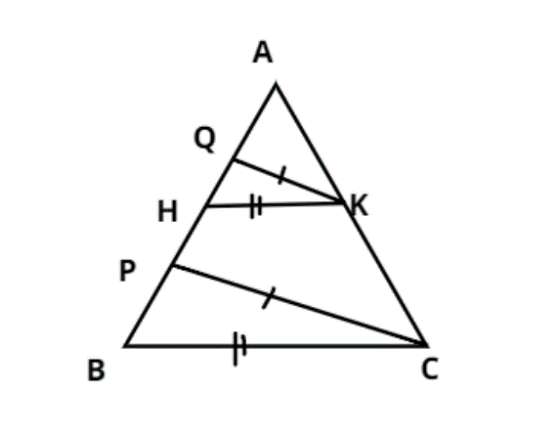
In the figure, PC || QK, BC|| HK, AQ = 6cm, QH = 4cm, HP = 5cm and KC = 18cm.
Find AK and PB.
Answer
 Verified
618k+ views
Hint – In this question use the concept of proportionality theorem, as PC || QK thus $\dfrac{{AQ}}{{QP}} = \dfrac{{AK}}{{KC}}$, and as HK || BC hence $\dfrac{{AH}}{{HB}} = \dfrac{{AK}}{{KC}}$. Moreover QP = QH + HP and AH = AQ + QH, this will help getting the right value of AK and PB.
Complete step-by-step answer:
Given data:
PC || QK, BC|| HK, AQ = 6cm, QH = 4cm, HP = 5cm and KC = 18cm.
According to the proportionality theorem of the triangle, if a line is drawn parallel to one of its sides of the triangle and it intersects the other two sides at two distinct points as shown in the given figure then it divides the two sides in the same ratio.
Therefore in triangle AQK and APC.
PC || QK (given)
$ \Rightarrow \dfrac{{AQ}}{{QP}} = \dfrac{{AK}}{{KC}}$
Now, QP = QH + HP = 4 + 5 =9cm
Now substitute the value we have,
$ \Rightarrow \dfrac{6}{9} = \dfrac{{AK}}{{18}}$
$ \Rightarrow AK = \dfrac{{6 \times 18}}{9} = 12$cm.
Now in the triangle AHK and ABC.
HK || BC
$ \Rightarrow \dfrac{{AH}}{{HB}} = \dfrac{{AK}}{{KC}}$................... (1)
Now, AH = AQ + QH = 6 + 4 =10cm.
HB = HP + PB = 5 + PB
Now substitute all the values in equation (1) we have,
$ \Rightarrow \dfrac{{10}}{{5 + PB}} = \dfrac{{12}}{{18}}$
Now simplify this we have,
$ \Rightarrow 10 \times 18 = 12 \times \left( {5 + PB} \right)$
$ \Rightarrow 180 = 60 + 12PB$
$ \Rightarrow 12PB = 180 - 60 = 120$
$ \Rightarrow PB = \dfrac{{120}}{{12}} = 10$cm.
Therefore, AK = 12cm and PB = 10cm.
So this is the required answer.
Note – Understanding of diagrammatic representation always helps in figuring out the geometry involved in problems of such type. Proportionality theorem plays a vital role during solution and is applicable to any triangle no matter isosceles or equilateral if lines are drawn parallel to sides.
Complete step-by-step answer:
Given data:
PC || QK, BC|| HK, AQ = 6cm, QH = 4cm, HP = 5cm and KC = 18cm.
According to the proportionality theorem of the triangle, if a line is drawn parallel to one of its sides of the triangle and it intersects the other two sides at two distinct points as shown in the given figure then it divides the two sides in the same ratio.
Therefore in triangle AQK and APC.
PC || QK (given)
$ \Rightarrow \dfrac{{AQ}}{{QP}} = \dfrac{{AK}}{{KC}}$
Now, QP = QH + HP = 4 + 5 =9cm
Now substitute the value we have,
$ \Rightarrow \dfrac{6}{9} = \dfrac{{AK}}{{18}}$
$ \Rightarrow AK = \dfrac{{6 \times 18}}{9} = 12$cm.
Now in the triangle AHK and ABC.
HK || BC
$ \Rightarrow \dfrac{{AH}}{{HB}} = \dfrac{{AK}}{{KC}}$................... (1)
Now, AH = AQ + QH = 6 + 4 =10cm.
HB = HP + PB = 5 + PB
Now substitute all the values in equation (1) we have,
$ \Rightarrow \dfrac{{10}}{{5 + PB}} = \dfrac{{12}}{{18}}$
Now simplify this we have,
$ \Rightarrow 10 \times 18 = 12 \times \left( {5 + PB} \right)$
$ \Rightarrow 180 = 60 + 12PB$
$ \Rightarrow 12PB = 180 - 60 = 120$
$ \Rightarrow PB = \dfrac{{120}}{{12}} = 10$cm.
Therefore, AK = 12cm and PB = 10cm.
So this is the required answer.
Note – Understanding of diagrammatic representation always helps in figuring out the geometry involved in problems of such type. Proportionality theorem plays a vital role during solution and is applicable to any triangle no matter isosceles or equilateral if lines are drawn parallel to sides.
Recently Updated Pages
Basicity of sulphurous acid and sulphuric acid are

Master Class 12 English: Engaging Questions & Answers for Success
Master Class 12 Social Science: Engaging Questions & Answers for Success
Master Class 12 Maths: Engaging Questions & Answers for Success
Master Class 12 Economics: Engaging Questions & Answers for Success
Master Class 12 Physics: Engaging Questions & Answers for Success
Trending doubts
Which are the Top 10 Largest Countries of the World?
Draw a labelled sketch of the human eye class 12 physics CBSE
Which country did Danny Casey play for class 12 english CBSE
Give 10 examples of unisexual and bisexual flowers
Coming together federation is practiced in A India class 12 social science CBSE
Write the formula to find the shortest distance between class 12 maths CBSE