




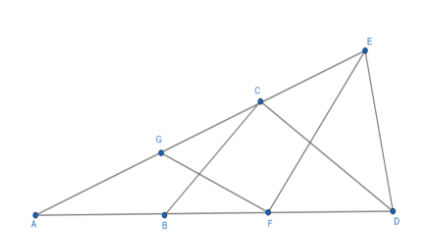
In the figure given below: $AB=BC=CD=DE=EF=FG=GA$ , then find $\angle DAE$ (approximately).
(a) ${{24}^{0}}$
(b) ${{25}^{0}}$
(c) ${{26}^{0}}$
(d) None of the above
Answer
 Verified
663.6k+ views
Hint: To solve this question easily first we will understand some important properties related to triangles, especially isosceles triangles and exterior angle theorem to find the correct answer.
Complete step-by-step answer:
Given:
In the above figure: $AB=BC=CD=DE=EF=FG=GA$ .
Let, $\angle DAE=\theta $ .
Now, we will see 3 important properties related to triangles one by one which will be used to solve this problem.
First property:
Sum of interior angles of a triangle is always ${{180}^{0}}$ . It is a very basic property but very useful and important.
Second property:
It is also known as “Exterior Angle Theorem”. It states that if a side of a triangle is produced, then the exterior angle so formed is equal to the sum of the two interior angles. As shown in the figure below:
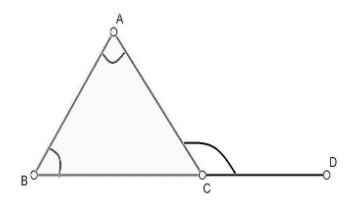
In the above figure, $\Delta ABC$ is shown in which side $BC$ is extended to $D$ . Then, from exterior angle theorem, we can write, $\angle DCA=\angle ABC+\angle CAB$ .
Third property:
Angles opposite to equal sides of an isosceles triangle are equal. This can be understood with the help of the figure below:
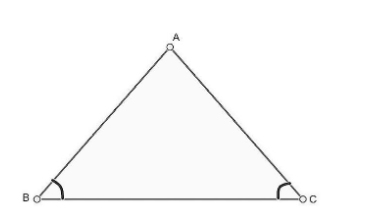
In the above figure, $\Delta ABC$ is shown in which $AB=AC$ . Then, $\angle ABC=\angle ACB$ .
Now, we will use the above three properties collectively to solve the given problem.
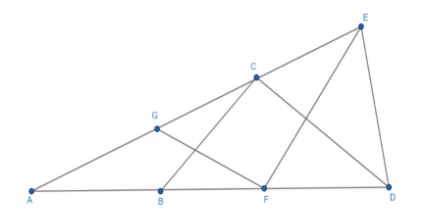
In the above figure:
In $\Delta ABC$ , it is given that $AB=BC$ . Then, from the third property of the isosceles triangle we get,
$\angle BAC=\angle ACB............\left( 1 \right)$
In $\Delta AGF$ , it is given that $FG=GA$ . Then, from the third property of the isosceles triangle we get,
$\angle FAG=\angle AFG........\left( 2 \right)$
If we look at the given figure then we can write that, $\angle DAE=\angle BAC=\angle FAG=\theta $ . Then,
From (1) and (2) we get, $\angle DAE=\angle BAC=\angle ACB=\angle FAG=\angle AFG=\theta $ .
Now, in $\Delta BCD$ , it is given that $BC=CD$ . Then, from the second property of the isosceles triangle we get, $\angle DBC=\angle CDB$ and let, $\angle DBC=\angle CDB=\beta $ .
Now, if we look in the given figure and consider $\Delta ABC$ then, we will find that the side $AB$ is extended to $D$ . So, we can apply the second property of exterior angle theorem. Then,
$\begin{align}
& \angle DBC=\angle BAC+\angle ACB \\
& \Rightarrow \beta =\theta +\theta \\
& \Rightarrow \beta =2\theta ........\left( 3 \right) \\
\end{align}$
Now, in the given figure consider $\Delta GFE$ , it is given that $EF=FG$ . Then, from the third property of the isosceles triangle we get, $\angle FGE=\angle FEG$ and let, $\angle FGE=\angle FEG=\delta $ .
Now, if we look in the given figure and consider $\Delta AGF$ then, we will find that the side $AG$ is extended to $E$ . So, we can apply the second property of the exterior angle theorem. Then,
$\begin{align}
& \angle FGE=\angle FAG+\angle AFG \\
& \Rightarrow \delta =\theta +\theta \\
& \Rightarrow \delta =2\theta ........\left( 4 \right) \\
\end{align}$
Now, in the given figure consider $\Delta DEF$ , it is given that $DE=EF$ . Then, from the third property of the isosceles triangle we get, $\angle DFE=\angle FDE$ and let, $\angle DEF=\angle FDE=\alpha $ .
Now, if we look in the given figure and consider $\Delta AEF$ then, we will find that the side $AF$ is extended to $D$ . So, we can apply the second property of the exterior angle theorem. Then,
$\angle DFE=\angle FAE+\angle AEF$
In the above equation we can substitute, $\angle FAE=\angle BAC=\theta $ and $\angle AEF=\angle FEG=\delta $. Then,
$\angle DFE=\theta +\delta $
Now, from (4) put $\delta =2\theta $ in the above equation. Then,
$\begin{align}
& \angle DFE=\theta +2\theta \\
& \Rightarrow \alpha =3\theta ...........\left( 4 \right) \\
\end{align}$
Now, in the given figure consider $\Delta DCE$ , it is given that $CD=DE$ . Then, from the third property of the isosceles triangle we get, $\angle DCE=\angle DEC$ and let, $\angle DCE=\angle DEC=\gamma $ .
Now, if we look in the given figure and consider $\Delta ACD$ then, we will find that the side $AC$ is extended to $E$ . So, we can apply the second property of the exterior angle theorem. Then,
$\angle DCE=\angle DAC+\angle CDA$
In the above equation we can substitute, $\angle DAC=\angle BAC=\theta $ and $\angle CDA=\angle CDB=\beta $ . Then,
$\angle DCE=\theta +\beta $
Now, from (3) put $\beta =2\theta $ in the above equation. Then,
$\begin{align}
& \angle DCE=\theta +2\theta \\
& \Rightarrow \gamma =3\theta .............\left( 5 \right) \\
\end{align}$
Now, in the given figure consider $\Delta DAE$ . Then in $\Delta DAE$ ,
$\angle DAE=\theta $ and $\angle ADE=\angle FDE=\alpha $ , $\angle DEA=\angle DEC=\gamma $ . Using the first property of the sum of interior angles of any triangle to be ${{180}^{0}}$ . We get,
\[\begin{align}
& \angle DAE+\angle ADE+\angle DEA={{180}^{0}} \\
& \Rightarrow \theta +\alpha +\gamma ={{180}^{0}} \\
\end{align}\]
Now, using (4) and (5) substitute $\alpha =3\theta $ and $\gamma =3\theta $ in the above equation. Then,
\[\begin{align}
& \theta +\alpha +\gamma ={{180}^{0}} \\
& \Rightarrow \theta +3\theta +3\theta ={{180}^{0}} \\
& \Rightarrow 7\theta ={{180}^{0}} \\
& \Rightarrow \theta =\dfrac{{{180}^{0}}}{7} \\
& \Rightarrow \theta ={{\left( 25.71428 \right)}^{0}} \\
& \Rightarrow \theta \approx {{26}^{0}} \\
& \Rightarrow \angle DAE\approx {{26}^{0}} \\
\end{align}\]
Thus, $\angle DAE={{26}^{0}}$ (approximately).
Hence, (c) is the correct option.
Note:Here, the student should apply the exterior angle theorem carefully stepwise and also use the property of the isosceles triangle correctly. Moreover, variables like $\theta ,\alpha ,\beta ,\gamma $ should be assigned carefully so that we will get the correct answer. And finally, match the most suitable option.
Complete step-by-step answer:
Given:
In the above figure: $AB=BC=CD=DE=EF=FG=GA$ .
Let, $\angle DAE=\theta $ .
Now, we will see 3 important properties related to triangles one by one which will be used to solve this problem.
First property:
Sum of interior angles of a triangle is always ${{180}^{0}}$ . It is a very basic property but very useful and important.
Second property:
It is also known as “Exterior Angle Theorem”. It states that if a side of a triangle is produced, then the exterior angle so formed is equal to the sum of the two interior angles. As shown in the figure below:
In the above figure, $\Delta ABC$ is shown in which side $BC$ is extended to $D$ . Then, from exterior angle theorem, we can write, $\angle DCA=\angle ABC+\angle CAB$ .
Third property:
Angles opposite to equal sides of an isosceles triangle are equal. This can be understood with the help of the figure below:
In the above figure, $\Delta ABC$ is shown in which $AB=AC$ . Then, $\angle ABC=\angle ACB$ .
Now, we will use the above three properties collectively to solve the given problem.
In the above figure:
In $\Delta ABC$ , it is given that $AB=BC$ . Then, from the third property of the isosceles triangle we get,
$\angle BAC=\angle ACB............\left( 1 \right)$
In $\Delta AGF$ , it is given that $FG=GA$ . Then, from the third property of the isosceles triangle we get,
$\angle FAG=\angle AFG........\left( 2 \right)$
If we look at the given figure then we can write that, $\angle DAE=\angle BAC=\angle FAG=\theta $ . Then,
From (1) and (2) we get, $\angle DAE=\angle BAC=\angle ACB=\angle FAG=\angle AFG=\theta $ .
Now, in $\Delta BCD$ , it is given that $BC=CD$ . Then, from the second property of the isosceles triangle we get, $\angle DBC=\angle CDB$ and let, $\angle DBC=\angle CDB=\beta $ .
Now, if we look in the given figure and consider $\Delta ABC$ then, we will find that the side $AB$ is extended to $D$ . So, we can apply the second property of exterior angle theorem. Then,
$\begin{align}
& \angle DBC=\angle BAC+\angle ACB \\
& \Rightarrow \beta =\theta +\theta \\
& \Rightarrow \beta =2\theta ........\left( 3 \right) \\
\end{align}$
Now, in the given figure consider $\Delta GFE$ , it is given that $EF=FG$ . Then, from the third property of the isosceles triangle we get, $\angle FGE=\angle FEG$ and let, $\angle FGE=\angle FEG=\delta $ .
Now, if we look in the given figure and consider $\Delta AGF$ then, we will find that the side $AG$ is extended to $E$ . So, we can apply the second property of the exterior angle theorem. Then,
$\begin{align}
& \angle FGE=\angle FAG+\angle AFG \\
& \Rightarrow \delta =\theta +\theta \\
& \Rightarrow \delta =2\theta ........\left( 4 \right) \\
\end{align}$
Now, in the given figure consider $\Delta DEF$ , it is given that $DE=EF$ . Then, from the third property of the isosceles triangle we get, $\angle DFE=\angle FDE$ and let, $\angle DEF=\angle FDE=\alpha $ .
Now, if we look in the given figure and consider $\Delta AEF$ then, we will find that the side $AF$ is extended to $D$ . So, we can apply the second property of the exterior angle theorem. Then,
$\angle DFE=\angle FAE+\angle AEF$
In the above equation we can substitute, $\angle FAE=\angle BAC=\theta $ and $\angle AEF=\angle FEG=\delta $. Then,
$\angle DFE=\theta +\delta $
Now, from (4) put $\delta =2\theta $ in the above equation. Then,
$\begin{align}
& \angle DFE=\theta +2\theta \\
& \Rightarrow \alpha =3\theta ...........\left( 4 \right) \\
\end{align}$
Now, in the given figure consider $\Delta DCE$ , it is given that $CD=DE$ . Then, from the third property of the isosceles triangle we get, $\angle DCE=\angle DEC$ and let, $\angle DCE=\angle DEC=\gamma $ .
Now, if we look in the given figure and consider $\Delta ACD$ then, we will find that the side $AC$ is extended to $E$ . So, we can apply the second property of the exterior angle theorem. Then,
$\angle DCE=\angle DAC+\angle CDA$
In the above equation we can substitute, $\angle DAC=\angle BAC=\theta $ and $\angle CDA=\angle CDB=\beta $ . Then,
$\angle DCE=\theta +\beta $
Now, from (3) put $\beta =2\theta $ in the above equation. Then,
$\begin{align}
& \angle DCE=\theta +2\theta \\
& \Rightarrow \gamma =3\theta .............\left( 5 \right) \\
\end{align}$
Now, in the given figure consider $\Delta DAE$ . Then in $\Delta DAE$ ,
$\angle DAE=\theta $ and $\angle ADE=\angle FDE=\alpha $ , $\angle DEA=\angle DEC=\gamma $ . Using the first property of the sum of interior angles of any triangle to be ${{180}^{0}}$ . We get,
\[\begin{align}
& \angle DAE+\angle ADE+\angle DEA={{180}^{0}} \\
& \Rightarrow \theta +\alpha +\gamma ={{180}^{0}} \\
\end{align}\]
Now, using (4) and (5) substitute $\alpha =3\theta $ and $\gamma =3\theta $ in the above equation. Then,
\[\begin{align}
& \theta +\alpha +\gamma ={{180}^{0}} \\
& \Rightarrow \theta +3\theta +3\theta ={{180}^{0}} \\
& \Rightarrow 7\theta ={{180}^{0}} \\
& \Rightarrow \theta =\dfrac{{{180}^{0}}}{7} \\
& \Rightarrow \theta ={{\left( 25.71428 \right)}^{0}} \\
& \Rightarrow \theta \approx {{26}^{0}} \\
& \Rightarrow \angle DAE\approx {{26}^{0}} \\
\end{align}\]
Thus, $\angle DAE={{26}^{0}}$ (approximately).
Hence, (c) is the correct option.
Note:Here, the student should apply the exterior angle theorem carefully stepwise and also use the property of the isosceles triangle correctly. Moreover, variables like $\theta ,\alpha ,\beta ,\gamma $ should be assigned carefully so that we will get the correct answer. And finally, match the most suitable option.
Recently Updated Pages
Which of the following graphs shows the variation of class 12 physics CBSE

Draw a labelled diagram of the human male reproductive class 12 biology CBSE
Describe the experiment to compare the emf of two cells class 12 physics CBSE
What is standard hydrogen electrode
What is conventional current and electric current class 12 physics CBSE
2Bromopentane is treated with an alcoholic KOH solution class 12 chemistry CBSE
Trending doubts
Draw a labelled sketch of the human eye class 12 physics CBSE
Which are the Top 10 Largest Countries of the World?
Differentiate between homogeneous and heterogeneous class 12 chemistry CBSE
Draw ray diagrams each showing i myopic eye and ii class 12 physics CBSE
Which is the correct genotypic ratio of mendel dihybrid class 12 biology CBSE
What is the Full Form of PVC, PET, HDPE, LDPE, PP and PS ?