




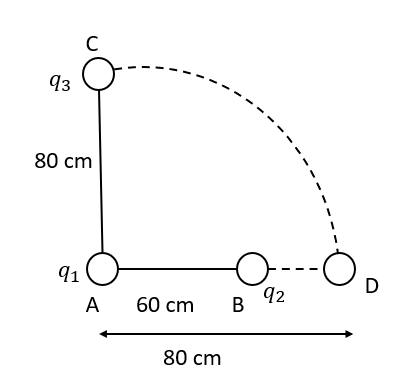
In the figure are shown charges $q_{1} = 2 \times 10^{-8} C$ and $q_{2} = -0.4 \times 10^{-8} C$. A charge $q_{3} = 0.2 \times 10^{-8} C$ is moved along the arc of a circle from C to D. The potential energy of $q_{3}$ is
a) will increase approximately by $76 \%$
b) will decrease approximately by $76 \%$
c) will remain same
d) will increase approximately by $12 \%$
Answer
 Verified
506.1k+ views
Hint: An object possesses electric potential energy by two elements: the charge possessed by an object itself and the relative position of an object concerning other electrically charged objects. The measurement of electric potential depends on the value of work done in transferring the object from one location to another against the electric field.
Complete step-by-step solution:
Given: $q_{1} = 2 \times 10^{-8} C$
$q_{2} = -0.4 \times 10^{-8} C$
$q_{3} = 0.2 \times 10^{-8} C$
Initial potential energy on the $q_{3}$:
$U_{i} = \dfrac{k q_{3} q_{1}}{r_{13}} + \dfrac{k q_{3} q_{2}}{r_{23}}$
Final potential energy on the $q_{3}$:
$U_{f} = \dfrac{k q_{3} q_{1}}{r’_{13}} + \dfrac{k q_{3} q_{2}}{r’_{23}}$
Change in potential energy $= U_{f} -U_{i}$
$= \dfrac{k q_{3} q_{1}}{r_{13}} + \dfrac{k q_{3} q_{2}}{r_{23}} - \dfrac{k q_{3} q_{1}}{r’_{13}} - \dfrac{k q_{3} q_{2}}{r’_{23}}$
Put $r_{13} = r’_{13}$.
Therefore, change in potential energy will be:
$= \dfrac{k q_{3} q_{2}}{r_{23}} - \dfrac{k q_{3} q_{2}}{r’_{23}}$
Percentage of change in energy
$= \dfrac{ U_{f} -U_{i}}{U_{i}} \times 100$
$= \dfrac{\dfrac{k q_{3} q_{2}}{r_{23}} - \dfrac{k q_{3} q_{2}}{r’_{23}}}{\dfrac{k q_{3} q_{1}}{r_{13}} + \dfrac{k q_{3} q_{2}}{r_{23}}} \times 100$
$= \dfrac {q_{2}\left(\dfrac{ 1}{r_{23}} - \dfrac{1}{r’_{23}}\right)}{\dfrac{q_{1}}{r_{13}} + \dfrac{q_{2}}{r_{23}}} \times 100$
$r’_{23} = 0.2 m$, $r_{23} = 1 m$, $r_{13} = 0.8 m$
Put all the values in the above formula.
$= \dfrac {-0.4 \times 10^{-8} \left(\dfrac{ 1}{0.2} - \dfrac{1}{1}\right)}{\dfrac{2 \times 10^{-8} }{0.8} + \dfrac{-0.4 \times 10^{-8} }{1}} \times 100$
$= \dfrac {-0.4 \left(5-1\right)}{2.5-0.4} \times 100$
$= \dfrac{-1.6}{2.1} \times 100$
$= -76 \%$
So, Potential energy is decreased by $-76 \%$.
Option (b) is right.
Note:When an object is pushed against the electric field, it achieves some energy, described as the electric potential energy. For a charge, the electric potential is achieved by dividing the potential energy by the amount of charge.
Complete step-by-step solution:
Given: $q_{1} = 2 \times 10^{-8} C$
$q_{2} = -0.4 \times 10^{-8} C$
$q_{3} = 0.2 \times 10^{-8} C$
Initial potential energy on the $q_{3}$:
$U_{i} = \dfrac{k q_{3} q_{1}}{r_{13}} + \dfrac{k q_{3} q_{2}}{r_{23}}$
Final potential energy on the $q_{3}$:
$U_{f} = \dfrac{k q_{3} q_{1}}{r’_{13}} + \dfrac{k q_{3} q_{2}}{r’_{23}}$
Change in potential energy $= U_{f} -U_{i}$
$= \dfrac{k q_{3} q_{1}}{r_{13}} + \dfrac{k q_{3} q_{2}}{r_{23}} - \dfrac{k q_{3} q_{1}}{r’_{13}} - \dfrac{k q_{3} q_{2}}{r’_{23}}$
Put $r_{13} = r’_{13}$.
Therefore, change in potential energy will be:
$= \dfrac{k q_{3} q_{2}}{r_{23}} - \dfrac{k q_{3} q_{2}}{r’_{23}}$
Percentage of change in energy
$= \dfrac{ U_{f} -U_{i}}{U_{i}} \times 100$
$= \dfrac{\dfrac{k q_{3} q_{2}}{r_{23}} - \dfrac{k q_{3} q_{2}}{r’_{23}}}{\dfrac{k q_{3} q_{1}}{r_{13}} + \dfrac{k q_{3} q_{2}}{r_{23}}} \times 100$
$= \dfrac {q_{2}\left(\dfrac{ 1}{r_{23}} - \dfrac{1}{r’_{23}}\right)}{\dfrac{q_{1}}{r_{13}} + \dfrac{q_{2}}{r_{23}}} \times 100$
$r’_{23} = 0.2 m$, $r_{23} = 1 m$, $r_{13} = 0.8 m$
Put all the values in the above formula.
$= \dfrac {-0.4 \times 10^{-8} \left(\dfrac{ 1}{0.2} - \dfrac{1}{1}\right)}{\dfrac{2 \times 10^{-8} }{0.8} + \dfrac{-0.4 \times 10^{-8} }{1}} \times 100$
$= \dfrac {-0.4 \left(5-1\right)}{2.5-0.4} \times 100$
$= \dfrac{-1.6}{2.1} \times 100$
$= -76 \%$
So, Potential energy is decreased by $-76 \%$.
Option (b) is right.
Note:When an object is pushed against the electric field, it achieves some energy, described as the electric potential energy. For a charge, the electric potential is achieved by dividing the potential energy by the amount of charge.
Recently Updated Pages
Master Class 12 Economics: Engaging Questions & Answers for Success

Master Class 12 Physics: Engaging Questions & Answers for Success
Master Class 12 English: Engaging Questions & Answers for Success
Master Class 12 Social Science: Engaging Questions & Answers for Success
Master Class 12 Maths: Engaging Questions & Answers for Success
Master Class 12 Business Studies: Engaging Questions & Answers for Success
Trending doubts
Which are the Top 10 Largest Countries of the World?
What are the major means of transport Explain each class 12 social science CBSE
Draw a labelled sketch of the human eye class 12 physics CBSE
Why cannot DNA pass through cell membranes class 12 biology CBSE
Differentiate between insitu conservation and exsitu class 12 biology CBSE
Draw a neat and well labeled diagram of TS of ovary class 12 biology CBSE