




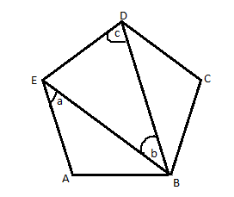
In the figure, ABCDE is a regular pentagon. Find the relation between a, b and c.
Answer
 Verified
599.2k+ views
Hint- In order to find the value of a, b and c, we will use the property as all inner angles of a regular pentagon is ${108^0}$ and by using the data of the given figure we will proceed further.
Complete step-by-step answer:
As we know that, all inner angles of a regular pentagon is ${108^0}$
Therefore $\angle B = {108^0}$
The pentagon is divided into 3 equal parts and the angles also
Therefore the value of angle b is
$b = \dfrac{{{{108}^0}}}{3} = {36^0}{\text{ [}}\because \angle {\text{B = 3b]}}$
$\Delta EBD$ is an isosceles triangle and sum of all angles of and sum of all angles of triangle is ${180^0}$
Therefore
$b + c + \angle DEB = {180^0}$
As we know that in isosceles triangle the angles opposite to equal sides are equal
Therefore angle $c = \angle DEB$
$
\Rightarrow b + c + c = {180^0} \\
\Rightarrow 2c + b = {180^0} \\
$
Substituting the value of b in the above equation
$
\Rightarrow 2c + {36^0} = {180^0} \\
\Rightarrow 2c = {180^0} - {36^0} \\
\Rightarrow c = \dfrac{{{{144}^0}}}{2} = {72^0} \\
$
As we know that alternate angles are equal and
Here a and b are alternate angles therefore
$
a = b \\
a = {36^0} \\
$
Hence, angles a, b and c are ${36^0},{36^0}and{\text{ }}{72^0}$ respectively.
Note- In order to solve these types of questions, remember the properties of triangles, squares, pentagons etc. Also remember the properties of angles and parallel lines such as alternate angles, corresponding angles, vertically opposite angles and about transverse lines and more. Draw the figure first and try to solve for a single angle first and then proceed further.
Complete step-by-step answer:
As we know that, all inner angles of a regular pentagon is ${108^0}$
Therefore $\angle B = {108^0}$
The pentagon is divided into 3 equal parts and the angles also
Therefore the value of angle b is
$b = \dfrac{{{{108}^0}}}{3} = {36^0}{\text{ [}}\because \angle {\text{B = 3b]}}$
$\Delta EBD$ is an isosceles triangle and sum of all angles of and sum of all angles of triangle is ${180^0}$
Therefore
$b + c + \angle DEB = {180^0}$
As we know that in isosceles triangle the angles opposite to equal sides are equal
Therefore angle $c = \angle DEB$
$
\Rightarrow b + c + c = {180^0} \\
\Rightarrow 2c + b = {180^0} \\
$
Substituting the value of b in the above equation
$
\Rightarrow 2c + {36^0} = {180^0} \\
\Rightarrow 2c = {180^0} - {36^0} \\
\Rightarrow c = \dfrac{{{{144}^0}}}{2} = {72^0} \\
$
As we know that alternate angles are equal and
Here a and b are alternate angles therefore
$
a = b \\
a = {36^0} \\
$
Hence, angles a, b and c are ${36^0},{36^0}and{\text{ }}{72^0}$ respectively.
Note- In order to solve these types of questions, remember the properties of triangles, squares, pentagons etc. Also remember the properties of angles and parallel lines such as alternate angles, corresponding angles, vertically opposite angles and about transverse lines and more. Draw the figure first and try to solve for a single angle first and then proceed further.
Recently Updated Pages
Master Class 10 Computer Science: Engaging Questions & Answers for Success

Master Class 12 Physics: Engaging Questions & Answers for Success
Master Class 12 Social Science: Engaging Questions & Answers for Success
Master Class 12 English: Engaging Questions & Answers for Success
Master Class 12 Maths: Engaging Questions & Answers for Success
Master Class 12 Business Studies: Engaging Questions & Answers for Success
Trending doubts
Fill the blanks with the suitable prepositions 1 The class 9 english CBSE
Difference Between Plant Cell and Animal Cell
What is the full form of pH?
What is pollution? How many types of pollution? Define it
What is the Full Form of ICSE / ISC ?
On an outline map of India show its neighbouring c class 9 social science CBSE