




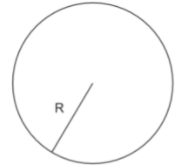
In the figure, a uniform electric field is directed out of the page within a circular region of radius $R = 3.00cm$. The field magnitude is given by $E = (4.50 \times {10^{ - 3}}V/ms)t$,
Where $t$ is in seconds. What is the magnitude of the induced magnetic field at radial distances?
A. $2.00cm$
B. $5.00cm$
Answer
 Verified
487.5k+ views
Hint: Since we have to find an induced magnetic field we will be using ampere’s circuital law which is $\int {B.dl = {\mu _0}{\varepsilon _0}\dfrac{{d{\phi _E}}}{{dt}}} $
where $\int {B.dl} $is the line integral of B around a closed path, \[{\mu _0}\]is the permeability of free space.
We will find the area of the circle by $A = \pi {r^2}$ and put the value of radial distance in the above formula. We will get the magnitude of the induced magnetic field.
Complete step by step solution:
A. We have been given that $\dfrac{{dE}}{{dt}} = 4.50 \times {10^{ - 3}}V/ms = 0.0045V/ms$
We will find the area of the circle by using the formula $A = \pi {r^2}$
For $r = 2.00cm$
$r = 0.02m$
Using ampere’s circuital law, Ampere's circuital law states that the integrated magnetic field around a closed loop to the electric current passing through the loop.
$B = \dfrac{1}{2}{\varepsilon _0}{\mu _0}r(0.0045)$
$ = \dfrac{1}{2}(8.85 \times {10^{ - 12}}{C^2}/N{m^2})(4\pi \times {10^{ - 7}}Tm/A)(0.02m)(0.0045)$
$ = 5.01 \times {10^{ - 22}}T$
This is the magnitude of the induced magnetic field at a radial distance $r = 2.00cm$
B. For $r\rangle R$ the above expression will change into
$B(2\pi r) = {\mu _0}{\varepsilon _0}\pi {R^2}(0.0045)$
Substituting the values of $r = 0.05m$ and $R = 0.03m$ we get,
$B = 4.51 \times {10^{ - 22}}T$
This is the magnitude of the induced magnetic field at a radial distance $r = 5.00cm$
Note:
Ampere's law is one of the Maxwell's equations, which is useful when the structure involved is symmetric, to evaluate the line integral of $\overrightarrow B $
The product of current enclosed by the path and permeability of the medium equals the integral of magnetic field density ($\overrightarrow B $) along an imaginary closed path.
where $\int {B.dl} $is the line integral of B around a closed path, \[{\mu _0}\]is the permeability of free space.
We will find the area of the circle by $A = \pi {r^2}$ and put the value of radial distance in the above formula. We will get the magnitude of the induced magnetic field.
Complete step by step solution:
A. We have been given that $\dfrac{{dE}}{{dt}} = 4.50 \times {10^{ - 3}}V/ms = 0.0045V/ms$
We will find the area of the circle by using the formula $A = \pi {r^2}$
For $r = 2.00cm$
$r = 0.02m$
Using ampere’s circuital law, Ampere's circuital law states that the integrated magnetic field around a closed loop to the electric current passing through the loop.
$B = \dfrac{1}{2}{\varepsilon _0}{\mu _0}r(0.0045)$
$ = \dfrac{1}{2}(8.85 \times {10^{ - 12}}{C^2}/N{m^2})(4\pi \times {10^{ - 7}}Tm/A)(0.02m)(0.0045)$
$ = 5.01 \times {10^{ - 22}}T$
This is the magnitude of the induced magnetic field at a radial distance $r = 2.00cm$
B. For $r\rangle R$ the above expression will change into
$B(2\pi r) = {\mu _0}{\varepsilon _0}\pi {R^2}(0.0045)$
Substituting the values of $r = 0.05m$ and $R = 0.03m$ we get,
$B = 4.51 \times {10^{ - 22}}T$
This is the magnitude of the induced magnetic field at a radial distance $r = 5.00cm$
Note:
Ampere's law is one of the Maxwell's equations, which is useful when the structure involved is symmetric, to evaluate the line integral of $\overrightarrow B $
The product of current enclosed by the path and permeability of the medium equals the integral of magnetic field density ($\overrightarrow B $) along an imaginary closed path.
Recently Updated Pages
Master Class 12 Economics: Engaging Questions & Answers for Success

Master Class 12 Physics: Engaging Questions & Answers for Success
Master Class 12 English: Engaging Questions & Answers for Success
Master Class 12 Social Science: Engaging Questions & Answers for Success
Master Class 12 Maths: Engaging Questions & Answers for Success
Master Class 12 Business Studies: Engaging Questions & Answers for Success
Trending doubts
Which are the Top 10 Largest Countries of the World?
What are the major means of transport Explain each class 12 social science CBSE
Draw a labelled sketch of the human eye class 12 physics CBSE
Why cannot DNA pass through cell membranes class 12 biology CBSE
Differentiate between insitu conservation and exsitu class 12 biology CBSE
Draw a neat and well labeled diagram of TS of ovary class 12 biology CBSE