




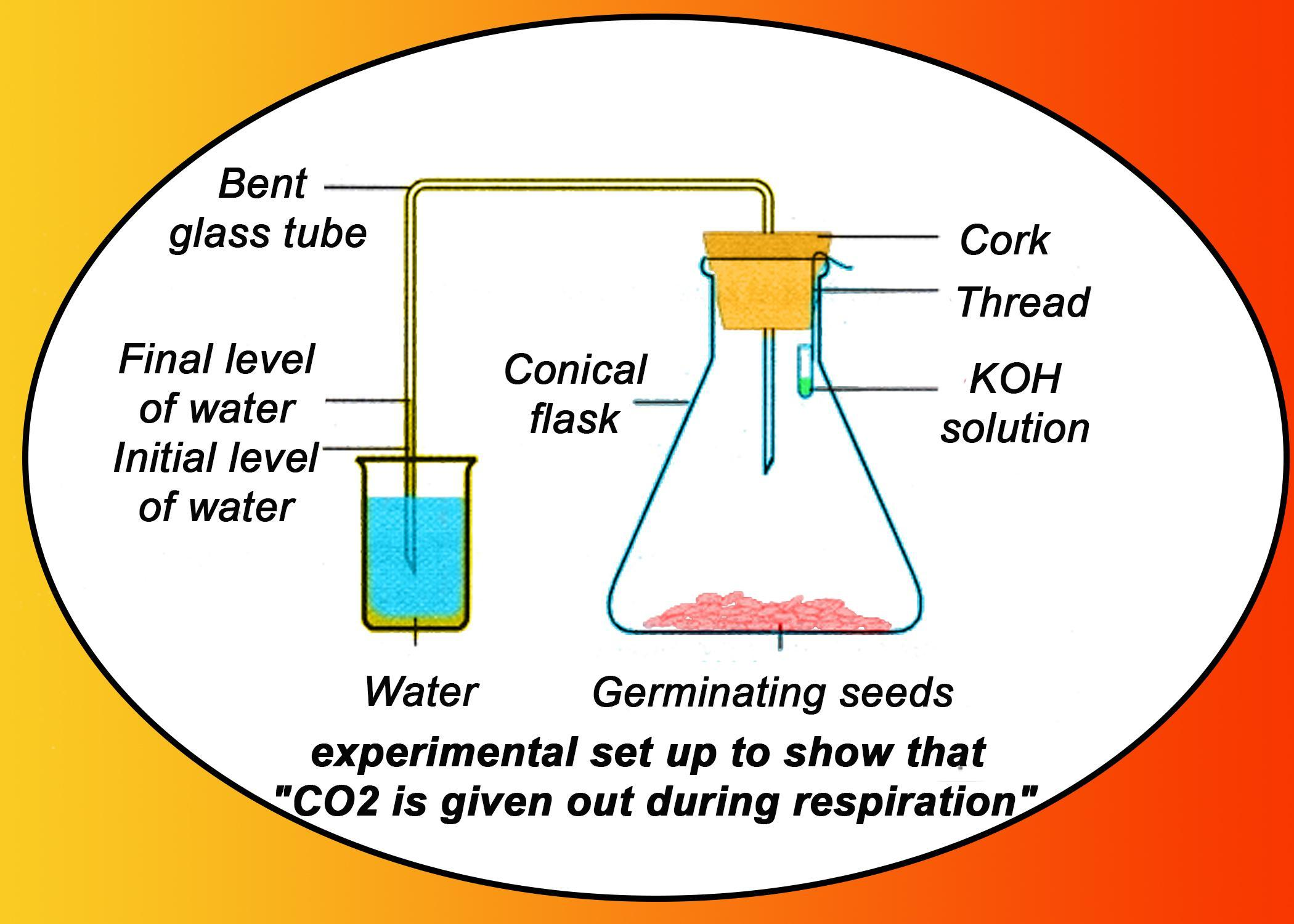
In the experimental set up to show that "Carbon dioxide is given out during respiration", name the substance taken in the small test tube kept in the conical flask. State its function and the consequence of its use.
Answer
 Verified
642.3k+ views
Hint: The substance that is taken in the small test tube is an inorganic compound and is commonly called as caustic potash. It is a colorless solid and comes under the category of a strong base. Its molar mass is 56.1056 g/mol.
Complete answer:
In the experiment in which Carbon dioxide is given out during respiration, KOH solution or pallets are taken in a tube and placed within the conical flask, KOH absorbs the carbon dioxide and it prevents the carbon dioxide from being utilized by the plant for the method of photosynthesis.
Additional Information: Photosynthesis- The method by which green plants and certain other organisms transform light energy into energy. During photosynthesis, light energy is captured and is further used by the plant to convert water, Carbon dioxide, and minerals into oxygen and energy-rich organic compounds. As you know that the photosynthesis is performed differently by different species, the method always starts when energy from light is absorbed by proteins called reaction centers that contain green chlorophyll pigments.
In plants, these proteins are held inside organelles called chloroplasts, which are most abundant in leaf cells, while in bacteria they're embedded within the cell wall. In these light-dependent reactions, some energy is employed to take out electrons from suitable substances, like water, producing oxygen gas. The hydrogen which was available as was removed by the splitting of water is employed within the creation of two further compounds, these compounds are reduced nicotinamide adenine dinucleotide phosphate (NADPH) and ATP (ATP), the "energy currency" of cells.
Note: Plants use carbon dioxide from the surrounding environment to produce sugars such as glucose and oxygen, which can later be utilized as a source of energy by the plants.
Complete answer:
In the experiment in which Carbon dioxide is given out during respiration, KOH solution or pallets are taken in a tube and placed within the conical flask, KOH absorbs the carbon dioxide and it prevents the carbon dioxide from being utilized by the plant for the method of photosynthesis.
Additional Information: Photosynthesis- The method by which green plants and certain other organisms transform light energy into energy. During photosynthesis, light energy is captured and is further used by the plant to convert water, Carbon dioxide, and minerals into oxygen and energy-rich organic compounds. As you know that the photosynthesis is performed differently by different species, the method always starts when energy from light is absorbed by proteins called reaction centers that contain green chlorophyll pigments.
In plants, these proteins are held inside organelles called chloroplasts, which are most abundant in leaf cells, while in bacteria they're embedded within the cell wall. In these light-dependent reactions, some energy is employed to take out electrons from suitable substances, like water, producing oxygen gas. The hydrogen which was available as was removed by the splitting of water is employed within the creation of two further compounds, these compounds are reduced nicotinamide adenine dinucleotide phosphate (NADPH) and ATP (ATP), the "energy currency" of cells.
Note: Plants use carbon dioxide from the surrounding environment to produce sugars such as glucose and oxygen, which can later be utilized as a source of energy by the plants.
Recently Updated Pages
If x a + bt + ct2 where x is in meters and t is in class 11 physics CBSE

A car covers the first half distance between two places class 11 physics CBSE
The resultant of two vectors overrightarrow P and overrightarrow class 11 physics CBSE
Find the value of cos 135 class 11 maths CBSE
A mass M is held in place by an applied force F and class 11 physics CBSE
A solution of glucose in water is labelled as 10 dfracwv class 11 chemistry CBSE
Trending doubts
One Metric ton is equal to kg A 10000 B 1000 C 100 class 11 physics CBSE
Find the value of the expression given below sin 30circ class 11 maths CBSE
What do you mean by retardation What is its SI uni class 11 physics CBSE
Draw a diagram of nephron and explain its structur class 11 biology CBSE
10 examples of friction in our daily life
Difference between physical and chemical change class 11 chemistry CBSE