




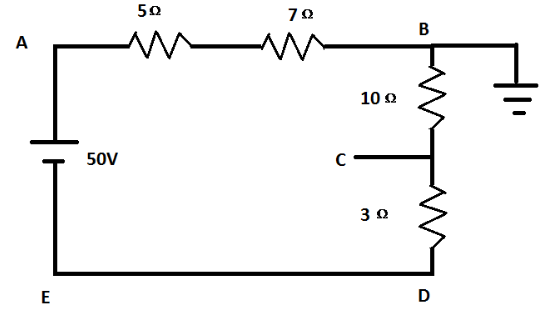
In the circuit shown, the point ‘B’ is earthed. The potential at the point ‘A’ is
A. 14V
B. 24V
C. 26V
D. 50V
Answer
 Verified
585.9k+ views
Hint:Here, we want to find the potential at A and as the potential at B is earthed, we can find the potential at A by solving the potential of the wire AB. Applying Kirchhoff’s law on the loop ABDEA, we will first find the current in the circuit and then apply its value for the circuit A to B and find the potential ${V_AB}$.
Complete step by step answer:
Kirchhoff’s law shows the relationship between the voltages at different points in the circuit. It also describes how the current flows through a circuit.The two Kirchhoff’s laws are as follows:
1. Loop Law: The summation of the drop of voltage across each component of a circuit is equal to the voltage supplied by the source.
2. Junction Law: The net current; that is incoming and outgoing at each junction should always be zero.
Now, the voltage of the battery which is denoted by V is given as 50V. There are four resistances in the circuit having resistances as\[5\Omega ,10\Omega ,7\Omega \] and\[3\Omega \]. Now, let the current flowing through the circuit be i. Thus, applying Kirchhoff’s laws for the loop ABDEA, we will get the net voltage in a loop as zero. Thus, we will get the below equation:
\[
V - 5i - 7i - 10i - 3i = 0 \\
\Rightarrow i = \dfrac{{50}}{{5 + 7 + 10 + 3}} \\
\Rightarrow i = 2A \]
The current flowing through the circuit is 2A. Now, potential B is earthed, thus the potential at A would be:
\[
{V_{(AB)}} = {V_B} - {V_A} \\
\Rightarrow{V_{(AB)}} = - {V_A}
\]
The potential VAB is given by:
\[
{V_{(AB)}} = - 5i - 7i \\
\Rightarrow {V_{(AB)}} = - 24V \\
\therefore {V_A} = 24V \\ \]
Thus, option B is the correct answer.
Note: In this circuit, we only take into account the resistances which are shown in the circuit and neglect the internal resistances present in the wire which can cause lesser current to be flown as compared to the theoretical value of the current which we have obtained. Because of this, voltage across AB could also decrease.
Complete step by step answer:
Kirchhoff’s law shows the relationship between the voltages at different points in the circuit. It also describes how the current flows through a circuit.The two Kirchhoff’s laws are as follows:
1. Loop Law: The summation of the drop of voltage across each component of a circuit is equal to the voltage supplied by the source.
2. Junction Law: The net current; that is incoming and outgoing at each junction should always be zero.
Now, the voltage of the battery which is denoted by V is given as 50V. There are four resistances in the circuit having resistances as\[5\Omega ,10\Omega ,7\Omega \] and\[3\Omega \]. Now, let the current flowing through the circuit be i. Thus, applying Kirchhoff’s laws for the loop ABDEA, we will get the net voltage in a loop as zero. Thus, we will get the below equation:
\[
V - 5i - 7i - 10i - 3i = 0 \\
\Rightarrow i = \dfrac{{50}}{{5 + 7 + 10 + 3}} \\
\Rightarrow i = 2A \]
The current flowing through the circuit is 2A. Now, potential B is earthed, thus the potential at A would be:
\[
{V_{(AB)}} = {V_B} - {V_A} \\
\Rightarrow{V_{(AB)}} = - {V_A}
\]
The potential VAB is given by:
\[
{V_{(AB)}} = - 5i - 7i \\
\Rightarrow {V_{(AB)}} = - 24V \\
\therefore {V_A} = 24V \\ \]
Thus, option B is the correct answer.
Note: In this circuit, we only take into account the resistances which are shown in the circuit and neglect the internal resistances present in the wire which can cause lesser current to be flown as compared to the theoretical value of the current which we have obtained. Because of this, voltage across AB could also decrease.
Recently Updated Pages
Master Class 12 Business Studies: Engaging Questions & Answers for Success

Master Class 12 Biology: Engaging Questions & Answers for Success
Master Class 12 Chemistry: Engaging Questions & Answers for Success
Class 12 Question and Answer - Your Ultimate Solutions Guide
Master Class 11 Social Science: Engaging Questions & Answers for Success
Master Class 11 English: Engaging Questions & Answers for Success
Trending doubts
Which is more stable and why class 12 chemistry CBSE
Which are the Top 10 Largest Countries of the World?
Draw a labelled sketch of the human eye class 12 physics CBSE
Differentiate between homogeneous and heterogeneous class 12 chemistry CBSE
What are the major means of transport Explain each class 12 social science CBSE
Sulphuric acid is known as the king of acids State class 12 chemistry CBSE