




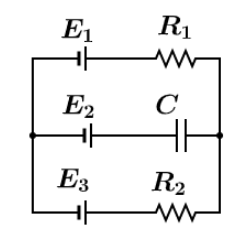
In the circuit shown, the batteries ${E_1} = {E_2} = 2V$ ${E_3} = 5V$ and the resistances ${R_1} = 10\Omega ,{R_2} = 20\Omega $ . The potential difference across the capacitor at the steady state is:
Answer
 Verified
515.4k+ views
Hint: In electrical circuits consisting of a capacitor, circuits are said to be in steady state when the capacitor is fully charged and no more current flows through the part of the circuit where the capacitor is connected. So, we will find the current flowing in circuit while neglecting the wire consisting ${E_2}(and)C$ and then we will use the general formula between potential difference across two points as $V = E - Ir$ where, $E$ is the net emf and $r$ is the resistance and $I$ is the current flowing across the wire.
Complete step by step answer:
while, neglecting the ${E_2}(and)C$ wire, we have two batteries left of ${E_1} = 2V$ and ${E_3} = 5V$ , both batteries are facing with their opposite polarity with each other, hence net emf will gets added so net emf between batteries of ${E_1} = 2V$ and ${E_3} = 5V$ is
${E_{net}} = {E_3} - {E_1}$
And current is calculated as:
$I = \dfrac{{{E_{net}}}}{{{R_{net}}}}$
Since, resistances ${R_1} = 10\Omega ,{R_2} = 20\Omega $ are connected in series so, ${R_{net}} = {R_1} + {R_2}$ in the case while neglecting ${E_2}(and)C$ wire, so
$I = \dfrac{{{E_{net}}}}{{{R_{net}}}}$
$\Rightarrow I = \dfrac{{5 - 2}}{{10 + 20}}$
$\Rightarrow I = \dfrac{3}{{30}}$
$\Rightarrow I = 0.1A$
Now, consider the only part of circuit consisting of ${E_2}(and)C$ wire and ${E_3} = 5V$ wire, we have,
${E_3} = 5V$
$\Rightarrow {E_2} = 2V$
With a resistance $r = 20\Omega $
And $I = 0.1A$
net emf can be written as ${E_{net}} = {E_3} - {E_2}$
${E_{net}} = 3V$
Let, $V$ be the potential difference across the capacitor, the we have
$V = {E_{net}} - Ir$
$\Rightarrow V = 3 - 0.1(20)$
$\therefore V = 1\,V$
Hence, the potential difference across the capacitor at steady state will be $V = 1\,V$.
Note:It should be remembered that, while calculating the net emf between two batteries always check the facing polarity of two batteries, if facing polarity are same then net emf will get subtracted and if facing polarity are different net emf will gets added. The relation $I = \dfrac{E}{R}$ is known as Ohm’s law.
Complete step by step answer:
while, neglecting the ${E_2}(and)C$ wire, we have two batteries left of ${E_1} = 2V$ and ${E_3} = 5V$ , both batteries are facing with their opposite polarity with each other, hence net emf will gets added so net emf between batteries of ${E_1} = 2V$ and ${E_3} = 5V$ is
${E_{net}} = {E_3} - {E_1}$
And current is calculated as:
$I = \dfrac{{{E_{net}}}}{{{R_{net}}}}$
Since, resistances ${R_1} = 10\Omega ,{R_2} = 20\Omega $ are connected in series so, ${R_{net}} = {R_1} + {R_2}$ in the case while neglecting ${E_2}(and)C$ wire, so
$I = \dfrac{{{E_{net}}}}{{{R_{net}}}}$
$\Rightarrow I = \dfrac{{5 - 2}}{{10 + 20}}$
$\Rightarrow I = \dfrac{3}{{30}}$
$\Rightarrow I = 0.1A$
Now, consider the only part of circuit consisting of ${E_2}(and)C$ wire and ${E_3} = 5V$ wire, we have,
${E_3} = 5V$
$\Rightarrow {E_2} = 2V$
With a resistance $r = 20\Omega $
And $I = 0.1A$
net emf can be written as ${E_{net}} = {E_3} - {E_2}$
${E_{net}} = 3V$
Let, $V$ be the potential difference across the capacitor, the we have
$V = {E_{net}} - Ir$
$\Rightarrow V = 3 - 0.1(20)$
$\therefore V = 1\,V$
Hence, the potential difference across the capacitor at steady state will be $V = 1\,V$.
Note:It should be remembered that, while calculating the net emf between two batteries always check the facing polarity of two batteries, if facing polarity are same then net emf will get subtracted and if facing polarity are different net emf will gets added. The relation $I = \dfrac{E}{R}$ is known as Ohm’s law.
Recently Updated Pages
Master Class 12 Economics: Engaging Questions & Answers for Success

Master Class 12 Physics: Engaging Questions & Answers for Success
Master Class 12 English: Engaging Questions & Answers for Success
Master Class 12 Social Science: Engaging Questions & Answers for Success
Master Class 12 Maths: Engaging Questions & Answers for Success
Master Class 12 Business Studies: Engaging Questions & Answers for Success
Trending doubts
Which are the Top 10 Largest Countries of the World?
What are the major means of transport Explain each class 12 social science CBSE
Draw a labelled sketch of the human eye class 12 physics CBSE
Why cannot DNA pass through cell membranes class 12 biology CBSE
Differentiate between insitu conservation and exsitu class 12 biology CBSE
Draw a neat and well labeled diagram of TS of ovary class 12 biology CBSE