




In the circuit shown, switch S is placed in position 1 till the capacitor is charged to half of the maximum possible charge in this situation. Now, switch S is placed in position 2. The maximum energy lost by the circuit after switch S is placed in position 2 is:
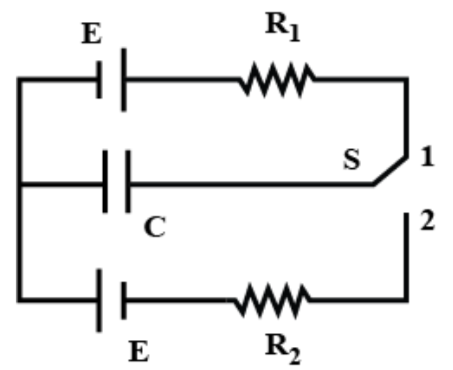
A). $\dfrac {1}{2}C{E}^{2}$
B). $\dfrac {1}{8}C{E}^{2}$
C). $\dfrac {7}{8}C{E}^{2}$
D). $\dfrac {9}{8}C{E}^{2}$
Answer
 Verified
585.3k+ views
Hint: Find the energy which was stored in the capacitor initially. Then, find the final energy stored in the capacitor. Obtain the expression for work done by the battery. Then, subtract the initial energy from the final energy and subtract the obtained answer from work done by the battery. This will give the maximum energy lost by the circuit.
Complete step-by-step solution:
Initial charge of the capacitor is $\dfrac {Q}{2}$
Energy stored in a capacitor is given by,
$U= \dfrac {1}{2} \dfrac { {Q}^{2}}{C}$ ...(1)
Where Q is the charge
V is the voltage
Substituting value in equation. (1) we get,
${U}_{I}= \dfrac {1}{2} {(\dfrac {Q}{2})}^{2} \dfrac {1}{C}$
$\therefore {U}_{I}= \dfrac {1}{8}\dfrac {{Q}^{2}}{C}$ ...(2)
But, $Q=CE$
Substituting this value in the equation. (2) we get,
${U}_{i}= \dfrac {1}{8}C{E}^{2}$ ...(3)
Final energy stored in the capacitor is given by,
${U}_{f}= \dfrac {1}{2}C{E}^{2}$
Work done by the battery is
$W= (\dfrac {3}{2}CE) \times E$
$\therefore W= \dfrac {3}{2}C{E}^{2}$
Heat energy is lost by,
Energy lost=$W – ({U}_{f}-{U}_{I})$
Substituting values in above equation we get,
Energy lost= $ \dfrac {3}{2}C{E}^{2}-( \dfrac {1}{2}C{E}^{2}- \dfrac {1}{8}C{E}^{2})$
$\therefore$ Energy lost= $\dfrac {9}{8}C{E}^{2}$
Thus, the maximum energy lost by the circuit is $\dfrac {9}{8}C{E}^{2}$.
Hence, the correct answer is option D i.e. $\dfrac {9}{8}C{E}^{2}$.
Note: Make sure you write the powers correctly.
The energy stored in the capacitor is electrical energy and not potential energy. An ideal capacitor does not dissipate any of the energy supplied to it. The total energy of a system is always conserved. The lost energy is converted from one form to another by some component in the circuit. In our case, the resistor acts as a medium to expand the energy which was lost by capacitors.
Complete step-by-step solution:
Initial charge of the capacitor is $\dfrac {Q}{2}$
Energy stored in a capacitor is given by,
$U= \dfrac {1}{2} \dfrac { {Q}^{2}}{C}$ ...(1)
Where Q is the charge
V is the voltage
Substituting value in equation. (1) we get,
${U}_{I}= \dfrac {1}{2} {(\dfrac {Q}{2})}^{2} \dfrac {1}{C}$
$\therefore {U}_{I}= \dfrac {1}{8}\dfrac {{Q}^{2}}{C}$ ...(2)
But, $Q=CE$
Substituting this value in the equation. (2) we get,
${U}_{i}= \dfrac {1}{8}C{E}^{2}$ ...(3)
Final energy stored in the capacitor is given by,
${U}_{f}= \dfrac {1}{2}C{E}^{2}$
Work done by the battery is
$W= (\dfrac {3}{2}CE) \times E$
$\therefore W= \dfrac {3}{2}C{E}^{2}$
Heat energy is lost by,
Energy lost=$W – ({U}_{f}-{U}_{I})$
Substituting values in above equation we get,
Energy lost= $ \dfrac {3}{2}C{E}^{2}-( \dfrac {1}{2}C{E}^{2}- \dfrac {1}{8}C{E}^{2})$
$\therefore$ Energy lost= $\dfrac {9}{8}C{E}^{2}$
Thus, the maximum energy lost by the circuit is $\dfrac {9}{8}C{E}^{2}$.
Hence, the correct answer is option D i.e. $\dfrac {9}{8}C{E}^{2}$.
Note: Make sure you write the powers correctly.
The energy stored in the capacitor is electrical energy and not potential energy. An ideal capacitor does not dissipate any of the energy supplied to it. The total energy of a system is always conserved. The lost energy is converted from one form to another by some component in the circuit. In our case, the resistor acts as a medium to expand the energy which was lost by capacitors.
Recently Updated Pages
Master Class 12 Economics: Engaging Questions & Answers for Success

Master Class 12 Physics: Engaging Questions & Answers for Success
Master Class 12 English: Engaging Questions & Answers for Success
Master Class 12 Social Science: Engaging Questions & Answers for Success
Master Class 12 Maths: Engaging Questions & Answers for Success
Master Class 12 Business Studies: Engaging Questions & Answers for Success
Trending doubts
Which are the Top 10 Largest Countries of the World?
What are the major means of transport Explain each class 12 social science CBSE
Draw a labelled sketch of the human eye class 12 physics CBSE
Why cannot DNA pass through cell membranes class 12 biology CBSE
Differentiate between insitu conservation and exsitu class 12 biology CBSE
Draw a neat and well labeled diagram of TS of ovary class 12 biology CBSE