




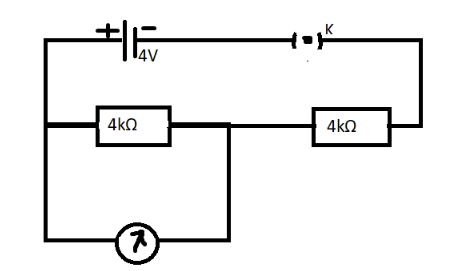
In the circuit shown below, if the resistance of voltmeter is $ {{4K}}\Omega $ , then the error in the reading of voltmeter will be
(A) 50 %
(B) 68 %
(C) 17 %
(D) 33.3%
Answer
 Verified
581.4k+ views
Hint: We only need to apply the ohm’s law on the following circuit. Then by simply putting the values in the formula we can get the answer.
Formula used: As required here we need ohm’s law:
$ \begin{array}{*{20}{l}}
{{{V = iR}}}
\end{array} $
Here, $ {{V}} $ is the voltage,
$ {{i}} $ is the current passing through the circuit,
$ {{R}} $ is the resistance of the circuit.
Complete step by step answer:
We are already provided with the resistances of $ {{4K}}\Omega $ connected in series.
And $ {{4K}}\Omega $ means 4000 $ \Omega $
When the voltmeter is ideal,
So, no current is passing through the voltmeter.
At that moment the current that we will get is:
$ {{I = }}\dfrac{{{4}}}{{{{4000 + 4000}}}}{{ = 0}}.{{5mA}} $
When the reading of the voltmeter is $ {{V}} $ :
$ {{V = 4000I = 4000}}\left( {\dfrac{{{{0}}.{{5}}}}{{{{1000}}}}} \right){{ = 2V}} $
When we apply the resistances to the circuit in parallel:
$ {{I' = }}\dfrac{{{4}}}{{\left( {\dfrac{{{1}}}{{{{4000}}}}{{ + }}\dfrac{{{1}}}{{{{4000}}}}} \right){{ + 4000}}}}{{ = }}\dfrac{{{4}}}{{{{2000 + 4000}}}}{{ = }}\dfrac{{{2}}}{{{3}}}{{A}} $
The corresponding reading of the voltmeter:
$ {{V' = 4000I' = 4000}}\left( {\dfrac{{{2}}}{{{3}}} \times {{1}}{{{0}}^{{{ - 3}}}}} \right){{ = 2}}.{{67V}} $
Now, the error in voltmeter $ {{ = }}\dfrac{{{{2}}{{.67 - 2}}}}{{{2}}}{{ \times 100 = 33}}{{.3}} $
$ {{ = }}\dfrac{{{{2}}.{{67 - 2}}}}{{{2}}} \times {{100 = 33}}.{{3}} $ %
So, we need to see from the above options, and select the appropriate value.
Thus, the correct answer is option D.
Additional Information
Ohm's law is the fundamental law in the field of electricity. It was discovered by George Ohm, and named after him. Ohm's law provides the relationship between current, voltage, and resistance. It states that the voltage across any resistance is equal to current times the resistance.
Note:
Some common applications of ohm’s law in our daily lives are electric Kettles and irons, mobile and laptop charger, conventional domestic fans. It provides variable output voltage based on the resistance and the overall working is controlled by Ohm's Law. The working of heaters, kettles and other equipment also follows this law. Mobile phone & laptop chargers use DC power supply in operations. Ohm's Law states that the current flowing in a circuit is directly proportional to the applied potential difference and inversely proportional to the resistance in the circuit. In other words, by doubling the voltage across a circuit the current will also double.
Formula used: As required here we need ohm’s law:
$ \begin{array}{*{20}{l}}
{{{V = iR}}}
\end{array} $
Here, $ {{V}} $ is the voltage,
$ {{i}} $ is the current passing through the circuit,
$ {{R}} $ is the resistance of the circuit.
Complete step by step answer:
We are already provided with the resistances of $ {{4K}}\Omega $ connected in series.
And $ {{4K}}\Omega $ means 4000 $ \Omega $
When the voltmeter is ideal,
So, no current is passing through the voltmeter.
At that moment the current that we will get is:
$ {{I = }}\dfrac{{{4}}}{{{{4000 + 4000}}}}{{ = 0}}.{{5mA}} $
When the reading of the voltmeter is $ {{V}} $ :
$ {{V = 4000I = 4000}}\left( {\dfrac{{{{0}}.{{5}}}}{{{{1000}}}}} \right){{ = 2V}} $
When we apply the resistances to the circuit in parallel:
$ {{I' = }}\dfrac{{{4}}}{{\left( {\dfrac{{{1}}}{{{{4000}}}}{{ + }}\dfrac{{{1}}}{{{{4000}}}}} \right){{ + 4000}}}}{{ = }}\dfrac{{{4}}}{{{{2000 + 4000}}}}{{ = }}\dfrac{{{2}}}{{{3}}}{{A}} $
The corresponding reading of the voltmeter:
$ {{V' = 4000I' = 4000}}\left( {\dfrac{{{2}}}{{{3}}} \times {{1}}{{{0}}^{{{ - 3}}}}} \right){{ = 2}}.{{67V}} $
Now, the error in voltmeter $ {{ = }}\dfrac{{{{2}}{{.67 - 2}}}}{{{2}}}{{ \times 100 = 33}}{{.3}} $
$ {{ = }}\dfrac{{{{2}}.{{67 - 2}}}}{{{2}}} \times {{100 = 33}}.{{3}} $ %
So, we need to see from the above options, and select the appropriate value.
Thus, the correct answer is option D.
Additional Information
Ohm's law is the fundamental law in the field of electricity. It was discovered by George Ohm, and named after him. Ohm's law provides the relationship between current, voltage, and resistance. It states that the voltage across any resistance is equal to current times the resistance.
Note:
Some common applications of ohm’s law in our daily lives are electric Kettles and irons, mobile and laptop charger, conventional domestic fans. It provides variable output voltage based on the resistance and the overall working is controlled by Ohm's Law. The working of heaters, kettles and other equipment also follows this law. Mobile phone & laptop chargers use DC power supply in operations. Ohm's Law states that the current flowing in a circuit is directly proportional to the applied potential difference and inversely proportional to the resistance in the circuit. In other words, by doubling the voltage across a circuit the current will also double.
Recently Updated Pages
Three beakers labelled as A B and C each containing 25 mL of water were taken A small amount of NaOH anhydrous CuSO4 and NaCl were added to the beakers A B and C respectively It was observed that there was an increase in the temperature of the solutions contained in beakers A and B whereas in case of beaker C the temperature of the solution falls Which one of the following statements isarecorrect i In beakers A and B exothermic process has occurred ii In beakers A and B endothermic process has occurred iii In beaker C exothermic process has occurred iv In beaker C endothermic process has occurred

Master Class 12 Social Science: Engaging Questions & Answers for Success
Master Class 12 Physics: Engaging Questions & Answers for Success
Master Class 12 Maths: Engaging Questions & Answers for Success
Master Class 12 Economics: Engaging Questions & Answers for Success
Master Class 12 Chemistry: Engaging Questions & Answers for Success
Three beakers labelled as A B and C each containing 25 mL of water were taken A small amount of NaOH anhydrous CuSO4 and NaCl were added to the beakers A B and C respectively It was observed that there was an increase in the temperature of the solutions contained in beakers A and B whereas in case of beaker C the temperature of the solution falls Which one of the following statements isarecorrect i In beakers A and B exothermic process has occurred ii In beakers A and B endothermic process has occurred iii In beaker C exothermic process has occurred iv In beaker C endothermic process has occurred
Master Class 12 Social Science: Engaging Questions & Answers for Success
Master Class 12 Physics: Engaging Questions & Answers for Success
Trending doubts
Which are the Top 10 Largest Countries of the World?
Draw a labelled sketch of the human eye class 12 physics CBSE
Differentiate between homogeneous and heterogeneous class 12 chemistry CBSE
What are the major means of transport Explain each class 12 social science CBSE
Sulphuric acid is known as the king of acids State class 12 chemistry CBSE
Why should a magnesium ribbon be cleaned before burning class 12 chemistry CBSE