




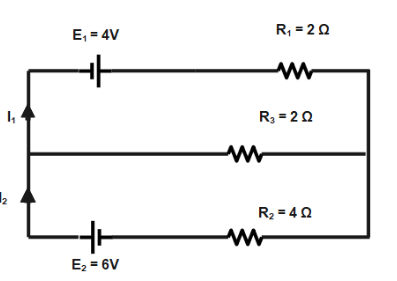
In the circuit shown below ${E_1} = {\text{ }}4{\text{ }}V$, ${R_1} = {\text{ 2}}\Omega $, ${E_2} = {\text{ }}6{\text{ V}}$, ${R_2} = {\text{ }}4{\text{ }}\Omega $and ${R_3} = {\text{ 2 }}\Omega $. The current ${I_1}$ will be:
A. $1{\text{ A}}$
B. $1.6{\text{ A}}$
C. $1.8{\text{ A}}$
D. $1.25{\text{ A}}$
Answer
 Verified
534k+ views
Hint:For these kinds of sums, name all the end points by denoting them as A, B, C etc. Now pass current from one point to another by the help of the given resistance and voltage values. Calculate resultant emf between two points and find the direction of current and apply Kirchhoff's Voltage Law (KVL) at required points.
Complete step by step answer:
Let’s mark the different points of the circuit which will help us to resolve the circuit :
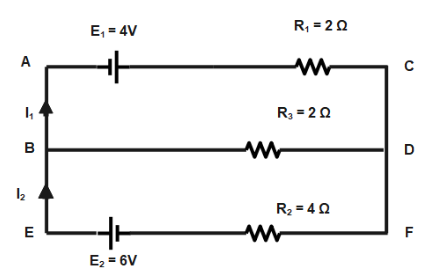
From the figure we see, BD is parallel to the circuit. Now from the figure , we see that current through BD is : \[\]$I_1^{} - {\text{ }}I_2^{}$. ( From the diagram) .
Now applying KVL in the part AEFC :-
\[6 - 4{I_2} + 4 - 2{I_1} = 0\]
\[\Rightarrow 10 - 2{I_1} - 4{I_2} = 0\]
Arranging this:
\[5 = {I_1} + 2{I_2}\] \[ - - - - (1)\]
Now applying KVL in the part ABDC:-
\[4 - 2{I_1} + 2({I_2} - {I_1}) = 0\]
\[\Rightarrow 4 - 4{I_1} + 2{I_2} = 0\]
Arranging this:
\[4{I_1} - 2{I_2} = 4\; - - - - \left( 2 \right)\;\]
Now adding (1) and (2) we get the following:
\[5{I_1} = 9\]
\[\therefore {I_1} = 1.8\]
Hence from the question by applying the KVL equation we easily found the value of current.Now we can find the other current also by the help of equation (1). Let’s find the value of ${I_2}$ : From 1 , ${I_2} = \dfrac{{5 - {I_1}}}{2}$. Thus, the value of ${I_2}= 1.6$ .Thus we get both the values of current.Keep in mind we need to break the circuit in components and solve.
Hence, the correct answer is option B.
Note: To solve these type of equations keep in mind , we need to use KVL and point out the different positions of the circuit (Students generally take the sign of voltage wrong while current passing through a resistor) .Break the circuit into different components and solve individual equation, and your problem is solved.
Complete step by step answer:
Let’s mark the different points of the circuit which will help us to resolve the circuit :
From the figure we see, BD is parallel to the circuit. Now from the figure , we see that current through BD is : \[\]$I_1^{} - {\text{ }}I_2^{}$. ( From the diagram) .
Now applying KVL in the part AEFC :-
\[6 - 4{I_2} + 4 - 2{I_1} = 0\]
\[\Rightarrow 10 - 2{I_1} - 4{I_2} = 0\]
Arranging this:
\[5 = {I_1} + 2{I_2}\] \[ - - - - (1)\]
Now applying KVL in the part ABDC:-
\[4 - 2{I_1} + 2({I_2} - {I_1}) = 0\]
\[\Rightarrow 4 - 4{I_1} + 2{I_2} = 0\]
Arranging this:
\[4{I_1} - 2{I_2} = 4\; - - - - \left( 2 \right)\;\]
Now adding (1) and (2) we get the following:
\[5{I_1} = 9\]
\[\therefore {I_1} = 1.8\]
Hence from the question by applying the KVL equation we easily found the value of current.Now we can find the other current also by the help of equation (1). Let’s find the value of ${I_2}$ : From 1 , ${I_2} = \dfrac{{5 - {I_1}}}{2}$. Thus, the value of ${I_2}= 1.6$ .Thus we get both the values of current.Keep in mind we need to break the circuit in components and solve.
Hence, the correct answer is option B.
Note: To solve these type of equations keep in mind , we need to use KVL and point out the different positions of the circuit (Students generally take the sign of voltage wrong while current passing through a resistor) .Break the circuit into different components and solve individual equation, and your problem is solved.
Recently Updated Pages
Master Class 12 Economics: Engaging Questions & Answers for Success

Master Class 12 English: Engaging Questions & Answers for Success
Master Class 12 Social Science: Engaging Questions & Answers for Success
Master Class 12 Maths: Engaging Questions & Answers for Success
Master Class 12 Physics: Engaging Questions & Answers for Success
Master Class 12 Business Studies: Engaging Questions & Answers for Success
Trending doubts
Which are the Top 10 Largest Countries of the World?
Draw a labelled sketch of the human eye class 12 physics CBSE
Differentiate between homogeneous and heterogeneous class 12 chemistry CBSE
Why is the cell called the structural and functional class 12 biology CBSE
Draw ray diagrams each showing i myopic eye and ii class 12 physics CBSE
Which is the correct genotypic ratio of mendel dihybrid class 12 biology CBSE