




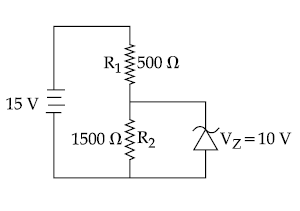
In the circuit diagram, the current through the Zener diode is:
A. 10mA
B. 3.33mA
C. 6.67mA
D. 0mA
Answer
 Verified
625.8k+ views
- Hint: This question is based upon the basic property of Zener diode, as we know that it can operate continuously without being damaged in the region of reverse biased where it can act as voltage regulator and in forward biasing it act as ordinary diode. So we need to find the potential difference across \[{R_1}\] and potential difference across \[{R_2}\] through which we can find current across \[{R_1}\] and \[{R_2}\] which will help us in finding the required current.
Complete step-by-step answer:
As we see that the resistance ${R_2}$ and Zener diodes are connected in parallel so the voltage across them is equal, so the potential difference across ${R_2}$ is also 10 Volts.
Potential difference across \[{R_2}\]=10.
Let, Potential difference across\[{R_1}\]be${V_1}$.
Now apply a simple K.V.L in first loop of the circuit we have,
$15 - {V_1} - 10 = 0$
Now simplify this
$ \Rightarrow {V_1} = 15 - 10 = 5$ Volts
As we know the potential difference of both the resistor \[{R_1}\]and \[{R_2}\]
We shall find the current between \[{R_1}\] and \[{R_2}\]
So,applying Ohm’s law (V=IR) we have,
Current passing through \[{R_1}\], ${I_1}$ \[ = \dfrac{{{V_1}}}{{{R_1}}} = \dfrac{5}{{500}} = \dfrac{1}{{100}}A\]
Current passing through \[{R_2}\], ${I_2}$ = \[\dfrac{{{V_2}}}{{{R_2}}} = \dfrac{{10}}{{1500}} = \dfrac{1}{{150}}A\]
Now, we need to find the current through Zener diode, which is the difference of the currents calculated above,
Current through Zener diode = \[\dfrac{1}{{100}} - \dfrac{1}{{150}} = \dfrac{{3 - 2}}{{300}} = \dfrac{1}{{300}}\]= \[3.3mA\]
Therefore, current through Zener diodes would be \[3.3mA\].
Note: Zener diodes are generated with a wide range of Zener voltages, and some are variable also. Many Zener diodes have a straight, highly doped p – n junction with low Zener voltage, in which case the reverse conduction occurs in the short space between p and n regions due to the electron quantum tunneling − this is known as the Zener effect, after Clarence Zener.
Complete step-by-step answer:
As we see that the resistance ${R_2}$ and Zener diodes are connected in parallel so the voltage across them is equal, so the potential difference across ${R_2}$ is also 10 Volts.
Potential difference across \[{R_2}\]=10.
Let, Potential difference across\[{R_1}\]be${V_1}$.
Now apply a simple K.V.L in first loop of the circuit we have,
$15 - {V_1} - 10 = 0$
Now simplify this
$ \Rightarrow {V_1} = 15 - 10 = 5$ Volts
As we know the potential difference of both the resistor \[{R_1}\]and \[{R_2}\]
We shall find the current between \[{R_1}\] and \[{R_2}\]
So,applying Ohm’s law (V=IR) we have,
Current passing through \[{R_1}\], ${I_1}$ \[ = \dfrac{{{V_1}}}{{{R_1}}} = \dfrac{5}{{500}} = \dfrac{1}{{100}}A\]
Current passing through \[{R_2}\], ${I_2}$ = \[\dfrac{{{V_2}}}{{{R_2}}} = \dfrac{{10}}{{1500}} = \dfrac{1}{{150}}A\]
Now, we need to find the current through Zener diode, which is the difference of the currents calculated above,
Current through Zener diode = \[\dfrac{1}{{100}} - \dfrac{1}{{150}} = \dfrac{{3 - 2}}{{300}} = \dfrac{1}{{300}}\]= \[3.3mA\]
Therefore, current through Zener diodes would be \[3.3mA\].
Note: Zener diodes are generated with a wide range of Zener voltages, and some are variable also. Many Zener diodes have a straight, highly doped p – n junction with low Zener voltage, in which case the reverse conduction occurs in the short space between p and n regions due to the electron quantum tunneling − this is known as the Zener effect, after Clarence Zener.
Recently Updated Pages
Master Class 12 Economics: Engaging Questions & Answers for Success

Master Class 12 English: Engaging Questions & Answers for Success
Master Class 12 Social Science: Engaging Questions & Answers for Success
Master Class 12 Maths: Engaging Questions & Answers for Success
Master Class 12 Physics: Engaging Questions & Answers for Success
Master Class 9 General Knowledge: Engaging Questions & Answers for Success
Trending doubts
Which are the Top 10 Largest Countries of the World?
Draw a labelled sketch of the human eye class 12 physics CBSE
Differentiate between homogeneous and heterogeneous class 12 chemistry CBSE
Sulphuric acid is known as the king of acids State class 12 chemistry CBSE
Why is the cell called the structural and functional class 12 biology CBSE
Draw ray diagrams each showing i myopic eye and ii class 12 physics CBSE