




In the Beta-pleated secondary structure
A) Polypeptides show alternate reverse helix
B) Two or more polypeptides form sheet and run parallel
C) Two or more polypeptides form sheet but the polypeptides run antiparallel
D) Both B and C
Answer
 Verified
568.8k+ views
Hint:
- A polypeptide is a single, long, linear chain of amino acids held together by amide bonds.
- A protein is made up of one or more polypeptides (more than about 50 amino acids long).
- An oligopeptide is made up of only a few amino acids (between two and twenty).
Complete answer:
A few secondary structures are highly stable and are found in abundance in proteins. Secondary configuration refers to the local conformation of a portion of a polypeptide. The alpha-helix and beta conformations are the most common secondary structures.
The beta conformation is a more extended polypeptide chain conformation than the alpha helix. In the beta conformation, the polypeptide chain's backbone is stretched in a zigzag pattern rather than a helical configuration as in the alpha helix. Since the zigzag polypeptide chains are arranged side by side, they form a structure that looks like a sequence of pleats, thus the names beta (pleated) confirmation or beta-sheet. Hydrogen bonds are formed between adjacent segments of polypeptide chains in this process. A beta sheet's neighbouring polypeptide chains may be either parallel (with the same amino-to-carboxyl orientation) or antiparallel (having opposite amino-to-carboxyl orientation).
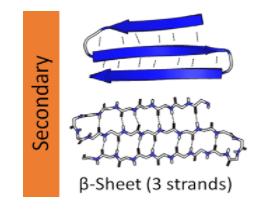
Here, option A is incorrect as we know that In the beta conformation, the polypeptide chain's backbone is stretched in a zigzag pattern rather than a helical configuration as in the alpha helix. Option B is correct as polypeptide can run in any direction. The same applies to option C. Hence, Option D is correct
Note:
- The instructions in mRNA are read during translation, and tRNA transports the proper sequence of amino acids to the ribosome.
- Then, rRNA aids in the formation of bonds between the amino acids, resulting in a polypeptide chain.
- Following the synthesis of a polypeptide chain, it may go through additional processing to shape the finished protein.
- A polypeptide is a single, long, linear chain of amino acids held together by amide bonds.
- A protein is made up of one or more polypeptides (more than about 50 amino acids long).
- An oligopeptide is made up of only a few amino acids (between two and twenty).
Complete answer:
A few secondary structures are highly stable and are found in abundance in proteins. Secondary configuration refers to the local conformation of a portion of a polypeptide. The alpha-helix and beta conformations are the most common secondary structures.
The beta conformation is a more extended polypeptide chain conformation than the alpha helix. In the beta conformation, the polypeptide chain's backbone is stretched in a zigzag pattern rather than a helical configuration as in the alpha helix. Since the zigzag polypeptide chains are arranged side by side, they form a structure that looks like a sequence of pleats, thus the names beta (pleated) confirmation or beta-sheet. Hydrogen bonds are formed between adjacent segments of polypeptide chains in this process. A beta sheet's neighbouring polypeptide chains may be either parallel (with the same amino-to-carboxyl orientation) or antiparallel (having opposite amino-to-carboxyl orientation).
Here, option A is incorrect as we know that In the beta conformation, the polypeptide chain's backbone is stretched in a zigzag pattern rather than a helical configuration as in the alpha helix. Option B is correct as polypeptide can run in any direction. The same applies to option C. Hence, Option D is correct
Note:
- The instructions in mRNA are read during translation, and tRNA transports the proper sequence of amino acids to the ribosome.
- Then, rRNA aids in the formation of bonds between the amino acids, resulting in a polypeptide chain.
- Following the synthesis of a polypeptide chain, it may go through additional processing to shape the finished protein.
Recently Updated Pages
Master Class 12 Economics: Engaging Questions & Answers for Success

Master Class 12 Social Science: Engaging Questions & Answers for Success
Master Class 12 English: Engaging Questions & Answers for Success
Master Class 12 Maths: Engaging Questions & Answers for Success
Master Class 12 Physics: Engaging Questions & Answers for Success
Master Class 12 Biology: Engaging Questions & Answers for Success
Trending doubts
Draw a labelled sketch of the human eye class 12 physics CBSE
Which are the Top 10 Largest Countries of the World?
Draw ray diagrams each showing i myopic eye and ii class 12 physics CBSE
Which is the correct genotypic ratio of mendel dihybrid class 12 biology CBSE
Differentiate between homogeneous and heterogeneous class 12 chemistry CBSE
Which animal never drinks water in its entire life class 12 biology CBSE