



In the below reaction, the reactivity of alcohols is;
$ROH + HX \to RX + {H_2}O$ ;
A) \[Tertiary{\text{ }} > {\text{ }}secondary{\text{ }} > {\text{ }}primary\]
B) \[Tertiary{\text{ }} < {\text{ }}secondary{\text{ }} < {\text{ }}primary\]
C) \[Tertiary{\text{ }} > {\text{ }}primary{\text{ }} > {\text{ }}secondary\]
D) \[Secondary{\text{ }} > {\text{ }}primary{\text{ }} > {\text{ }}tertiary\]
Answer
 Verified
634.2k+ views
Hint: Alcohols are compounds in which a hydroxyl (– OH) group is attached to saturated carbon atom.
General Formula: $R - OH$
Monohydric alcohols are classified as primary (1°) secondary (2°), or tertiary (3°), depending upon whether the –OH group is attached to a primary, a secondary, or a tertiary carbon.
Complete step by step answer:Alcohols are reactive compounds. They are attacked by polar or ionic reagents. This is because:
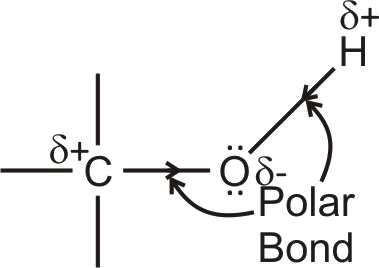
The C–O and O–H bonds of the alcohols are polar since oxygen is highly electronegative.
They oxygen atoms of alcohols is an electron-rich centre because it has two unshared pairs of electrons
Alcohols react with hydrogen (\[HX\]) to form the corresponding alkyl halides
Eg; $C{H_3}C{H_2}OH + HBr \to C{H_3}C{H_2}Br + {H_2}O$
In general, tertiary alcohols react rapidly with hydrogen halides; secondary alcohols react somewhat slower; and primary alcohols, even more slowly.
The reaction is acid catalyzed. Alcohols react with the strongly acidic hydrogen halides \[HCl,{\text{ }}HBr\] , and {\text{ }}HI\], but they do not react with non acidic \[NaCl,{\text{ }}NaBr,{\text{ }}or{\text{ }}NaI\] . Primary and secondary alcohols can be converted to alkyl chlorides and bromides by allowing them to react with a mixture of a sodium halide and sulfuric acid:
The order of reactivity of alcohols is \[3^\circ > 2^\circ > 1^\circ \] methyl.
So,Option “A” is correct.
Note: The order of reactivity of hydrogen halides\[is{\text{ }}HI{\text{ }} > {\text{ }}HBr{\text{ }} > {\text{ }}HCl\] . \[HCl\] reacts only in the presence of a catalyst anhydrous\[(ZnC{l_2})\] .No catalyst is required in the case of \[HBr{\text{ }}or{\text{ }}HI\].
Primary alcohols react with hydrogen halides by an \[{S_N}1\] mechanism.
General Formula: $R - OH$
Monohydric alcohols are classified as primary (1°) secondary (2°), or tertiary (3°), depending upon whether the –OH group is attached to a primary, a secondary, or a tertiary carbon.
Complete step by step answer:Alcohols are reactive compounds. They are attacked by polar or ionic reagents. This is because:
The C–O and O–H bonds of the alcohols are polar since oxygen is highly electronegative.
They oxygen atoms of alcohols is an electron-rich centre because it has two unshared pairs of electrons
Alcohols react with hydrogen (\[HX\]) to form the corresponding alkyl halides
Eg; $C{H_3}C{H_2}OH + HBr \to C{H_3}C{H_2}Br + {H_2}O$
In general, tertiary alcohols react rapidly with hydrogen halides; secondary alcohols react somewhat slower; and primary alcohols, even more slowly.
The reaction is acid catalyzed. Alcohols react with the strongly acidic hydrogen halides \[HCl,{\text{ }}HBr\] , and {\text{ }}HI\], but they do not react with non acidic \[NaCl,{\text{ }}NaBr,{\text{ }}or{\text{ }}NaI\] . Primary and secondary alcohols can be converted to alkyl chlorides and bromides by allowing them to react with a mixture of a sodium halide and sulfuric acid:
The order of reactivity of alcohols is \[3^\circ > 2^\circ > 1^\circ \] methyl.
So,Option “A” is correct.
Note: The order of reactivity of hydrogen halides\[is{\text{ }}HI{\text{ }} > {\text{ }}HBr{\text{ }} > {\text{ }}HCl\] . \[HCl\] reacts only in the presence of a catalyst anhydrous\[(ZnC{l_2})\] .No catalyst is required in the case of \[HBr{\text{ }}or{\text{ }}HI\].
Primary alcohols react with hydrogen halides by an \[{S_N}1\] mechanism.
Recently Updated Pages
Which of the following graphs shows the variation of class 12 physics CBSE

Draw a labelled diagram of the human male reproductive class 12 biology CBSE
Describe the experiment to compare the emf of two cells class 12 physics CBSE
What is standard hydrogen electrode
What is conventional current and electric current class 12 physics CBSE
2Bromopentane is treated with an alcoholic KOH solution class 12 chemistry CBSE
Trending doubts
Draw a labelled sketch of the human eye class 12 physics CBSE
Which are the Top 10 Largest Countries of the World?
A member of Simon commission later became Prime Minister class 12 social science CBSE
Differentiate between homogeneous and heterogeneous class 12 chemistry CBSE
Draw ray diagrams each showing i myopic eye and ii class 12 physics CBSE
Which is the correct genotypic ratio of mendel dihybrid class 12 biology CBSE