




In the bell jar experiment, after starting the vacuum pump the sound gradually becomes fainter & finally we hear a feeble sound rely.
A. The vacuum pump absorbs the sound.
B. The medium is sucked by the pump.
C. The bell jar behaves as an isolated medium.
D. The bell does not produce such a strong sound as it was producing earlier.
Answer
 Verified
636.3k+ views
Hint: Bell jar experiment has been done to check the property of medium. It clarifies the necessity of medium to travel the sound through it. Sound is a disturbance which is called due to medium, present in air. We can also say that sound is a form of energy and wave which has disturbance of wave particles.
Complete step by step solution:
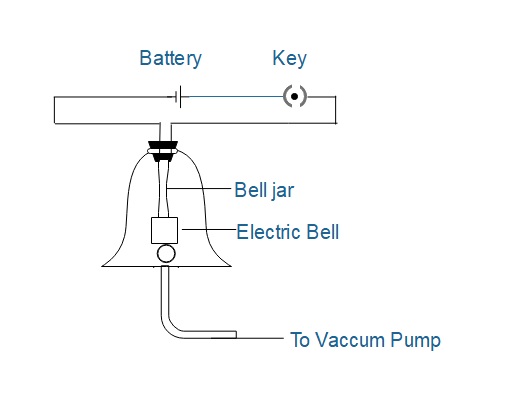
First let's do the contraction of experiment. Take a jar of glass and suspend an electric bell inside it. Take wires, connect positive terminal of wire to negative terminal of battery & negative terminal to positive terminal of battery outside the jar. Now switch on the key, i.e. now the circuit is closed. As soon as the circuit gets close, a sound is produced due to the bell ringing as the jar contains air and we know that sound travels through this air.
Now remove air from the jar with the help of a vacuum pump. Make sure before this, close the circuit. If you observe, then hardly any sound is coming to hear even though a hammer or striker is seen striking the gong.
So from this experiment, we can conclude that sound cannot propagate in absence of medium (It may be air). That is we can say sound requires medium to travel through any kind of medium.
Therefore, option (B) is correct.
Note: In this experiment, absence of air does not affect the frequency of stickers. Even though air has been removed, the sticker is still producing sound but it is not traveling because air contains particles & layers of particles & when sound produces, it disturbs that layer and hence sound is produced. Note that this experiment cannot be performed in vacuum, i.e. on the moon. Since sound cant propagate through vacuum.
Complete step by step solution:
First let's do the contraction of experiment. Take a jar of glass and suspend an electric bell inside it. Take wires, connect positive terminal of wire to negative terminal of battery & negative terminal to positive terminal of battery outside the jar. Now switch on the key, i.e. now the circuit is closed. As soon as the circuit gets close, a sound is produced due to the bell ringing as the jar contains air and we know that sound travels through this air.
Now remove air from the jar with the help of a vacuum pump. Make sure before this, close the circuit. If you observe, then hardly any sound is coming to hear even though a hammer or striker is seen striking the gong.
So from this experiment, we can conclude that sound cannot propagate in absence of medium (It may be air). That is we can say sound requires medium to travel through any kind of medium.
Therefore, option (B) is correct.
Note: In this experiment, absence of air does not affect the frequency of stickers. Even though air has been removed, the sticker is still producing sound but it is not traveling because air contains particles & layers of particles & when sound produces, it disturbs that layer and hence sound is produced. Note that this experiment cannot be performed in vacuum, i.e. on the moon. Since sound cant propagate through vacuum.
Recently Updated Pages
Explain the structure of megasporangium class 12 biology CBSE

Why is chloroform kept in dark coloured bottles class 12 chemistry CBSE
Derive the balancing condition of a Wheatstone bri class 12 physics CBSE
Draw VI characteristics of a pn junction diode Explain class 12 physics CBSE
Is it possible to carry pride in ones language too class 12 english CBSE
In a population at Hardy Weinberg equilibrium the allele class 12 biology CBSE
Trending doubts
Draw a labelled sketch of the human eye class 12 physics CBSE
Which are the Top 10 Largest Countries of the World?
Draw ray diagrams each showing i myopic eye and ii class 12 physics CBSE
One megawatt is equal to how many units of electri class 12 physics CBSE
Which is the correct genotypic ratio of mendel dihybrid class 12 biology CBSE
Give 10 examples of unisexual and bisexual flowers