




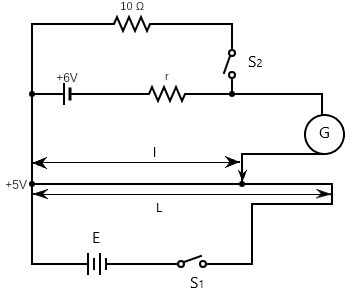
In the arrangement shown in figure when the switch $ {S_2} $ is open, the galvanometer shows no deflection for $ l = \dfrac{L}{2} $ . When the switch $ {S_2} $ is closed, the galvanometer shows no deflection for $ \dfrac{{5L}}{{12}} $ . The internal resistance $ \left( r \right) $ of 6V cell and the emf $ E $ of the other battery respectively are
(A) $ 3\Omega ,8{\text{V}} $
(B) $ 2\Omega ,12{\text{V}} $
(C) $ 2\Omega ,24{\text{V}} $
(D) $ 3\Omega ,12{\text{V}} $
Answer
 Verified
571.8k+ views
Hint: When galvanometer shows no deflection, it means no current is flowing through it. In this case the ratio of voltage across the wire to the point where the jockey is to the voltage across the entire wire is equal to the ratio of the length to the jockey is to the ratio of the entire length of the potentiometer.
Formula used: In this solution we will be using the following formulae;
$ \dfrac{{{E_1}}}{{{E_2}}} = \dfrac{{{L_1}}}{{{L_2}}} $ where $ {E_1} $ is the voltage across the potentiometer to where the jockey is, $ {E_2} $ is the voltage across the entire potentiometer, $ {L_1} $ is the length of the wire of the potentiometer to where the jockey is, and $ {L_2} $ is the length of the entire wire.
Complete step by step answer:
When the switch $ {S_2} $ is closed, no current will flow through the section of the circuit. Now at the same time, no deflection in the galvanometer if the jockey is at $ l = \dfrac{L}{2} $ . At this point, we can use the equation
$ \dfrac{{{E_1}}}{{{E_2}}} = \dfrac{{{L_1}}}{{{L_2}}} $ where $ {E_1} $ is the voltage across the potentiometer to where the jockey is, $ {E_2} $ is the voltage across the entire potentiometer, $ {L_1} $ is the length of the wire of the potentiometer to where the jockey is, and $ {L_2} $ is the length of the entire wire. Hence,
$ \dfrac{6}{E} = \dfrac{{\dfrac{L}{2}}}{L} $
Simplifying, and calculating for $ E $ , we have
$ E = 12{\text{V}} $ .
Also, there is no deflection when the switch $ {S_2} $ is closed at $ l = \dfrac{{5L}}{{12}} $ , however current will flow through the upper branch of the circuit.
Applying kirchoff’s rule to that circuit, we have
$ 6 - Ir - 10I = 0 $
$ \Rightarrow I = \dfrac{6}{{r + 10}} $
Hence, the voltage from the cell to beyond the internal resistance is
$ V = 6 - Ir = 6 - \dfrac{{6r}}{{r + 10}} $
Now, because there’s no deflection in galvanometer, we have
$ \dfrac{V}{E} = \dfrac{{\dfrac{{5L}}{{12}}}}{L} $ . replacing $ E $ with 12 volts and finding $ V $ , we have that
$ V = 5{\text{V}} $
Hence,
$ 6 - \dfrac{{6r}}{{r + 10}} = 5 $
$ \Rightarrow \dfrac{{6r}}{{r + 10}} = 1 $
Solving for $ r $ , we have
$ r = 2\Omega $
Hence, the correct option is B.
Note:
For clarity, observe that the internal resistance does not affect the emf of the 6 V cell in the first case but is affected in the second case. This is because in the first case, current is not flowing through the cell, thus the internal resistance is dormant.
Formula used: In this solution we will be using the following formulae;
$ \dfrac{{{E_1}}}{{{E_2}}} = \dfrac{{{L_1}}}{{{L_2}}} $ where $ {E_1} $ is the voltage across the potentiometer to where the jockey is, $ {E_2} $ is the voltage across the entire potentiometer, $ {L_1} $ is the length of the wire of the potentiometer to where the jockey is, and $ {L_2} $ is the length of the entire wire.
Complete step by step answer:
When the switch $ {S_2} $ is closed, no current will flow through the section of the circuit. Now at the same time, no deflection in the galvanometer if the jockey is at $ l = \dfrac{L}{2} $ . At this point, we can use the equation
$ \dfrac{{{E_1}}}{{{E_2}}} = \dfrac{{{L_1}}}{{{L_2}}} $ where $ {E_1} $ is the voltage across the potentiometer to where the jockey is, $ {E_2} $ is the voltage across the entire potentiometer, $ {L_1} $ is the length of the wire of the potentiometer to where the jockey is, and $ {L_2} $ is the length of the entire wire. Hence,
$ \dfrac{6}{E} = \dfrac{{\dfrac{L}{2}}}{L} $
Simplifying, and calculating for $ E $ , we have
$ E = 12{\text{V}} $ .
Also, there is no deflection when the switch $ {S_2} $ is closed at $ l = \dfrac{{5L}}{{12}} $ , however current will flow through the upper branch of the circuit.
Applying kirchoff’s rule to that circuit, we have
$ 6 - Ir - 10I = 0 $
$ \Rightarrow I = \dfrac{6}{{r + 10}} $
Hence, the voltage from the cell to beyond the internal resistance is
$ V = 6 - Ir = 6 - \dfrac{{6r}}{{r + 10}} $
Now, because there’s no deflection in galvanometer, we have
$ \dfrac{V}{E} = \dfrac{{\dfrac{{5L}}{{12}}}}{L} $ . replacing $ E $ with 12 volts and finding $ V $ , we have that
$ V = 5{\text{V}} $
Hence,
$ 6 - \dfrac{{6r}}{{r + 10}} = 5 $
$ \Rightarrow \dfrac{{6r}}{{r + 10}} = 1 $
Solving for $ r $ , we have
$ r = 2\Omega $
Hence, the correct option is B.
Note:
For clarity, observe that the internal resistance does not affect the emf of the 6 V cell in the first case but is affected in the second case. This is because in the first case, current is not flowing through the cell, thus the internal resistance is dormant.
Recently Updated Pages
Basicity of sulphurous acid and sulphuric acid are

Master Class 12 English: Engaging Questions & Answers for Success
Master Class 12 Social Science: Engaging Questions & Answers for Success
Master Class 12 Maths: Engaging Questions & Answers for Success
Master Class 12 Economics: Engaging Questions & Answers for Success
Master Class 12 Physics: Engaging Questions & Answers for Success
Trending doubts
Which are the Top 10 Largest Countries of the World?
Draw a labelled sketch of the human eye class 12 physics CBSE
Which country did Danny Casey play for class 12 english CBSE
Give 10 examples of unisexual and bisexual flowers
Coming together federation is practiced in A India class 12 social science CBSE
Write the formula to find the shortest distance between class 12 maths CBSE