




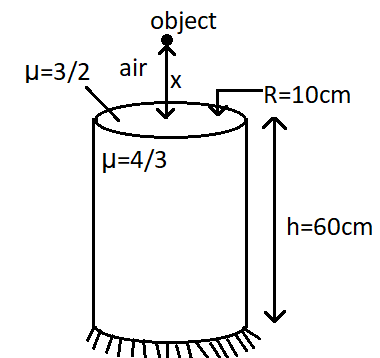
In the arrangement shown given that a biconvex lens of radius of curvature equal to $10cm$ and a concave mirror has focal length equal to $20cm$. Then find the distance $x$ such that the final image formed by the system coincides with the object.
Answer
 Verified
574.8k+ views
Hint: Using the formula for the focal length of the lens in the terms of the object and the image distance, we can find the object distance. Here the image distance will be the difference of the distance of the lens and the mirror and the focal length of the mirror.
Formula used: In this solution we will be using the following formula,
$\Rightarrow \dfrac{1}{f} = \dfrac{1}{u} + \dfrac{1}{v}$
where $f$ is the focal length of the lens, $u$ is the object distance and $v$ is the image distance.
Complete step by step solution:
In the problem, we are given that the focal length of the lens is $10cm$ as for a biconvex lens, the radius of curvature is the focal length. Now the image distance of the combination will be the difference between the distance between the lens and the mirror and the focal length of the mirror.
So can use the formula for the lens given as,
$\Rightarrow \dfrac{1}{f} = \dfrac{1}{u} + \dfrac{1}{v}$
Here, $f = 10cm$ and $v = 60 - 20$
So the image distance is $v = 40cn$
Now sub substituting the values we get,
$\Rightarrow \dfrac{1}{{10}} = \dfrac{1}{u} + \dfrac{1}{{40}}$
So taking the $\dfrac{1}{u}$ to the LHS we get,
$\Rightarrow \dfrac{1}{u} = \dfrac{1}{{10}} - \dfrac{1}{{40}}$
Taking LCM as 40,
$\Rightarrow \dfrac{1}{u} = \dfrac{{4 - 1}}{{10}}$
On taking the inverse we get,
$\Rightarrow u = \dfrac{{10}}{3}cm$
hence the object distance is $u = 3.33cm$.
Note:
A biconvex lens is a simple lens consisting of two convex surfaces which generally have the same radius of curvature. A concave mirror is a portion of a hollow sphere where the outer surface of the sphere is painted so that the inner surface reflects the light falling on it.
Formula used: In this solution we will be using the following formula,
$\Rightarrow \dfrac{1}{f} = \dfrac{1}{u} + \dfrac{1}{v}$
where $f$ is the focal length of the lens, $u$ is the object distance and $v$ is the image distance.
Complete step by step solution:
In the problem, we are given that the focal length of the lens is $10cm$ as for a biconvex lens, the radius of curvature is the focal length. Now the image distance of the combination will be the difference between the distance between the lens and the mirror and the focal length of the mirror.
So can use the formula for the lens given as,
$\Rightarrow \dfrac{1}{f} = \dfrac{1}{u} + \dfrac{1}{v}$
Here, $f = 10cm$ and $v = 60 - 20$
So the image distance is $v = 40cn$
Now sub substituting the values we get,
$\Rightarrow \dfrac{1}{{10}} = \dfrac{1}{u} + \dfrac{1}{{40}}$
So taking the $\dfrac{1}{u}$ to the LHS we get,
$\Rightarrow \dfrac{1}{u} = \dfrac{1}{{10}} - \dfrac{1}{{40}}$
Taking LCM as 40,
$\Rightarrow \dfrac{1}{u} = \dfrac{{4 - 1}}{{10}}$
On taking the inverse we get,
$\Rightarrow u = \dfrac{{10}}{3}cm$
hence the object distance is $u = 3.33cm$.
Note:
A biconvex lens is a simple lens consisting of two convex surfaces which generally have the same radius of curvature. A concave mirror is a portion of a hollow sphere where the outer surface of the sphere is painted so that the inner surface reflects the light falling on it.
Recently Updated Pages
Master Class 12 Economics: Engaging Questions & Answers for Success

Master Class 12 Physics: Engaging Questions & Answers for Success
Master Class 12 English: Engaging Questions & Answers for Success
Master Class 12 Social Science: Engaging Questions & Answers for Success
Master Class 12 Maths: Engaging Questions & Answers for Success
Master Class 12 Business Studies: Engaging Questions & Answers for Success
Trending doubts
Which are the Top 10 Largest Countries of the World?
What are the major means of transport Explain each class 12 social science CBSE
Draw a labelled sketch of the human eye class 12 physics CBSE
Why cannot DNA pass through cell membranes class 12 biology CBSE
Differentiate between insitu conservation and exsitu class 12 biology CBSE
Draw a neat and well labeled diagram of TS of ovary class 12 biology CBSE