




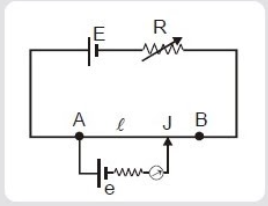
In the adjoining potentiometer circuit, the resistance of uniform cross section the potentiometer wire AB of Length 1 m is \[10\;\Omega \]. When the variable resistance \[R = 10\;\Omega \], the balance point is obtained for length l as shown. If the variable resistance is doubled, the new balance length is
A. \[l\]
B. \[1.5\;l\]
C. \[2\;l\]
D. \[\dfrac{l}{2}\]
Answer
 Verified
604.5k+ views
Hint: The above problem can be solved using the mathematical relations that come under the potentiometer; the two conditions are given. The first condition is the specific value of the variable resistance, and the other condition is given for the double value of the variable resistance. Hence, the current can be identified using the formula and then substitute accordingly to obtain the final result
Complete step by step answer:
The length of the wire AB is, \[L = 1\;{\rm{m}}\].
The value of the variable resistance is, \[R = 10\;\Omega \].
Let E be the voltage of the main source and current in the circuit is,
\[{I_1} = \dfrac{E}{{R + R}}\]
When the variable resistance becomes double, then the above formula is expressed as,
\[\begin{array}{l}
{I_1} = \dfrac{E}{{R + R}}\\
{I_2} = \dfrac{E}{{\left( {2R} \right) + R}}
\end{array}\]
Now, taking the voltages across the points A and J, for the both the conditions
The expression is,
\[{V_{AJ}} = \left( {\dfrac{E}{{R + R}}} \right) \times {l_1}................................\left( 1 \right)\]
Here, \[{l_1}\]is the initial balancing length.
As, on doubling the variable resistance , the voltage will remain same as,
\[{V_{AJ}} = \left( {\dfrac{E}{{\left( {2R} \right) + R}}} \right) \times {l_2}................................\left( 2 \right)\]
Here, \[{l_2}\]is the final balancing length.
Take the ratio of equation 2 and 1 as,
\[\begin{array}{l}
\dfrac{{\left( {\dfrac{E}{{\left( {2R} \right) + R}}} \right) \times {l_2}}}{{\left( {\dfrac{E}{{R + R}}} \right) \times {l_1}}} = \dfrac{3}{2}\\
\dfrac{{{l_2}}}{{{l_1}}} = \dfrac{3}{2}
\end{array}\]
Therefore, the ratio of new balance length is 3/2 or 1.5
So, the correct answer is “Option B”.
Note:
To solve the given problem, the potentiometer concepts must be cleared, along with all the mathematical relations derived, while undertaking the practical analysis of the potentiometer. The applications of the potentiometer find its importance in various labs and the electrical analysis. Moreover, the formulas need to be remembered along with their significance at each and every point on the analysis.
Complete step by step answer:
The length of the wire AB is, \[L = 1\;{\rm{m}}\].
The value of the variable resistance is, \[R = 10\;\Omega \].
Let E be the voltage of the main source and current in the circuit is,
\[{I_1} = \dfrac{E}{{R + R}}\]
When the variable resistance becomes double, then the above formula is expressed as,
\[\begin{array}{l}
{I_1} = \dfrac{E}{{R + R}}\\
{I_2} = \dfrac{E}{{\left( {2R} \right) + R}}
\end{array}\]
Now, taking the voltages across the points A and J, for the both the conditions
The expression is,
\[{V_{AJ}} = \left( {\dfrac{E}{{R + R}}} \right) \times {l_1}................................\left( 1 \right)\]
Here, \[{l_1}\]is the initial balancing length.
As, on doubling the variable resistance , the voltage will remain same as,
\[{V_{AJ}} = \left( {\dfrac{E}{{\left( {2R} \right) + R}}} \right) \times {l_2}................................\left( 2 \right)\]
Here, \[{l_2}\]is the final balancing length.
Take the ratio of equation 2 and 1 as,
\[\begin{array}{l}
\dfrac{{\left( {\dfrac{E}{{\left( {2R} \right) + R}}} \right) \times {l_2}}}{{\left( {\dfrac{E}{{R + R}}} \right) \times {l_1}}} = \dfrac{3}{2}\\
\dfrac{{{l_2}}}{{{l_1}}} = \dfrac{3}{2}
\end{array}\]
Therefore, the ratio of new balance length is 3/2 or 1.5
So, the correct answer is “Option B”.
Note:
To solve the given problem, the potentiometer concepts must be cleared, along with all the mathematical relations derived, while undertaking the practical analysis of the potentiometer. The applications of the potentiometer find its importance in various labs and the electrical analysis. Moreover, the formulas need to be remembered along with their significance at each and every point on the analysis.
Recently Updated Pages
Master Class 12 Social Science: Engaging Questions & Answers for Success

Master Class 12 Physics: Engaging Questions & Answers for Success
Master Class 12 Maths: Engaging Questions & Answers for Success
Master Class 12 Economics: Engaging Questions & Answers for Success
Master Class 12 Chemistry: Engaging Questions & Answers for Success
Master Class 12 Business Studies: Engaging Questions & Answers for Success
Trending doubts
Which are the Top 10 Largest Countries of the World?
Draw a labelled sketch of the human eye class 12 physics CBSE
Explain the structure of megasporangium class 12 biology CBSE
What are the major means of transport Explain each class 12 social science CBSE
How many chromosomes are found in human ovum a 46 b class 12 biology CBSE
The diagram of the section of a maize grain is given class 12 biology CBSE