




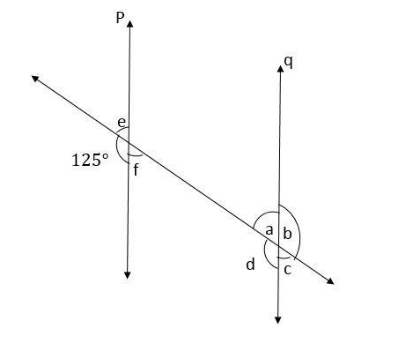
In the adjoining figure , $ p\parallel q $ . Find the unknown angles.
Answer
 Verified
622.8k+ views
Hint: It is better to understand the different properties of geometry. The angles can be found by using properties of parallel lines and straight lines.
Complete step-by-step answer:
Observe the diagram
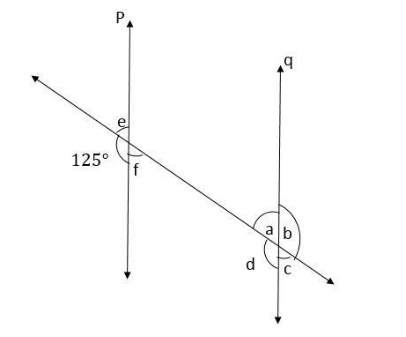
Sum of the angles which form a linear pair is equal to $ {180^0} $
Therefore, from the diagram, we can say that
$ 125^\circ + \angle e = 180^\circ $ (Linear pair)
So, we get
$ \angle e = 180^\circ - 125^\circ $
$ \Rightarrow \angle e = 55^\circ $
$ \angle e = \angle f $ (Vertically opposite angles)
$ \Rightarrow \angle f = 55^\circ $
$ \angle a = \angle e $ (Corresponding angles of two parallel lines)
$ \therefore \angle a = \angle e = 55^\circ $
$ \Rightarrow \angle a = 55^\circ $
$ \angle d = 125^\circ $ (Corresponding angles of two parallel lines)
$ \angle a = \angle c $ (Vertically opposite angles)
$ \Rightarrow \angle c = {55^0} $
$ \angle b = \angle d $ (Vertically opposite angles)
$ \Rightarrow \angle b = {125^0} $
Note: Such a question cannot be solved using what is given in the question. You need to figure out additional points to solve the problem using the given information. This question only can be solved if you know the properties of adjoining figures.
Complete step-by-step answer:
Observe the diagram
Sum of the angles which form a linear pair is equal to $ {180^0} $
Therefore, from the diagram, we can say that
$ 125^\circ + \angle e = 180^\circ $ (Linear pair)
So, we get
$ \angle e = 180^\circ - 125^\circ $
$ \Rightarrow \angle e = 55^\circ $
$ \angle e = \angle f $ (Vertically opposite angles)
$ \Rightarrow \angle f = 55^\circ $
$ \angle a = \angle e $ (Corresponding angles of two parallel lines)
$ \therefore \angle a = \angle e = 55^\circ $
$ \Rightarrow \angle a = 55^\circ $
$ \angle d = 125^\circ $ (Corresponding angles of two parallel lines)
$ \angle a = \angle c $ (Vertically opposite angles)
$ \Rightarrow \angle c = {55^0} $
$ \angle b = \angle d $ (Vertically opposite angles)
$ \Rightarrow \angle b = {125^0} $
Note: Such a question cannot be solved using what is given in the question. You need to figure out additional points to solve the problem using the given information. This question only can be solved if you know the properties of adjoining figures.

Recently Updated Pages
Master Class 11 English: Engaging Questions & Answers for Success

Master Class 11 Social Science: Engaging Questions & Answers for Success
Master Class 11 Maths: Engaging Questions & Answers for Success
Master Class 11 Biology: Engaging Questions & Answers for Success
Master Class 11 Physics: Engaging Questions & Answers for Success
Master Class 11 Chemistry: Engaging Questions & Answers for Success
Trending doubts
In Indian rupees 1 trillion is equal to how many c class 8 maths CBSE
What is BLO What is the full form of BLO class 8 social science CBSE
What are the 12 elements of nature class 8 chemistry CBSE
Citizens of India can vote at the age of A 18 years class 8 social science CBSE
Which of the following leader has given the term insensate class 8 social science CBSE
Name the states through which the Tropic of Cancer class 8 social science CBSE