




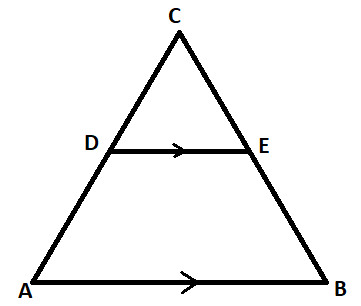
In the adjoining figure, $DE\parallel AB,$ $AD = 7$cm, $CD = 5$cm and $BC = 18$cm. Find BE and CE.
Answer
 Verified
591.6k+ views
Hint: First of all this is a very simple problem, and to solve such kind of problems, we should be familiar with some basic concepts or properties of a triangle, there are three properties. First property is that the triangles drawn between two parallel lines with the same base have equal areas. The second property is that the ratio of areas of triangles with equal height is equal to the ratio of their bases, as the area of a triangle is the half of product of base and height. The third property is the basic proportionality theorem which describes that a line parallel to one side of a triangle divides the other two sides in equal proportion.
Complete step by step answer:
Here applying the basic proportionality theorem which states that if a line is drawn parallel to one side of a triangle and it intersects the other two sides at two distinct points, then it divides the two sides in the same ratio.
Hence using the basic proportionality theorem here, for the triangle ABC, as given below:
\[ \Rightarrow \dfrac{{CD}}{{CA}} = \dfrac{{CE}}{{CB}} = \dfrac{{DE}}{{AB}}\]
Given that $DE\parallel AB$.
Given that $AD = 7$cm and $CD = 5$cm
Also given that $BC = 18$cm.
Now substituting the values in the basic proportionality theorem, as given below:
$ \Rightarrow \dfrac{{CD}}{{CA}} = \dfrac{{CE}}{{CB}}$
As $CA = CD + AD$
$ \Rightarrow CA = 5 + 7$
$\therefore CA = 12$
$ \Rightarrow \dfrac{5}{{12}} = \dfrac{{CE}}{{18}}$
$ \Rightarrow \dfrac{{5(18)}}{{12}} = CE$
$\therefore CE = 7.5$
And given that $BC = 18$
$ \Rightarrow BC = CE + BE$
We found out that $CE = 7.5$, substituting the above expression to find the value of EB, as given below:
$ \Rightarrow 18 = 7.5 + BE$
$ \Rightarrow BE = 18 - 7.5$
$\therefore BE = 10.5$
Hence, CE=7.5cm and BE=10.5cm
Note: This problem can be done by applying the same basic proportionality theorem, but in a different way which gives you the same solution at the end. Given that DE is parallel to AB, then it can also be done by equating the ratio of CD to DA and CE to EB, which is expressed mathematically as: $\dfrac{{CD}}{{DA}} = \dfrac{{CE}}{{EB}}$, which also holds true for a basic proportionality theorem.
Complete step by step answer:
Here applying the basic proportionality theorem which states that if a line is drawn parallel to one side of a triangle and it intersects the other two sides at two distinct points, then it divides the two sides in the same ratio.
Hence using the basic proportionality theorem here, for the triangle ABC, as given below:
\[ \Rightarrow \dfrac{{CD}}{{CA}} = \dfrac{{CE}}{{CB}} = \dfrac{{DE}}{{AB}}\]
Given that $DE\parallel AB$.
Given that $AD = 7$cm and $CD = 5$cm
Also given that $BC = 18$cm.
Now substituting the values in the basic proportionality theorem, as given below:
$ \Rightarrow \dfrac{{CD}}{{CA}} = \dfrac{{CE}}{{CB}}$
As $CA = CD + AD$
$ \Rightarrow CA = 5 + 7$
$\therefore CA = 12$
$ \Rightarrow \dfrac{5}{{12}} = \dfrac{{CE}}{{18}}$
$ \Rightarrow \dfrac{{5(18)}}{{12}} = CE$
$\therefore CE = 7.5$
And given that $BC = 18$
$ \Rightarrow BC = CE + BE$
We found out that $CE = 7.5$, substituting the above expression to find the value of EB, as given below:
$ \Rightarrow 18 = 7.5 + BE$
$ \Rightarrow BE = 18 - 7.5$
$\therefore BE = 10.5$
Hence, CE=7.5cm and BE=10.5cm
Note: This problem can be done by applying the same basic proportionality theorem, but in a different way which gives you the same solution at the end. Given that DE is parallel to AB, then it can also be done by equating the ratio of CD to DA and CE to EB, which is expressed mathematically as: $\dfrac{{CD}}{{DA}} = \dfrac{{CE}}{{EB}}$, which also holds true for a basic proportionality theorem.
Recently Updated Pages
Master Class 12 Business Studies: Engaging Questions & Answers for Success

Master Class 12 Biology: Engaging Questions & Answers for Success
Master Class 12 Chemistry: Engaging Questions & Answers for Success
Class 12 Question and Answer - Your Ultimate Solutions Guide
Master Class 11 Social Science: Engaging Questions & Answers for Success
Master Class 11 English: Engaging Questions & Answers for Success
Trending doubts
Which is more stable and why class 12 chemistry CBSE
Which are the Top 10 Largest Countries of the World?
Draw a labelled sketch of the human eye class 12 physics CBSE
Differentiate between homogeneous and heterogeneous class 12 chemistry CBSE
What are the major means of transport Explain each class 12 social science CBSE
Sulphuric acid is known as the king of acids State class 12 chemistry CBSE