




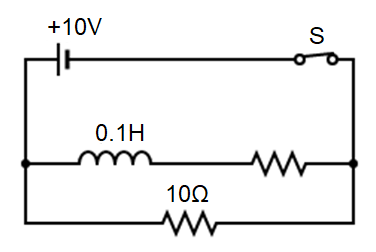
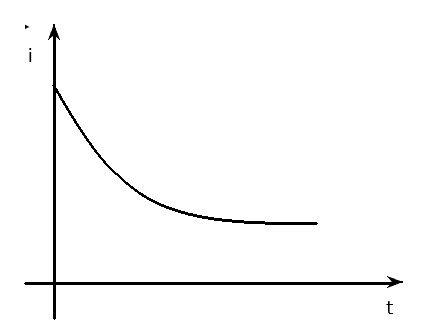
In the adjoining circuit, initially, the switch S is open. The switch S is closed at \[t = 0\]. The difference between the maximum and minimum current that can flow in the circuit is
(A) 2 Amp
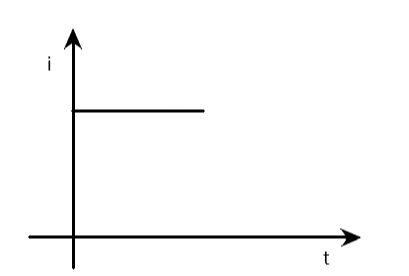
(B) 3 Amp
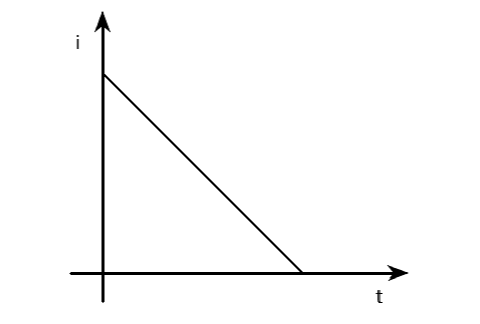
(C) Amp
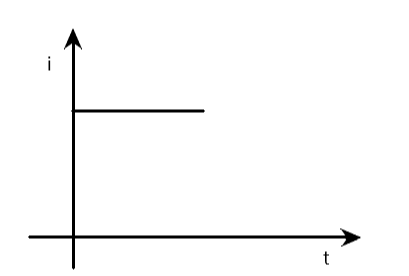
(D) Nothing can be concluded
Answer
 Verified
626.1k+ views
Hint: The inductor does not resist flow of a direct current, hence, acts as a closed circuit. Then the two 10 ohms resistors will simply be in parallel to one another.
Formula used: In this solution we will be using the following formulae;
\[\dfrac{1}{{{R_{eqp}}}} = \dfrac{1}{{{R_1}}} + \dfrac{1}{{{R_2}}}\] where \[{R_{eqp}}\] is the equivalent resistance of two resistors in parallel, \[{R_1}\] is the resistance of one, and \[{R_2}\] is the resistance of the other resistor.
\[V = IR\]where\[V\] is the voltage across a resistor, \[I\] is the current flowing through the resistor, and \[R\] is the resistance of the resistor.
Complete Step-by-Step solution:
To solve the above question, we note that the inductor will not resist the flow of the current of a steady electricity (dc). Hence, we can view the inductor as non-existent, replacing it with a closed switch or wire.
Doing that, we would observe that the two 10 ohms resistors are simply in parallel to each other. Hence, we shall find the equivalent resistance. The equivalent resistance of two resistors in parallel can be given as
\[\dfrac{1}{{{R_{eqp}}}} = \dfrac{1}{{{R_1}}} + \dfrac{1}{{{R_2}}}\] where \[{R_{eqp}}\] is the equivalent resistance of two resistors in parallel, \[{R_1}\] is the resistance of one, and \[{R_2}\] is the resistance of the other resistor.
Hence, inserting the known values, we have
\[\dfrac{1}{{{R_{eqp}}}} = \dfrac{1}{{10}} + \dfrac{1}{{10}} = \dfrac{2}{{10}}\]
Hence,
\[{R_{eqp}} = \dfrac{{10}}{2} = 5\Omega \]
Now, using the ohm's law, given by
\[V = IR\]where\[V\] is the voltage across a resistor, \[I\] is the current flowing through the resistor, and \[R\] is the resistance of the resistor.
We have,
\[10 = 5I\]
Then,
\[I = 2{\text{A}}\]
Hence, the correct answer is A
Note: For understanding and completeness, observe that since the current is a direct one, the graph will be a straight line as shown in A. Also, the minimum current hence is zero and which makes the difference between minimum and maximum 2 A.
Formula used: In this solution we will be using the following formulae;
\[\dfrac{1}{{{R_{eqp}}}} = \dfrac{1}{{{R_1}}} + \dfrac{1}{{{R_2}}}\] where \[{R_{eqp}}\] is the equivalent resistance of two resistors in parallel, \[{R_1}\] is the resistance of one, and \[{R_2}\] is the resistance of the other resistor.
\[V = IR\]where\[V\] is the voltage across a resistor, \[I\] is the current flowing through the resistor, and \[R\] is the resistance of the resistor.
Complete Step-by-Step solution:
To solve the above question, we note that the inductor will not resist the flow of the current of a steady electricity (dc). Hence, we can view the inductor as non-existent, replacing it with a closed switch or wire.
Doing that, we would observe that the two 10 ohms resistors are simply in parallel to each other. Hence, we shall find the equivalent resistance. The equivalent resistance of two resistors in parallel can be given as
\[\dfrac{1}{{{R_{eqp}}}} = \dfrac{1}{{{R_1}}} + \dfrac{1}{{{R_2}}}\] where \[{R_{eqp}}\] is the equivalent resistance of two resistors in parallel, \[{R_1}\] is the resistance of one, and \[{R_2}\] is the resistance of the other resistor.
Hence, inserting the known values, we have
\[\dfrac{1}{{{R_{eqp}}}} = \dfrac{1}{{10}} + \dfrac{1}{{10}} = \dfrac{2}{{10}}\]
Hence,
\[{R_{eqp}} = \dfrac{{10}}{2} = 5\Omega \]
Now, using the ohm's law, given by
\[V = IR\]where\[V\] is the voltage across a resistor, \[I\] is the current flowing through the resistor, and \[R\] is the resistance of the resistor.
We have,
\[10 = 5I\]
Then,
\[I = 2{\text{A}}\]
Hence, the correct answer is A
Note: For understanding and completeness, observe that since the current is a direct one, the graph will be a straight line as shown in A. Also, the minimum current hence is zero and which makes the difference between minimum and maximum 2 A.
Recently Updated Pages
Explain the structure of megasporangium class 12 biology CBSE

Why is chloroform kept in dark coloured bottles class 12 chemistry CBSE
Derive the balancing condition of a Wheatstone bri class 12 physics CBSE
Draw VI characteristics of a pn junction diode Explain class 12 physics CBSE
Is it possible to carry pride in ones language too class 12 english CBSE
In a population at Hardy Weinberg equilibrium the allele class 12 biology CBSE
Trending doubts
Draw a labelled sketch of the human eye class 12 physics CBSE
Which are the Top 10 Largest Countries of the World?
Draw ray diagrams each showing i myopic eye and ii class 12 physics CBSE
One megawatt is equal to how many units of electri class 12 physics CBSE
Which is the correct genotypic ratio of mendel dihybrid class 12 biology CBSE
Give 10 examples of unisexual and bisexual flowers