




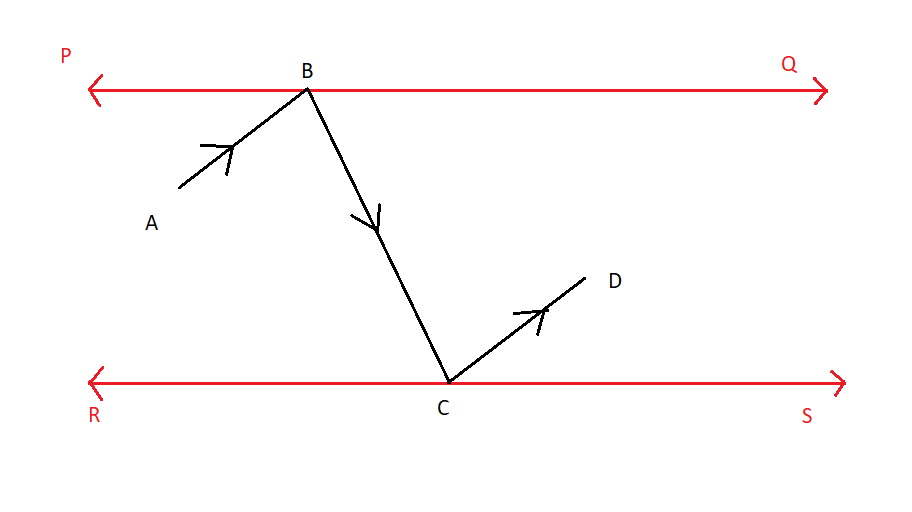
In the adjacent figure \[PQ\] and \[RS\] are two mirrors placed parallel to each other. An incident ray $\overrightarrow {AB} $strikes the mirror \[PQ\] at \[B\] , the reflected ray moves along the path $\overrightarrow {BC} $ and strikes the mirror \[RS\] at C and again reflected along $\overrightarrow {CD} $. Prove that \[AB||CD\].
Answer
 Verified
565.2k+ views
Hint: When any two parallel lines are intersected by another line called transversal, many angles are formed. These angles are related to each other and are equal, namely, corresponding angles, alternate interior angles, alternate exterior angles, and consecutive interior angles. So, to prove any two lines parallel we can make these angles equal.
Complete step by step solution:
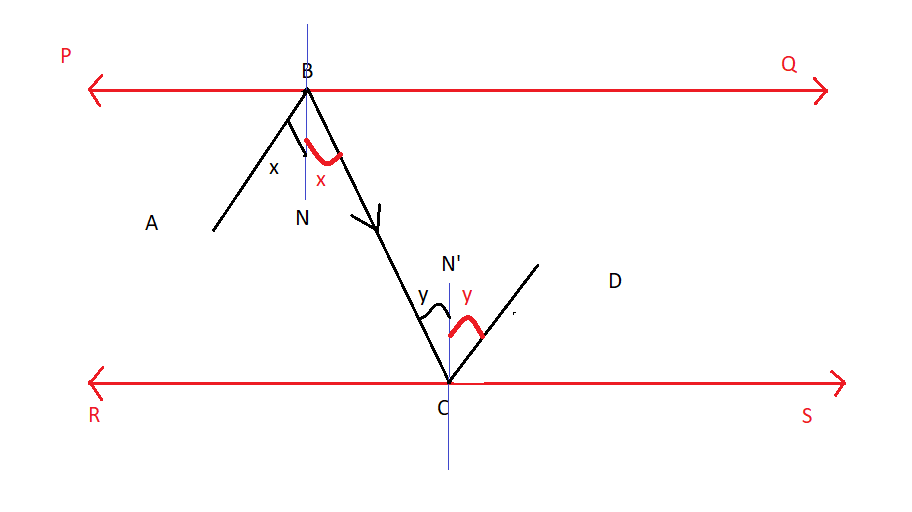
Here we draw perpendicular \[BN\] and \[CN'\] on a mirror \[PQ\] and \[RS\] . \[PQ\] is a mirror. So, the angle of incidence is equal to the angle of reflection.
Therefore, $\angle ABN = \angle NBC$ ………………(1)
Similarly, \[RS\] is a mirror. Therefore,
$\angle BCN' = \angle N'CD$……………(2)
So, \[BN\] is parallel to \[CN'\] . Let us take \[BC\] as a transversal.
$\angle NBC = \angle N'CB$ alternate interior angle………………(3)
Now, considering equations (1), (2), and (3), we can write the following, using the figure.
$\angle ABC = \angle BCD$
Hence, we can say that \[AB\] and \[CD\] are parallel rays.
Note:
A mirror angle of incidence is always equal to the angle of reflection. This is due to the laws of reflection. Which also states that the angle of incidence, angle of reflection, and normal lie on the same plane.
A Transversal is a line that intersects the two lines at two different points. These two lines can be parallel or not. The angles formed are called corresponding angles and alternate angles.
Parallel lines are those which never intersect each other even when extended to infinity.
Complete step by step solution:
Here we draw perpendicular \[BN\] and \[CN'\] on a mirror \[PQ\] and \[RS\] . \[PQ\] is a mirror. So, the angle of incidence is equal to the angle of reflection.
Therefore, $\angle ABN = \angle NBC$ ………………(1)
Similarly, \[RS\] is a mirror. Therefore,
$\angle BCN' = \angle N'CD$……………(2)
So, \[BN\] is parallel to \[CN'\] . Let us take \[BC\] as a transversal.
$\angle NBC = \angle N'CB$ alternate interior angle………………(3)
Now, considering equations (1), (2), and (3), we can write the following, using the figure.
$\angle ABC = \angle BCD$
Hence, we can say that \[AB\] and \[CD\] are parallel rays.
Note:
A mirror angle of incidence is always equal to the angle of reflection. This is due to the laws of reflection. Which also states that the angle of incidence, angle of reflection, and normal lie on the same plane.
A Transversal is a line that intersects the two lines at two different points. These two lines can be parallel or not. The angles formed are called corresponding angles and alternate angles.
Parallel lines are those which never intersect each other even when extended to infinity.
Recently Updated Pages
Which of the following graphs shows the variation of class 12 physics CBSE

Draw a labelled diagram of the human male reproductive class 12 biology CBSE
Describe the experiment to compare the emf of two cells class 12 physics CBSE
What is standard hydrogen electrode
What is conventional current and electric current class 12 physics CBSE
2Bromopentane is treated with an alcoholic KOH solution class 12 chemistry CBSE
Trending doubts
Draw a labelled sketch of the human eye class 12 physics CBSE
Which are the Top 10 Largest Countries of the World?
Differentiate between homogeneous and heterogeneous class 12 chemistry CBSE
Draw ray diagrams each showing i myopic eye and ii class 12 physics CBSE
Which is the correct genotypic ratio of mendel dihybrid class 12 biology CBSE
What is the Full Form of PVC, PET, HDPE, LDPE, PP and PS ?