




In the adjacent circuit diagram, initially switch S is opened and the circuit is in steady state. At time t = 0, the switch S is closed and the steady state is reached. Choose the correct option (s).
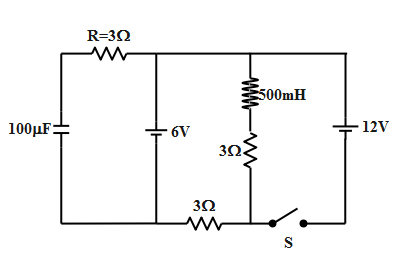
a) Current in the inductor when the circuit reaches the new steady state is 4A.
b) The net change in the magnetic flux in the inductor is 1.5Wb.
c) The potential difference across the inductor is 9 volt when the circuit reaches the new steady state.
d) The charge stored in the capacitor in the new steady state is 1.2mC.
Answer
 Verified
530.7k+ views
Hint: In the steady state when a capacitor is connected to a dc supply, the capacitor offer’s an infinite resistance and hence there is no flow of current across the capacitor. Similarly the inductor in steady state offers no resistance in the circuit and therefore it can just be considered as a wire. Hence using these conditions and Kirchhoff’s loop rule, we will analyze all the above options and obtain the correct option
Complete step-by-step solution:
As soon as the key ‘S’ is closed, there is a steady state attained. In the steady state, the capacitance offer’s and infinite resistance resulting in no flow of current. The inductor in steady state does not offer any resistance. Therefore the above circuit in steady state can be more precisely drawn as,
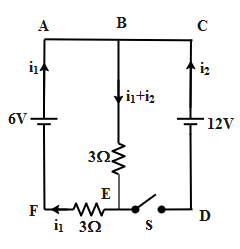
From the above circuit diagram, we have taken the direction of current ${{i}_{1}}$ from the source i.e. 6V and current ${{i}_{2}}$ from the source 12V. The direction of current is according to Kirchhoff’s junction rule.
Applying Kirchhoff’s voltage law to the loop ABEF, we obtain
$6V=\left( {{i}_{1}}+{{i}_{2}} \right)3\Omega +{{i}_{1}}3\Omega .......(1)$
Similarly applying the Kirchhoff’s voltage law for loop BCED, we get
$12V=\left( {{i}_{1}}+{{i}_{2}} \right)3\Omega ......(2)$
Subtracting equation 1 from 2 we obtain,
$\begin{align}
& 12V-6V=\left( {{i}_{1}}+{{i}_{2}} \right)3\Omega -\left[ \left( {{i}_{1}}+{{i}_{2}} \right)3\Omega +{{i}_{1}}3\Omega \right] \\
& \Rightarrow 6V=-{{i}_{1}}3\Omega \\
& \therefore {{i}_{1}}=-2A \\
\end{align}$
Substituting the value of ${{i}_{1}}$ equation in equation 2 we obtain,
$\begin{align}
& 12V=\left( {{i}_{1}}+{{i}_{2}} \right)3\Omega \\
& \Rightarrow \dfrac{12}{3}=\left( -2+{{i}_{2}} \right) \\
& \Rightarrow 4=\left( -2+{{i}_{2}} \right) \\
& \therefore {{i}_{2}}=6A \\
\end{align}$
Hence the current across the inductor i.e. ${{i}_{1}}+{{i}_{2}}$ is equal to,
$\begin{align}
& i={{i}_{1}}+{{i}_{2}} \\
& \therefore i=-2A+6A=4A \\
\end{align}$
Therefore the correct answer of the above question is option B.
Note: The Kirchhoff’s voltage law states that if we trace a closed loop in a circuit, the sum of the potential difference across the resistors in the circuit is equal to the sum of emf of the cell in the loop. If the path traced is in the direction of current then the potential difference across the resistors is taken as positive and the emf is taken as positive if we move across the cell from the negative to positive terminal of the cell. Similarly Kirchhoff’s junction rule states that the amount of current entering the junction is equal to that leaving the junction.
Complete step-by-step solution:
As soon as the key ‘S’ is closed, there is a steady state attained. In the steady state, the capacitance offer’s and infinite resistance resulting in no flow of current. The inductor in steady state does not offer any resistance. Therefore the above circuit in steady state can be more precisely drawn as,
From the above circuit diagram, we have taken the direction of current ${{i}_{1}}$ from the source i.e. 6V and current ${{i}_{2}}$ from the source 12V. The direction of current is according to Kirchhoff’s junction rule.
Applying Kirchhoff’s voltage law to the loop ABEF, we obtain
$6V=\left( {{i}_{1}}+{{i}_{2}} \right)3\Omega +{{i}_{1}}3\Omega .......(1)$
Similarly applying the Kirchhoff’s voltage law for loop BCED, we get
$12V=\left( {{i}_{1}}+{{i}_{2}} \right)3\Omega ......(2)$
Subtracting equation 1 from 2 we obtain,
$\begin{align}
& 12V-6V=\left( {{i}_{1}}+{{i}_{2}} \right)3\Omega -\left[ \left( {{i}_{1}}+{{i}_{2}} \right)3\Omega +{{i}_{1}}3\Omega \right] \\
& \Rightarrow 6V=-{{i}_{1}}3\Omega \\
& \therefore {{i}_{1}}=-2A \\
\end{align}$
Substituting the value of ${{i}_{1}}$ equation in equation 2 we obtain,
$\begin{align}
& 12V=\left( {{i}_{1}}+{{i}_{2}} \right)3\Omega \\
& \Rightarrow \dfrac{12}{3}=\left( -2+{{i}_{2}} \right) \\
& \Rightarrow 4=\left( -2+{{i}_{2}} \right) \\
& \therefore {{i}_{2}}=6A \\
\end{align}$
Hence the current across the inductor i.e. ${{i}_{1}}+{{i}_{2}}$ is equal to,
$\begin{align}
& i={{i}_{1}}+{{i}_{2}} \\
& \therefore i=-2A+6A=4A \\
\end{align}$
Therefore the correct answer of the above question is option B.
Note: The Kirchhoff’s voltage law states that if we trace a closed loop in a circuit, the sum of the potential difference across the resistors in the circuit is equal to the sum of emf of the cell in the loop. If the path traced is in the direction of current then the potential difference across the resistors is taken as positive and the emf is taken as positive if we move across the cell from the negative to positive terminal of the cell. Similarly Kirchhoff’s junction rule states that the amount of current entering the junction is equal to that leaving the junction.
Recently Updated Pages
Master Class 12 Economics: Engaging Questions & Answers for Success

Master Class 12 Physics: Engaging Questions & Answers for Success
Master Class 12 English: Engaging Questions & Answers for Success
Master Class 12 Social Science: Engaging Questions & Answers for Success
Master Class 12 Maths: Engaging Questions & Answers for Success
Master Class 12 Business Studies: Engaging Questions & Answers for Success
Trending doubts
Which are the Top 10 Largest Countries of the World?
What are the major means of transport Explain each class 12 social science CBSE
Draw a labelled sketch of the human eye class 12 physics CBSE
Why cannot DNA pass through cell membranes class 12 biology CBSE
Differentiate between insitu conservation and exsitu class 12 biology CBSE
Draw a neat and well labeled diagram of TS of ovary class 12 biology CBSE