




In sweet potato vegetative propagation takes place by
(a)Root
(b)Stem
(c)Leaves
(d)All of the above
Answer
 Verified
624.9k+ views
Hint: These are the organs of a plant that can be under the soil, aerial, or aerating i.e. grow up above the ground or above the water.
Complete answer:
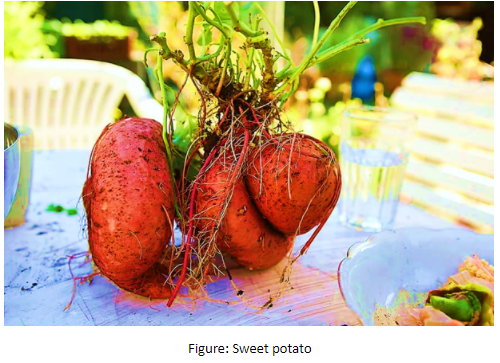
The formation of a new plant from vegetative portions of the plant-like roots, stem or leaves is known as vegetative propagation. The roots of some plants like sweet potatoes have adventitious buds that develop into new plants by breaking off from the root. The vegetative propagation in sweet potato takes place by the roots which produce shoots or producing buds.
Additional Information: -Sweet potatoes (Ipomoea batatas) are root vegetables and are different from regular potatoes in density, tasty, and nutrition.
-Sweet potatoes are cultivated in America, Asia, New Zealand and China is the largest producer of sweet potatoes.
-Sweet potato needs a long warm season of nearly 110 days with temperatures of a minimum of 30 degrees Celsius.
-Sweet potatoes are a great source of fiber, vitamins, and minerals and promote Gut Health. Support healthy vision, enhance brain function and may support your immune system.
-The nutrition facts for 100 grams of raw sweet potatoes are calories- 86%, water- 77%, protein- 1.6 grams, carbs- 20.1 grams, sugar- 4.2 grams, fiber- 3 gram and fat- 0.1 grams.
-Sweet potatoes shouldn’t be stored in refrigeration unless they have already been cooked. Refrigeration will harden the core of the vegetable and create an off-taste, which leads the vegetable to spoil much faster. They can be kept in a cool place (55 to 60° F).
- Sweet potatoes are not only nutritious but also can be baked for better varieties.
So, the correct answer is option ‘Root’.
Note: The various types of vegetative propagation like grafting, cutting, layering, tuber, bulb or stolon formation, suckering, and tissue culture are examples of asexual reproduction. The offspring is a clone of the original plant. Examples are the rhizome of ginger, crops such as cassava, sugarcane, pineapple, banana, onion, etc.
Complete answer:
The formation of a new plant from vegetative portions of the plant-like roots, stem or leaves is known as vegetative propagation. The roots of some plants like sweet potatoes have adventitious buds that develop into new plants by breaking off from the root. The vegetative propagation in sweet potato takes place by the roots which produce shoots or producing buds.
Additional Information: -Sweet potatoes (Ipomoea batatas) are root vegetables and are different from regular potatoes in density, tasty, and nutrition.
-Sweet potatoes are cultivated in America, Asia, New Zealand and China is the largest producer of sweet potatoes.
-Sweet potato needs a long warm season of nearly 110 days with temperatures of a minimum of 30 degrees Celsius.
-Sweet potatoes are a great source of fiber, vitamins, and minerals and promote Gut Health. Support healthy vision, enhance brain function and may support your immune system.
-The nutrition facts for 100 grams of raw sweet potatoes are calories- 86%, water- 77%, protein- 1.6 grams, carbs- 20.1 grams, sugar- 4.2 grams, fiber- 3 gram and fat- 0.1 grams.
-Sweet potatoes shouldn’t be stored in refrigeration unless they have already been cooked. Refrigeration will harden the core of the vegetable and create an off-taste, which leads the vegetable to spoil much faster. They can be kept in a cool place (55 to 60° F).
- Sweet potatoes are not only nutritious but also can be baked for better varieties.
So, the correct answer is option ‘Root’.
Note: The various types of vegetative propagation like grafting, cutting, layering, tuber, bulb or stolon formation, suckering, and tissue culture are examples of asexual reproduction. The offspring is a clone of the original plant. Examples are the rhizome of ginger, crops such as cassava, sugarcane, pineapple, banana, onion, etc.
Recently Updated Pages
Master Class 12 Business Studies: Engaging Questions & Answers for Success

Master Class 12 Chemistry: Engaging Questions & Answers for Success
Master Class 12 Biology: Engaging Questions & Answers for Success
Class 12 Question and Answer - Your Ultimate Solutions Guide
Master Class 11 English: Engaging Questions & Answers for Success
Master Class 11 Social Science: Engaging Questions & Answers for Success
Trending doubts
Which are the Top 10 Largest Countries of the World?
Draw a labelled sketch of the human eye class 12 physics CBSE
Differentiate between homogeneous and heterogeneous class 12 chemistry CBSE
In order to find out the different types of gametes class 12 biology NEET_UG
Why is the cell called the structural and functional class 12 biology CBSE
Draw ray diagrams each showing i myopic eye and ii class 12 physics CBSE